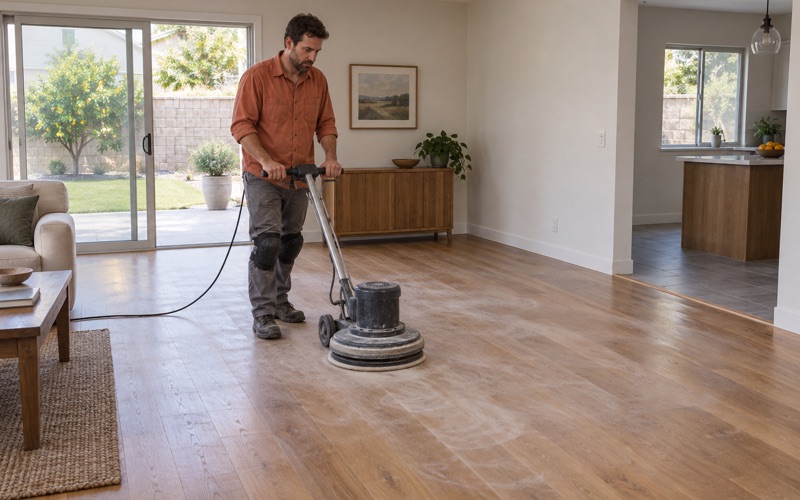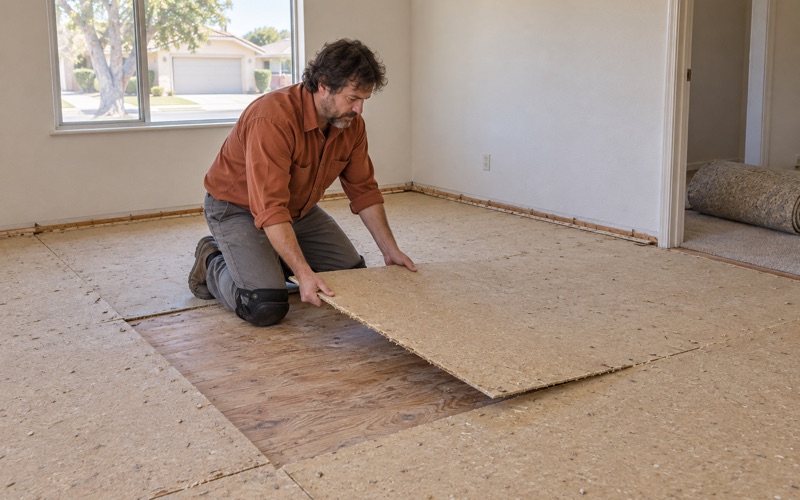
Baldwin Park Wood Flooring has handled wood-flooring in Citrus for more than 20 years, and much of that work is refinishing oak strip floors, uncovering hardwood from under carpet and renewing tired finishes. Before we quote a room, we lift a corner of the carpet so the estimate reflects the red oak, plywood or particle board that is actually down there.
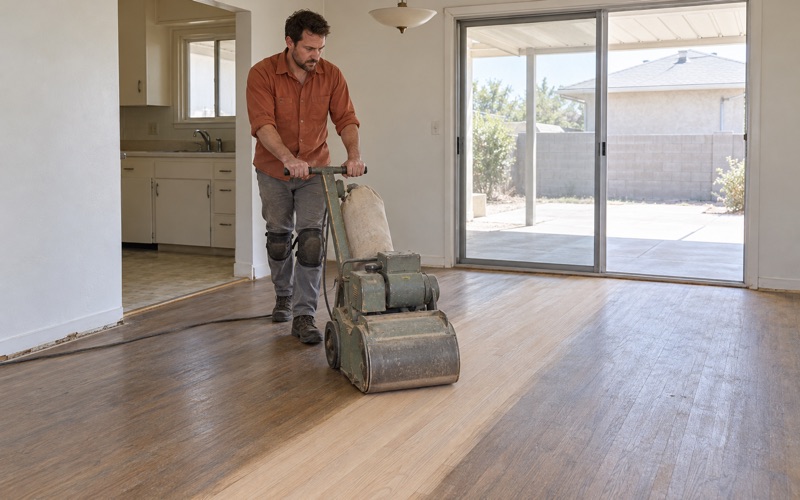
Refinishing, repair, board replacement and new installation all follow the same order with us: look first, measure second, schedule third. A moisture meter reading, a check of the wear layer on engineered boards and a close look at any small holes near the baseboards come before a drum sander touches the floor. That order keeps a quote from changing halfway through a job.
Below, we walk through what shapes a floor project here: the kind of houses we usually work in, who reviews permits, how rental turnovers are documented, and what owners living in the home should plan for. Each point is written for a real decision, so you know what to expect before anyone moves furniture or schedules a sanding day.
A Neighborhood Built Mostly in One Decade
Few places in Los Angeles County have a housing stock as uniform as Citrus. The American Community Survey 2024 five-year estimates count 2,740 housing units in the community, and the pattern inside those counts shapes nearly every floor we are asked to look at here, from the subfloor under the carpet to the finish layers sitting on top of the oak.
Most Houses Date From the 1950s
Of those 2,740 units, 1,789 were built between 1950 and 1959, which is 65.3 percent of the community. Adding the decades before, 72.5 percent went up before 1960. The same survey records no units built in 2010 or later, so there is essentially no newer construction mixed in to change what a typical Citrus floor looks like.
That concentration matters when we estimate. When most houses on a street share a decade, they tend to share materials and repair histories too, and the problems repeat: worn finish in traffic paths, gray boards near exterior doors, squeaks and nail pops where years of foot traffic loosened fasteners. We still inspect every house on its own terms before writing a number.
Nearly All Detached Houses
The survey counts 2,426 detached houses, or 88.5 percent of all units, with only small numbers of attached homes, small apartment buildings and mobile homes. For floor work, that means ground-level rooms, hallways connecting every bedroom, and whole-house projects where one continuous floor runs from the entry through the main living spaces.
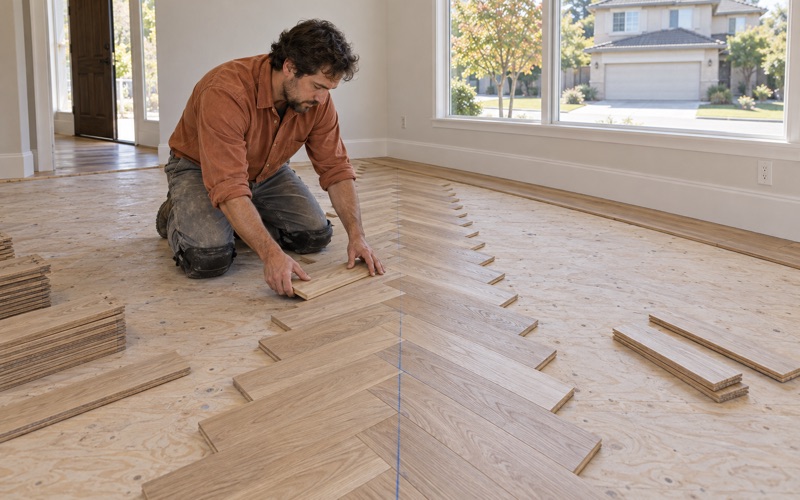
Detached houses also make staging simpler. Equipment comes in through a garage or side yard, dust containment covers one household rather than shared walls, and a floor can be sanded in sections without disturbing neighbors. The trade-off is scale: a continuous oak floor usually has to be refinished as one surface so the stain color and sheen match from room to room.
What Turns Up Under Old Carpet
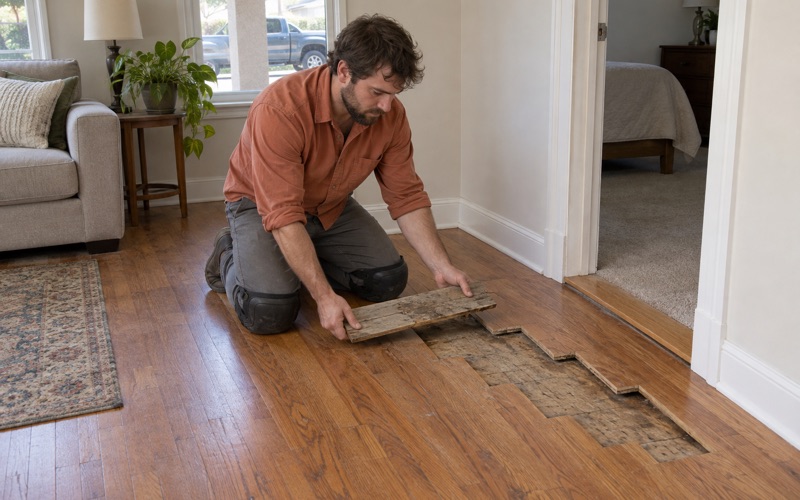
In houses of this age, wall-to-wall carpet often went down over oak strip flooring long after construction. Pulling it back usually reveals tack strip holes along the walls, rows of carpet staples, and pad stains where spills soaked through. We repair those as part of a carpet-to-wood job instead of leaving them hidden under a new area rug.
Sometimes the corner lift shows something else: particle board with swollen edges, an older layer of 9x9 floor tile over black mastic, or plywood patched where a wall was moved. Old tile and mastic can call for an asbestos survey under SCAQMD Rule 1403 before anyone disturbs them, and we say so in the estimate rather than after demolition begins.
Looking for wood-flooring closer to Arcadia? See Wood-Flooring in Arcadia.
Unincorporated, Not Covina or Azusa: Who Issues Permits
Citrus is an unincorporated community in Los Angeles County with no municipal government of its own. It first appeared as a census designated place in the 1980 census and still has no city hall, which surprises some homeowners when a floor project needs a permit and the city printed on their mailing address turns out not to be the one in charge.
Why the Address Says Covina or Azusa
Locals generally call the area unincorporated Covina or unincorporated Azusa, because many street addresses here carry one of those two city names. The community’s ZIP codes are 91702 and 91722. A postal city name decides where mail goes, not which government reviews construction, so the mailing address is not a reliable guide to who handles a permit.
We raise this at the first visit because it changes the paperwork, not the flooring. An owner who calls a city permit counter based on the address may learn the property sits outside that city’s boundary. Knowing up front that the house is in unincorporated territory saves the detour and keeps the project schedule from slipping while the right office is found.
County Building & Safety and Title 26
Building permits for Citrus come from Los Angeles County Public Works, Building & Safety, which serves unincorporated areas and works under Title 26 of the Los Angeles County Code. The department directs property owners to its Service Locator to find the office that handles a given address, and that lookup is the step to take before assuming which office applies.
Structural Repairs Are a Separate Question
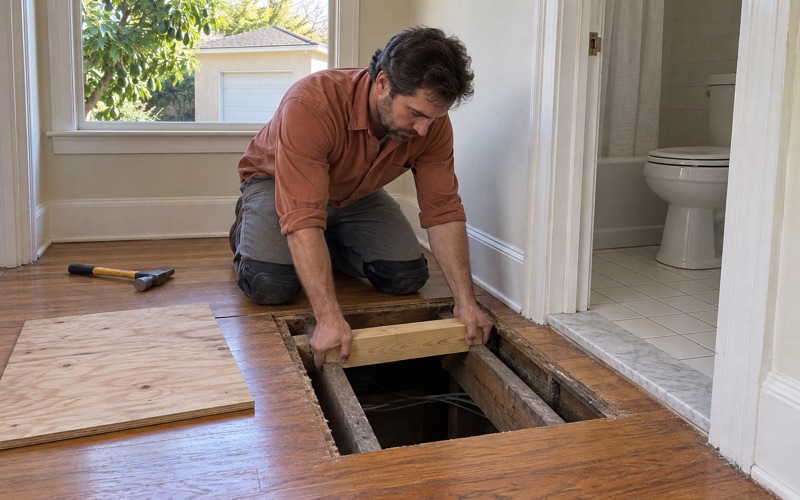
A refinish or a screen and recoat is surface work. Replacing a rotted subfloor section, sistering a floor joist beside a sagging one, or opening framing to fix a soft spot is structural work, and we treat the permit question for it as open until the county answers it. We never assume structural subfloor repair can skip county review.
In a 1950s house, these repairs usually appear as a local problem: a bouncy spot near a bathroom, an old plumbing leak that softened a board subfloor, or boards that dip where a wall once stood. We scope the structural piece separately from the finish work so a permit question does not hold up rooms that are ready to sand.
Rented Houses and the County’s Rent Stabilization Rules
Owners occupy 71.4 percent of occupied housing units in Citrus, so renters are the smaller share at 28.6 percent. What stands out is the kind of home they rent: of 784 renter households, 563, or 71.8 percent, rent a detached house. Many landlords here own a single house rather than a building, and floor decisions land on them directly.
Where the County Ordinance Reaches
In unincorporated Los Angeles County, the Rent Stabilization and Tenant Protection Ordinance, administered by the Department of Consumer and Business Affairs, applies to rental units with a certificate of occupancy issued on or before February 1, 1995. That includes single-family homes and condos unless an exemption applies, which puts many older rental houses within its possible reach.
Coverage still depends on the individual property. The certificate of occupancy date and any exemption decide it address by address, and the allowable increase changes each year, so we do not quote either one. Our role is the floor itself; the ordinance question belongs with the county program and the owner’s own advisers.
Looking Up a Rental in the County Registry
The county checks whether a specific rental is covered by address or parcel number in its online rent registry. A landlord planning floor work between tenants can look the house up before the job begins, which keeps the flooring budget separate from any question about what the ordinance does or does not require of the owner.
Turnover Floors With Records a Landlord Keeps
When a tenant moves out of a Citrus rental, we quote the floor with move-out photos and a written scope listing each room, what was found and what will be done. That document can sit with the deposit records, alongside the itemized statement California Civil Code 1950.5 calls for when deductions come out of a security deposit.
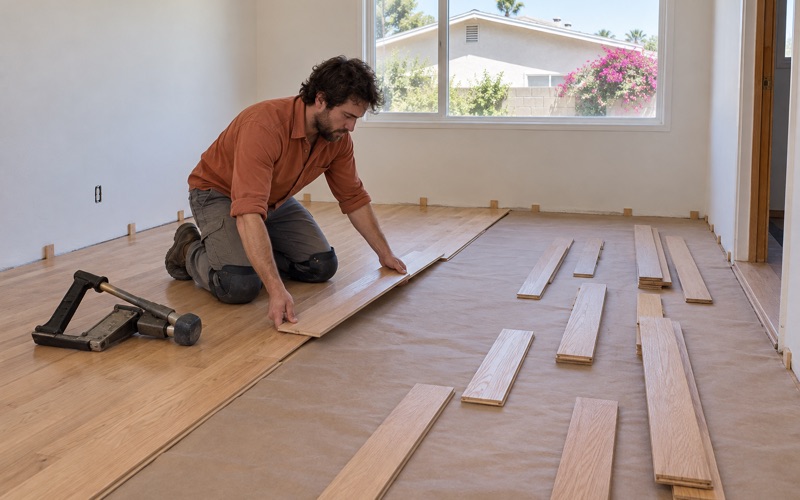
Separating normal wear and tear from damage is often the hardest part of a turnover. Sun fading and dull traffic lanes read differently from pet urine stains, black water stains or deep gouges, and the photos show which is which. A screen and recoat may be enough for a lightly worn floor, while deep stains usually mean board replacement or a full sand.
Planning Work in an Owner-Occupied Citrus Home
Of the 1,956 owner-occupied units in Citrus, 1,863 are detached houses. Owners here usually plan floor work around living in the house rather than around a vacancy, and that changes the order of the job, the finish choice and how rooms are handed back. These are the points we walk through before a start date goes on the calendar.
Checking the Build Year Before Sanding
With 72.5 percent of Citrus homes built before 1960, most houses here predate 1978, the cutoff the federal Renovation, Repair and Painting Rule uses for target housing. Old paint on baseboards, door casings and stair parts can be disturbed during sanding, so we confirm the build year first and plan containment and cleanup before a sanding day is set.
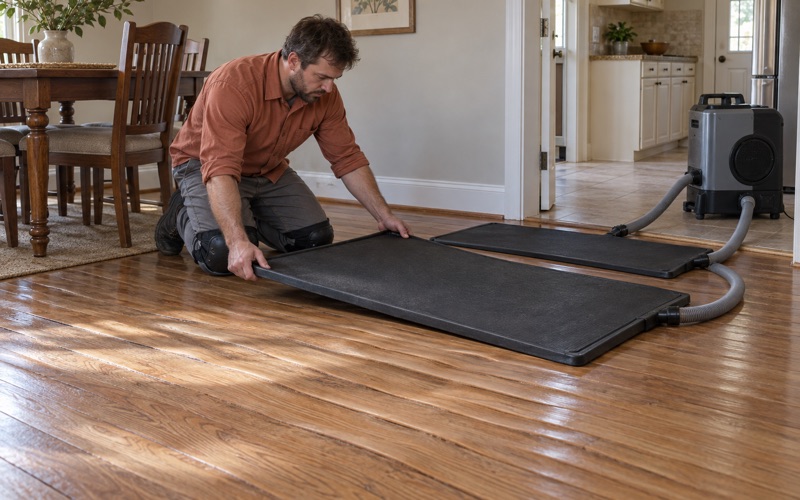
That check also shapes finish removal. Layers of wax, older oil-modified polyurethane and paint overspray near the walls load abrasive quickly, so the grit sequence and edger passes are planned for what is actually on the floor. Dustless sanding keeps most debris out of the air, but it does not replace a lead-safe setup when the house calls for one.
Engineered Boards and Finish Choices
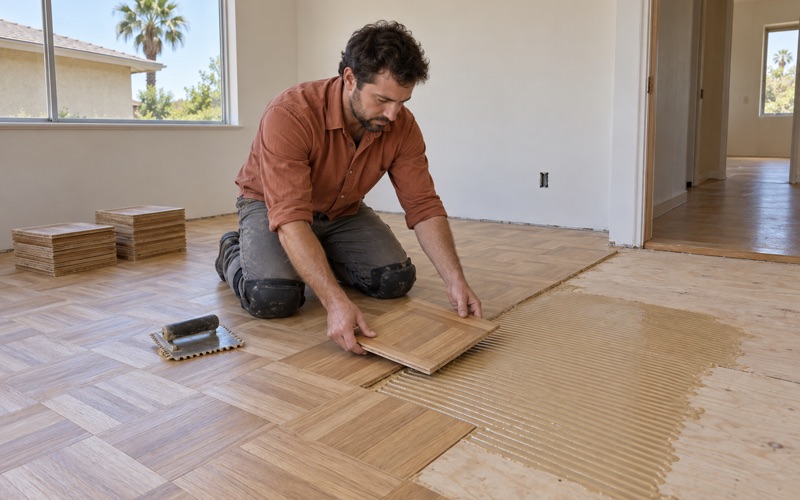
Not every floor in a mid-century house is original oak. Kitchens and additions sometimes carry engineered hardwood installed later, and a thin veneer changes what is possible. We measure the wear layer before promising a full sanding, because a thin top layer can take a screen and recoat but can be sanded through to the plywood beneath.
Finishes come from products legal to apply in the South Coast Air Quality Management District, where the wood coatings limit is 275 grams per liter. Within that limit, owners choose among waterborne polyurethane, oil-modified polyurethane and hardwax oil, plus stain color and sheen level, weighing cure time against how soon each room has to be back in use.
A Room-by-Room Schedule for the Household
Refinishing a whole detached house while living in it takes careful sequencing. We write a room-by-room schedule showing when each area is sanded, when finish goes down, and when furniture, rugs and people can return. Larger and multigenerational households use that schedule to plan sleeping arrangements and keep a working path to the kitchen.
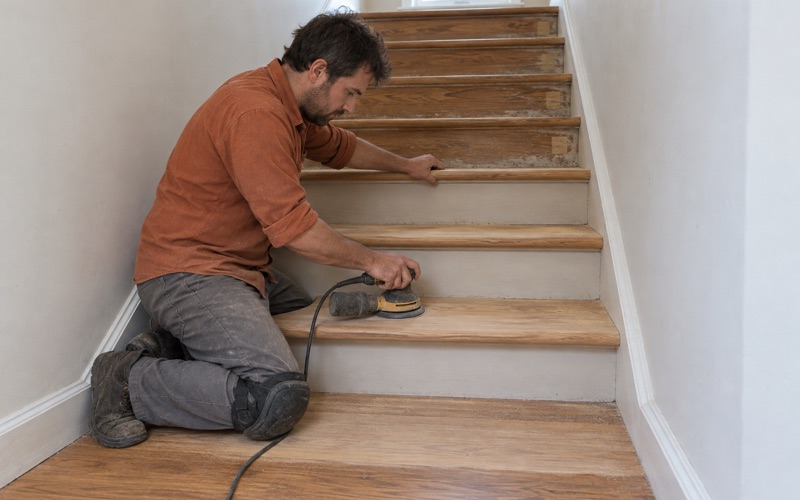
Stairs get their own line in the estimate, priced by tread, riser and nosing rather than folded into square footage. Owners also sometimes ask about seismic work: ZIP codes 91702 and 91722 both appear on the 2025 Earthquake Brace + Bolt list, which sets eligibility by ZIP code, so that program can be timed alongside a floor project.
- 20+ Years in Wood Floors
- Free Written Estimates
- Rental and Claim Documentation