Baldwin Park Wood Flooring has spent more than 20 years on wood flooring in Duarte, and a good share of that work starts after water has reached a floor. We repair, sand, refinish and install solid and engineered hardwood, and we pay close attention to what a wet event leaves behind in the boards and the subfloor underneath them.
Mud and runoff do different damage than a burst pipe. Silt settles into seams and bevels, water wicks into board ends, and a floor that looks dry on top can still hold moisture below. Our first visit is about finding out how far the water went before anyone talks about sanding, replacement or a new product.
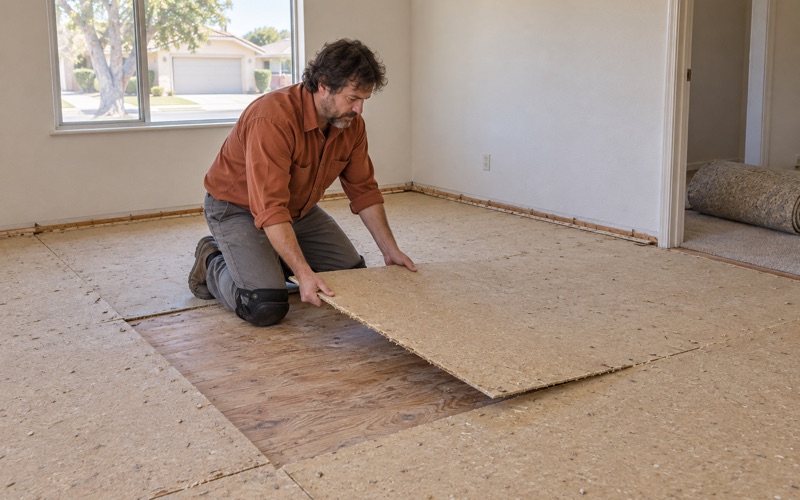
Where carpet covers the wood, we lift a corner before we quote, so the estimate describes the oak strip, plywood or particle board actually there. Every wet floor we assess gets photographs and moisture readings recorded as we go, and larger households get a written room-by-room schedule showing when furniture, rugs and people can move back in.
When the Hillside Comes Down After a Fire
The Fish Fire and the Neighborhoods Above Royal Oaks Drive
The Fish Fire was reported on June 20, 2016, near Opal Canyon and Brookridge roads close to the Duarte-Azusa border. According to MyNewsLA, 534 Duarte residences north of Royal Oaks Drive, east of Greenbank Avenue and west of Encanto Parkway were evacuated, and those residents were later allowed to return home. That report described no damage to homes.
A fire does not end when the flames do. Burned slopes shed water faster than vegetated ones, which is why the months after a fire concern us as much as the fire itself when a customer on a foothill street calls about a floor. On those calls, our questions are less about soot on the finish and more about what the rain carried downhill afterward.
January 2017 on Melcanyon Road
Seven months later the rain arrived. CBS Los Angeles reported on January 23, 2017, that a storm sent mud, rocks and debris down Melcanyon Road in the Fish Fire burn area, with water running 3 inches deep across the street and mud piling up behind K-rails. About 180 homes in the burn area were under evacuation orders.
That report describes street conditions and evacuations, not what happened inside any house, and we do not assume more than it says. What it does show is the kind of event a floor on a foothill lot can meet: shallow, fast water carrying fine silt, arriving at a door threshold, a garage slab or a crawl space vent.
Older Houses in the Path of Runoff
The housing stock matters here. Census estimates from the 2024 five-year American Community Survey count 7,832 housing units in Duarte, and 72.0 percent of them were built before 1980. Among owner households, 86.2 percent live in detached houses, so most owner-occupied floors sit in single-family houses with their own doors, vents and grade to consider.
An older house often carries decades of floor history: oak strip under carpet, a layer of 9x9 floor tile over black mastic, or particle board added during a remodel. Duarte’s stock also splits into two build waves, 39.0 percent of units from 1940 to 1959 and 36.2 percent from 1970 to 1989, and the floors from each era answer water differently.
Looking for wood-flooring closer to Monrovia? See Monrovia Wood-Flooring.
What Mud and Standing Water Do to a Wood Floor
Solid Oak Strip: Cupping, Crowning and Buckling
Solid red oak and white oak strip flooring absorbs water through its underside and board ends first. The bottom of each board swells before the top does, so the edges rise and the floor cups. If someone sands a cupped floor flat too soon, the boards can crown once they dry, leaving a hump down the middle of each strip.
When swelling has nowhere to go, the floor buckles and lifts off the subfloor, sometimes pulling cleats or staples with it. A buckled floor is not automatically a lost floor. Solid strip can often be dried, reset and sanded, provided the tongues have not split, the subfloor below is sound and the expansion gap at the walls can be restored.
Engineered Planks, Laminate and Particle Board
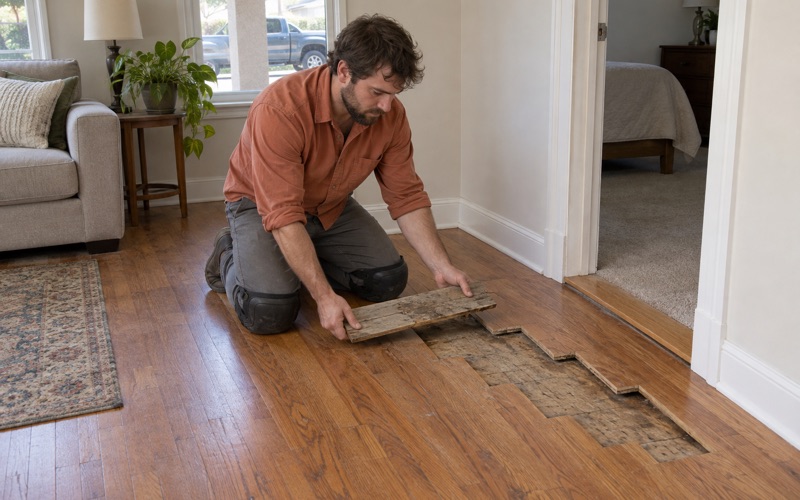
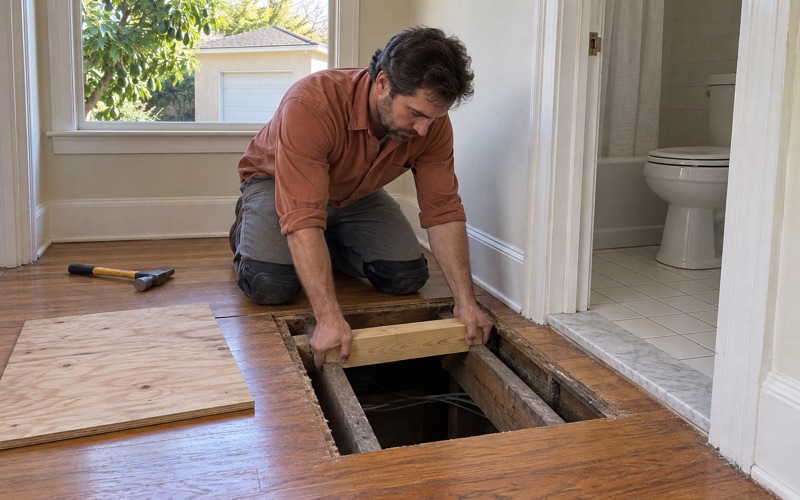
Engineered hardwood behaves differently. Its top veneer sits on plywood layers that can swell and separate, and veneer delamination after a soak is usually permanent. Laminate flooring and luxury vinyl plank installed as a floating floor can trap water beneath them, where it sits against the subfloor out of sight. Pulling a few planks is often the only way to see it.
Particle board subfloor is the weakest link in a wet room. Particleboard edge swell is permanent, the panel loses strength, and fasteners stop holding. Where we find it under a remodeled floor that took on water, we expect to cut it out rather than dry it, while a plywood subfloor or original board subfloor often has a better chance of recovering.
Silt, Grit and the Finish
Mud brings abrasive silt along with the water. Walked across a finished floor, that grit scratches through the coating the way sandpaper would, and it packs into bevels, seams and nail holes. We clean the surface before any readings or foot traffic, because grinding silt into a floor that could have been saved can turn a refinish into a replacement.
Water that sits under a finish shows up as white haze or a cloudy finish, and dark gray boards or black water stain mean moisture reached the wood itself. Surface haze sometimes buffs out. Dark staining that runs into the grain rarely sands out completely, which is when board replacement or a weave-in repair comes into the conversation.
Drying, Testing and Deciding What Can Be Saved
Moisture Readings Before Any Decision
A floor that feels dry is not a floor ready for work. We take moisture meter readings across the affected rooms and compare them with an unaffected area of the same house, which gives a baseline for that home rather than a generic number. We record each reading with its location so the drying can be tracked over days.
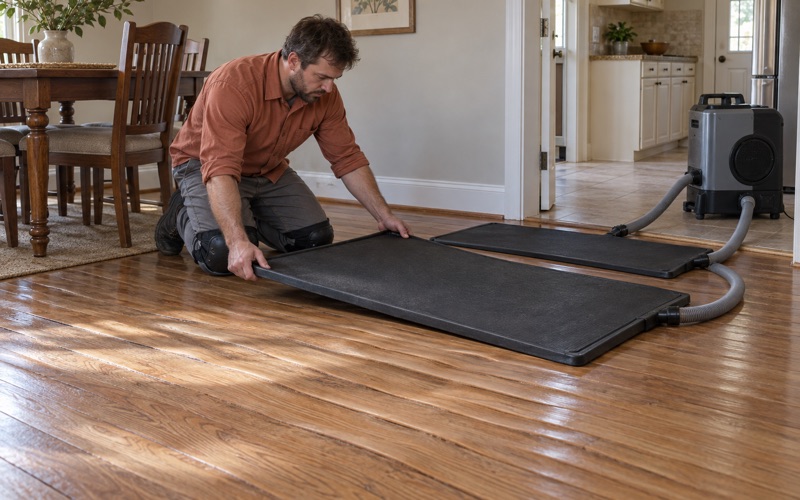
Relative humidity inside the house matters too. Running fans and dehumidifiers until the wood and subfloor settle near that baseline is slower than tearing everything out, but it is often what lets solid oak be kept. Sanding or refinishing before the readings level off can trap moisture under new finish and invite cupping to return.
Looking Underneath the Floor
What sits below the wood decides a great deal. On a raised foundation, we check the crawl space for standing water, wet insulation, silt at the vents and any soft spot or rotted subfloor at the edges. A floor joist that stayed wet may need attention, and structural repair such as a sister joist is a separate question from the flooring itself.
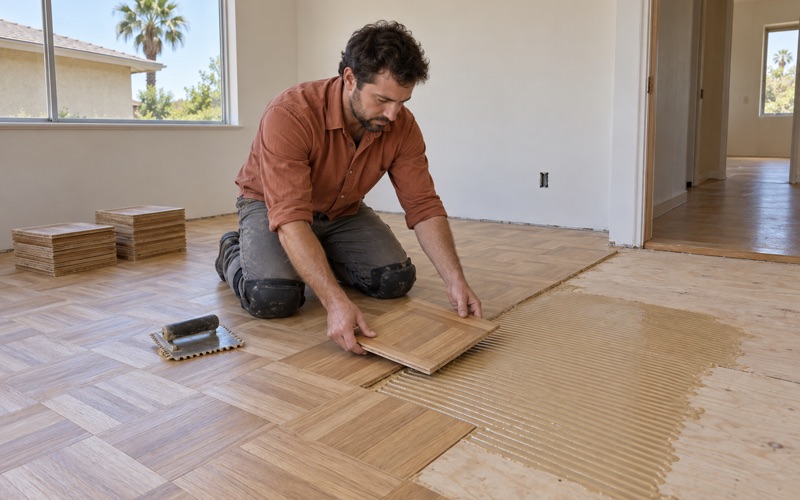
On slab-on-grade construction, water can sit between a glue-down or floating floor and the concrete, and the slab dries slowly. Before new wood goes over a slab that took on water, an ASTM F2170 in-situ relative humidity test gives a reading from inside the concrete rather than its surface, and a vapor retarder is chosen to suit the result.
An open crawl space is also a good moment to note the condition of the cripple wall. Duarte ZIP codes 91008 and 91010 appear on the 2025 Earthquake Brace + Bolt Southern California list, with 91008 newly added. Bracing is not flooring work, and we pass along what we saw rather than quote it.
Separating Water Damage From Older Problems
Pulling back wet carpet or lifting damaged boards often exposes problems that predate the storm. Tack strip holes, carpet staples and old pad stains are easy to confuse with fresh water marks, and small holes with powdery piles beside them may be drywood termite pellets, beetle frass or simply old nail holes.
We identify which is which before any board is replaced. Keeping pre-existing wear separate from water damage keeps the scope honest, and it gives an adjuster a cleaner picture of what the event actually did. The tack strip holes and staple rows get repaired as part of the job rather than left under a rug.
Repair, Refinish or Replace, and Documenting the Loss
Choosing the Right Level of Work
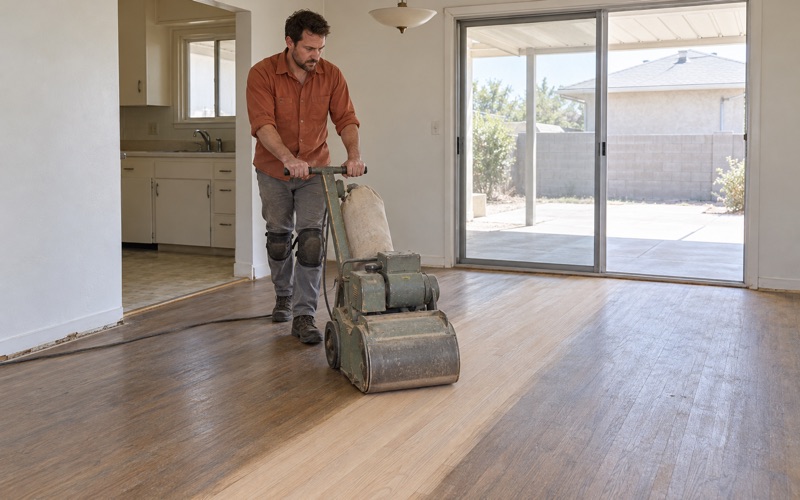
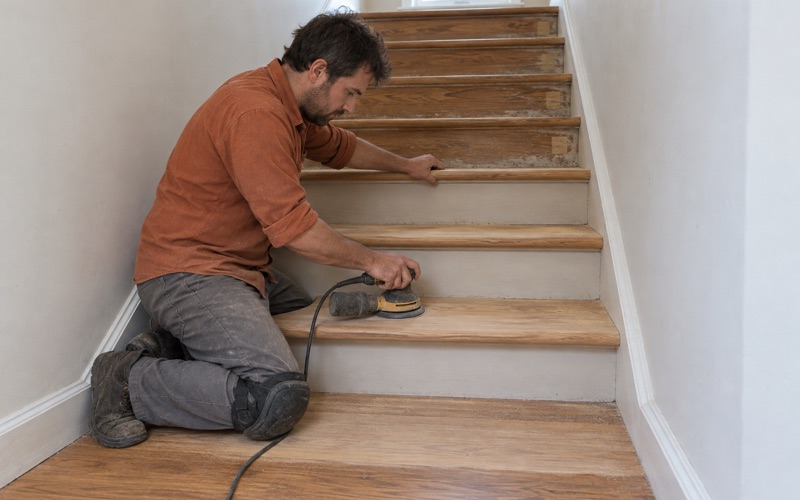
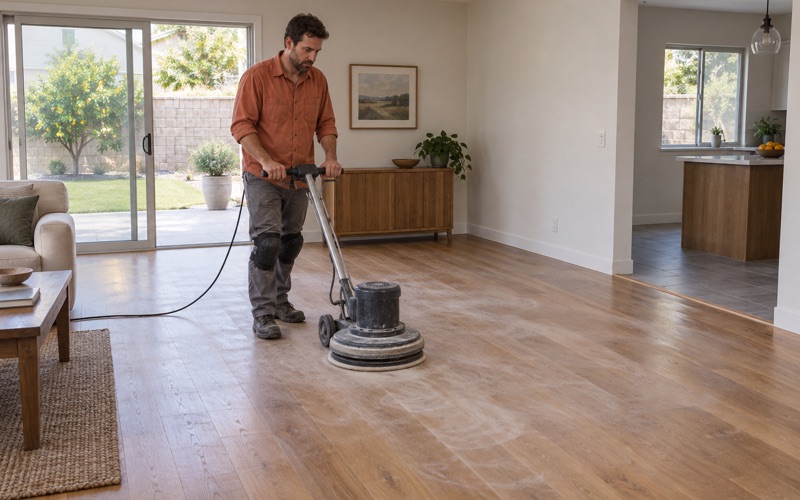
Once readings settle, the options narrow. A floor with surface haze and light scratching may need only a screen and recoat. Solid oak that cupped and flattened again as it dried can usually take a full sand with a drum sander and edger, while boards with deep black staining or split tongues get replaced and woven in.
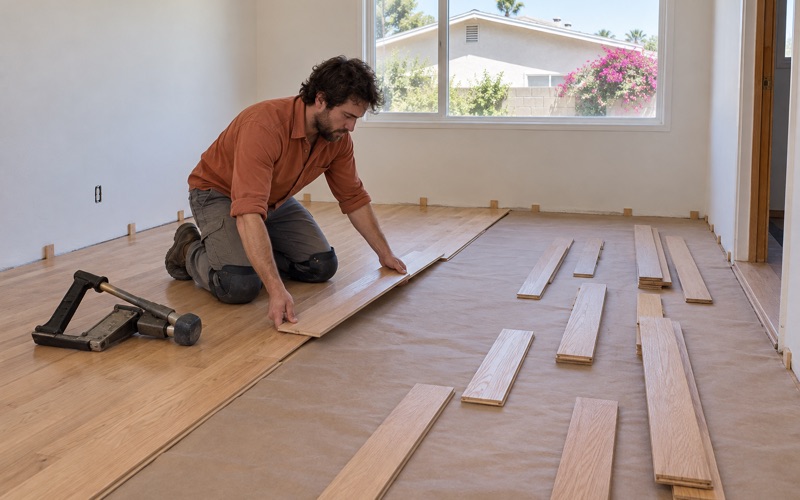
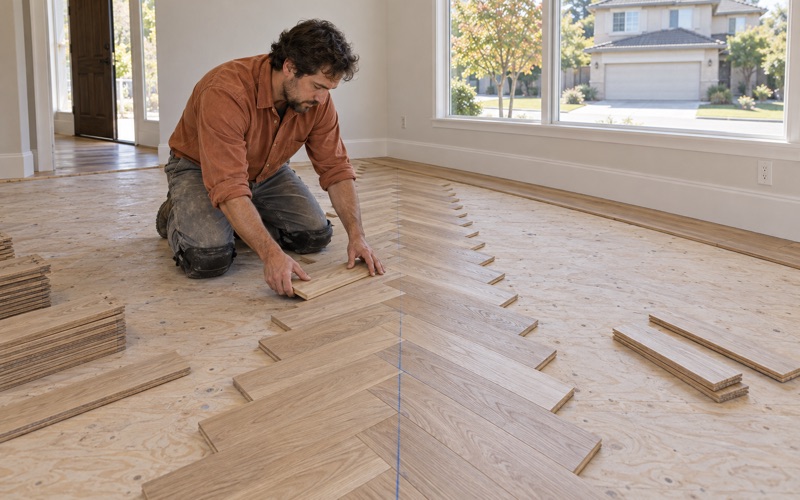
Engineered floors need one more check. We measure the wear layer before promising a sanding, because a thin veneer can accept a screen and recoat but not a full sand. Where delamination has set in or the core has swollen, replacement with new engineered hardwood or solid strip is the practical answer, and we say so plainly.
Photos and Readings for an Insurer
If a claim is involved, documentation starts on the first visit. We photograph each affected room, the high-water marks, the silt lines and any lifted boards, and we log moisture readings with dates and locations. That record is built so an adjuster can follow the damage from room to room without having to reconstruct it.
We do not predict what a policy will pay. How a policy treats mud, runoff or flood water is a question for the insurer and the homeowner, not for a flooring crew. Our part is a clear scope that separates what the water did from what was already there, so the conversation starts from facts.
Rental floors follow the same process with one addition. Of Duarte’s 7,515 occupied units, 2,934 are renter-occupied, and a landlord handling water damage between tenants needs a written scope and dated photos that can sit with the deposit records. We write the scope that way, keeping storm damage separate from normal wear and tear.
Build Year, Finishes and Permits
Because most of Duarte’s housing predates 1980, we check the build year before any sanding is scheduled. In pre-1978 housing, old paint and finish layers can bring the EPA Renovation, Repair and Painting Rule into the work, which shapes containment and cleanup. Older resilient flooring over black mastic may also call for an asbestos survey under SCAQMD Rule 1403 before removal.
New finishes are chosen from products legal to apply in the South Coast air district, where the wood coatings VOC limit is 275 grams per liter. Structural subfloor or joist repair can involve the City of Duarte Building and Safety Division, so we raise the permit question with the homeowner before that work starts, not after.
- 20+ Years in Wood Floors
- Free Written Estimates
- Rental and Claim Documentation