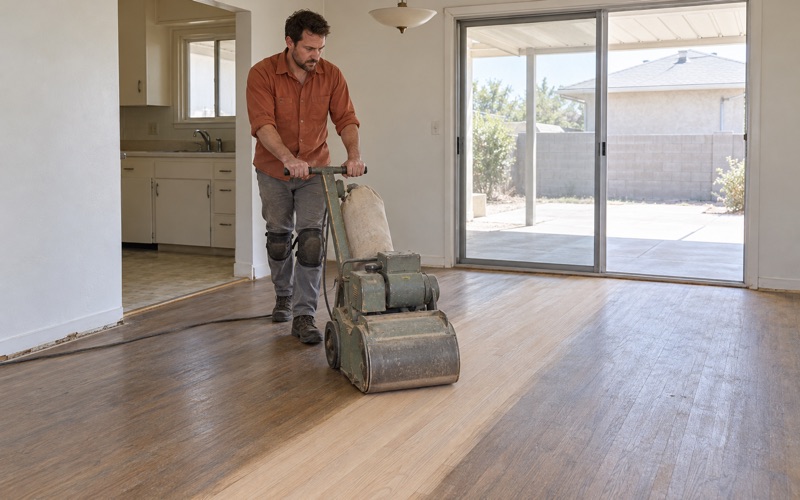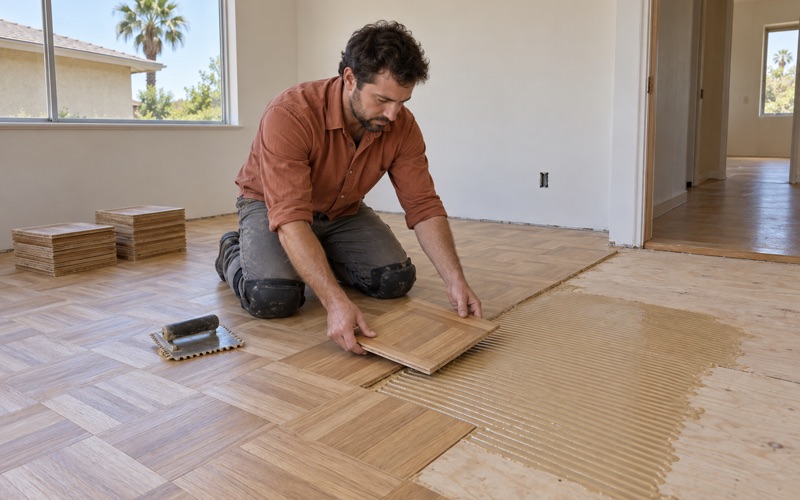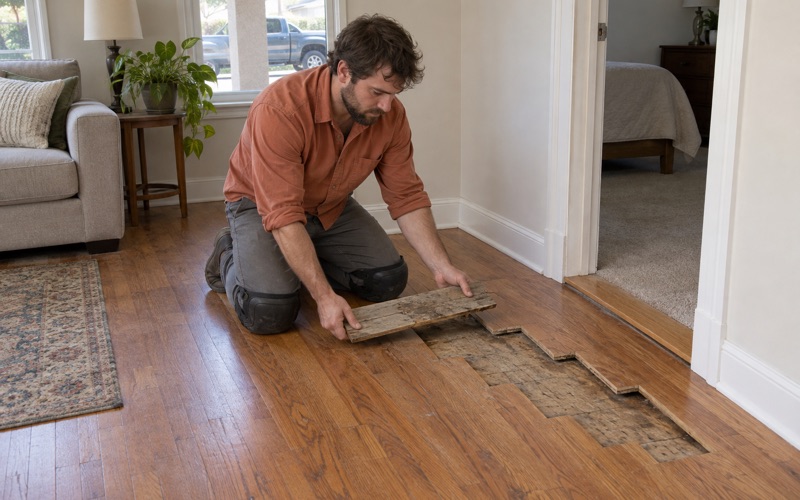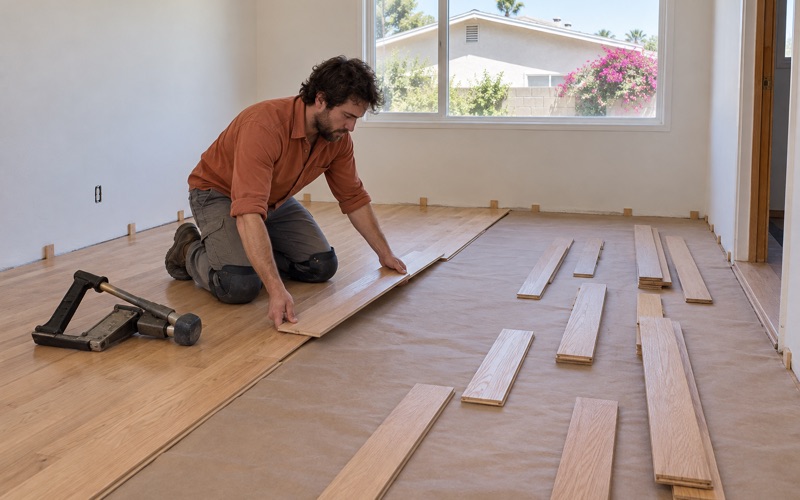
Baldwin Park Wood Flooring brings more than 20 years of wood-flooring experience to La Cañada Flintridge, sanding, repairing and installing hardwood for homeowners. Much of this work is about keeping a floor you already live on rather than tearing it out, so our process starts by finding out what that floor can still take and what it will need to last.
Before a price is written, we lift a corner of carpet or check an edge of the existing boards, so the estimate reflects the real oak, plywood or particle board underneath instead of an assumption. On engineered floors we measure the wear layer first, because a thin veneer can handle a screen and recoat but will not survive a full sanding.
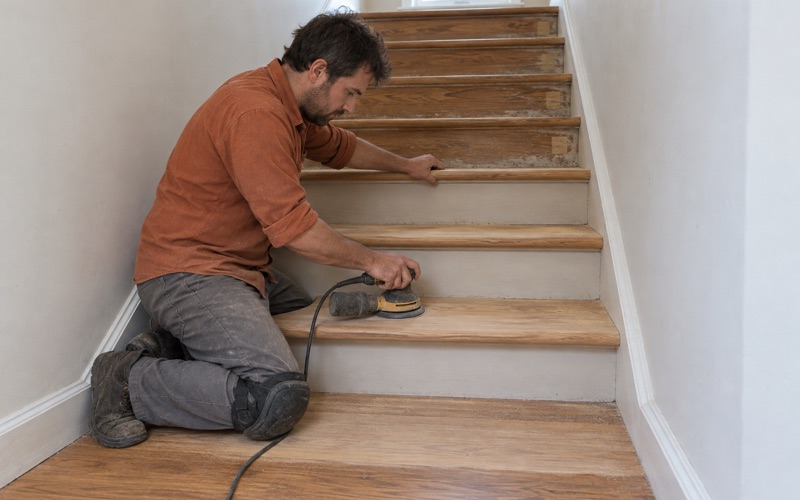
Stairs are priced by tread, riser and nosing rather than buried in a square-foot rate. Rooms are scheduled in writing, so you know which day furniture, rugs and family members can return. Where a floor shows small holes or powdery piles, we identify whether they are drywood termite pellets, beetle frass or old nail holes before recommending that any board be replaced.
An Owner City of 1940s and 1950s Houses
Owners living in detached houses
Census figures frame the kind of flooring work this city asks for. In the ACS 2024 5-year estimates, 5,531 of La Cañada Flintridge’s 6,367 occupied units are owner-occupied, which is 86.9 percent. Of those owner households, 98.2 percent live in detached houses. That describes people making decisions about their own floors, usually with the long run in mind.
For us, that changes the conversation. An owner planning to stay tends to ask how many more sandings a floor has left, which finish will hold up to years of daily use, and whether a patch will blend with the boards around it. Those are the questions our estimates are written to answer, room by room, before any equipment arrives.
Floors from the postwar decades
The housing stock leans heavily toward the middle of the last century. Of the city’s 7,053 housing units, 49.6 percent were built between 1940 and 1959, and the 1950s alone account for 34.4 percent. Houses from that period were often built with solid oak strip flooring, later left bare or covered by carpet, linoleum or tile.
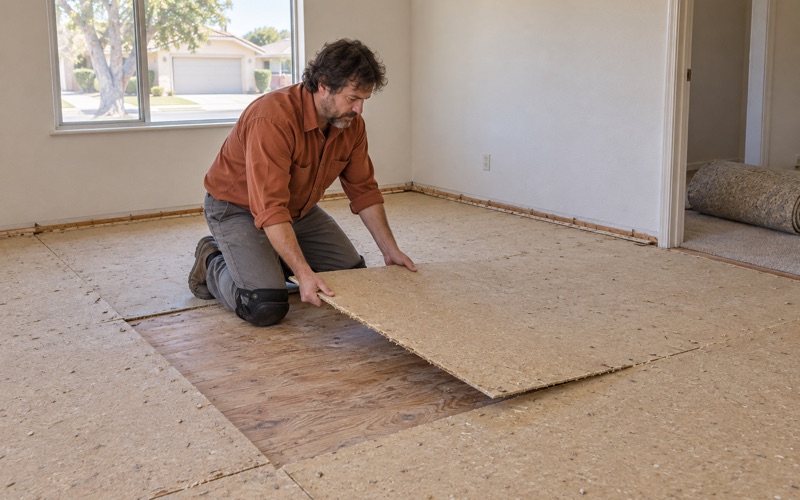
What turns up under a later covering varies. It might be red oak in good condition, a board subfloor ringed with tack strip holes and carpet staples, or black mastic left behind by 9x9 floor tile, which calls for an asbestos survey before anyone disturbs it. Each finding points to a different scope, which is why we look before quoting.
Build year and lead-safe work
About 81.4 percent of the city’s housing units predate 1980. The federal EPA Renovation, Repair and Painting Rule applies to pre-1978 housing, and older paint and finish layers near baseboards, thresholds and stair stringers are among the surfaces sanding can disturb. We check the build year before any sanding is put on the calendar.
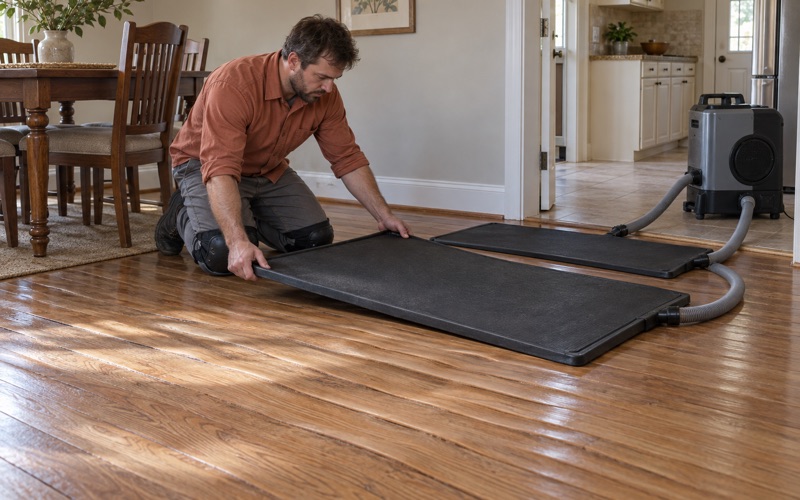
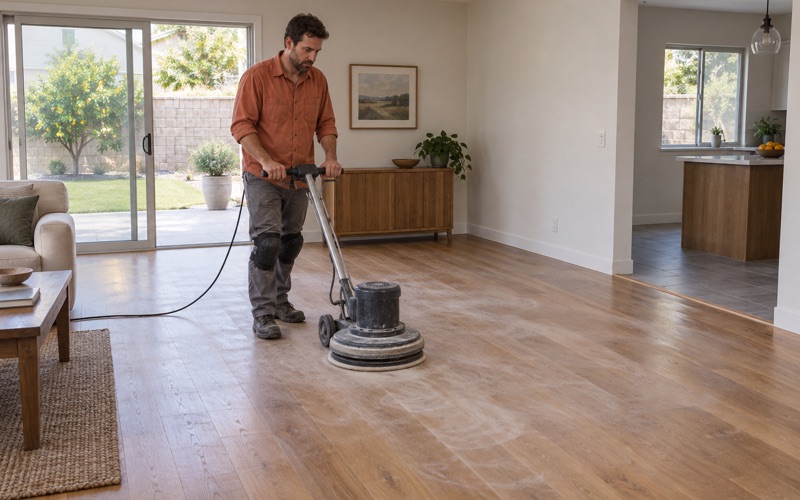
That check shapes containment, dust collection and cleanup on the job. Dustless sanding with a drum sander and edger connected to extraction cuts down airborne dust, but it does not replace the work practices the rule sets out for older homes. Knowing the year first means the plan is right on the first day instead of corrected halfway through.
Looking for wood-flooring closer to Artesia? See Wood-Flooring in Artesia.
Refinishing a Postwar Floor You Plan to Keep
Reading the floor before sanding
A floor that has already been refinished several times deserves a close look at how much wood remains above the tongue. We pull a floor vent or check a threshold to see board thickness, and we note cupping, crowning, nail pops, squeaks and hollow spots. Any of these can change whether a full sand is the right call.
Sometimes it is not. A floor with a sound finish and light surface wear can often be brought back with a screen and recoat, which removes almost no wood. On engineered hardwood, we measure wear layer thickness before promising a sanding, since a veneer that is too thin can take a fresh coat but not the abrasive grit sequence of a full refinish.
Repairs that blend in
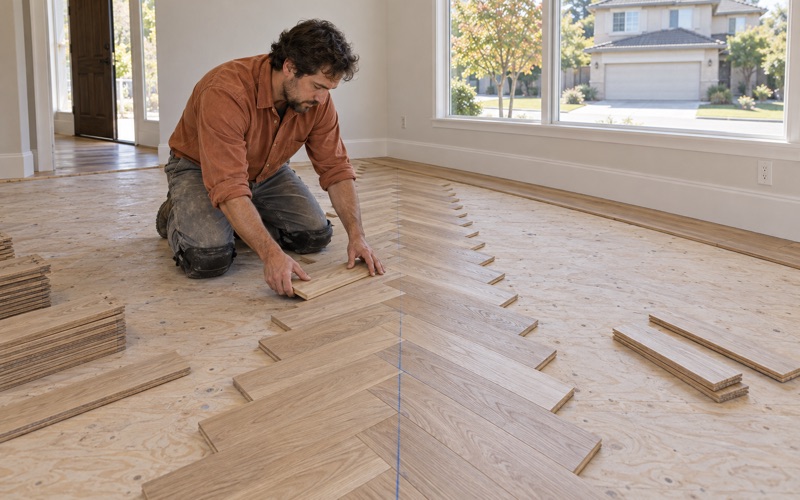
Long-term owners notice patches. When boards are marked by a pet urine stain, a black water stain or old termite activity, we use board replacement and weave-in repair so new pieces run into the existing layout rather than forming an obvious square. Matching red oak or white oak, and the direction of the grain, matters as much as matching stain color.
When carpet comes out as part of a job, the tack strip holes, staple rows and pad stains around the room’s edge are repaired within that same scope. We do not leave those marks for a rug to hide. After sanding and finishing, the perimeter of a room should read the same as its center.
Finishes that meet the air district limit
Finishes applied here fall under SCAQMD Rule 1113, which sets the wood coatings VOC limit at 275 grams per liter. We choose only products legal to apply in the South Coast air district, most often a waterborne polyurethane, along with a compliant sealer. Sheen level, durability and cure time are all weighed before a product is chosen.
For a household staying in the house during the work, cure time is often the deciding factor. A waterborne finish generally allows light foot traffic sooner, while full cure takes longer. We put those dates in writing, so nobody is guessing when a rug, a dining table or a heavy cabinet can safely go back down.
Working around a lived-in house
Owners who refinish in place need a sequence, not just a start date. We write a room-by-room schedule showing which spaces close, which stay open, and when furniture and people can return. Larger and multigenerational households use that schedule to plan meals, sleeping arrangements and bathroom access while the floors are out of use.
Who Handles Building Permits in La Cañada Flintridge
A contract consultant since October 2024
The city had contracted with Los Angeles County Public Works for building and safety services since incorporating in 1976. That changed on October 1, 2024, when m6 Consulting began overseeing the city’s plan checks and building inspections, and the county stopped providing them. The switch was reported at a projected savings of about 7 percent.
This matters when a floor project grows beyond finish work. Plan checks and inspections now run through the City of La Cañada Flintridge Building and Safety Division under that consultant arrangement rather than through the county. Homeowners who last pulled a permit before the change may find the process works differently than they remember.
ConnectLCF and the codes in force
Permits are handled through the ConnectLCF online portal. The city enforces the Los Angeles County Building Code and Fire Code as adopted, modified from the 2025 California Building and Fire Codes. It has also adopted the 2025 California Green Building Standards Code, the California Energy Code and the California Wildland-Urban Interface Code.
The city’s Building and Safety page does not address whether flooring work is exempt from permits, and we do not guess at that answer for you. Refinishing a surface and replacing a subfloor are very different kinds of work, and anything that touches joists or framing should be confirmed with the division before it begins.
When a floor repair turns structural
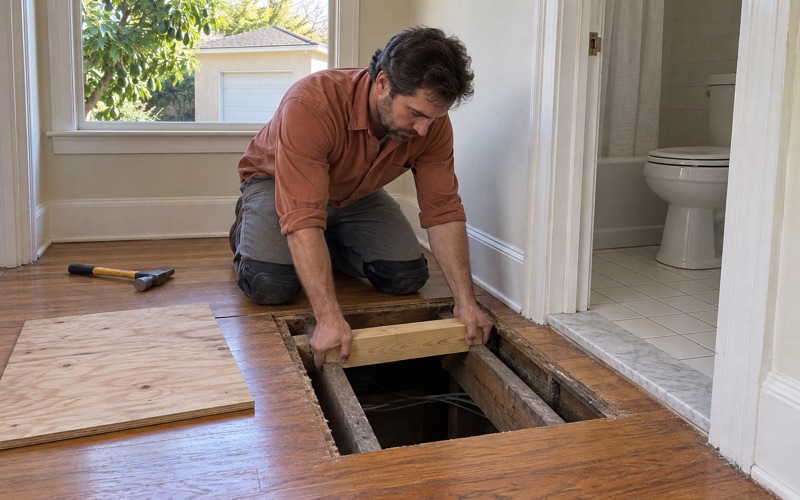
A soft spot or sagging floor is sometimes a surface problem and sometimes a framing one. When we open a section and find a rotted subfloor, or a floor joist that needs a sister joist, we stop and describe what we found, with photos and moisture meter readings you can bring to the city before structural work goes ahead.
Those same records help when the cause is a plumbing leak. Water losses are documented with photos and moisture readings an adjuster can use, taken before boards come up. That keeps the repair scope, the permit question and any insurance claim working from one consistent set of facts.
Fire Zone and Seismic Context in ZIP 91011
A whole-city Very High Fire Hazard Severity Zone
The entire City of La Cañada Flintridge is designated as being within a Very High Fire Hazard Severity Zone, and Los Angeles County Fuel Modification Plan Guidelines apply. Those designations shape how the city reviews building work and the land around structures. The city’s page does not connect them to interior flooring, and we do not present them as flooring rules.
Where they reach a floor project is in planning. If new flooring is one piece of a larger remodel, the other pieces are reviewed under the codes the city has adopted. We write our scope so the floor work is clearly separated, which lets the rest of the project move through the city’s review on its own terms.
Earthquake Brace + Bolt and raised foundations
ZIP code 91011 is on the 2025 Earthquake Brace + Bolt Southern California list. The program helps owners retrofit a house on a raised foundation, bolting it to the foundation and bracing the cripple walls from the crawl space. A house built slab-on-grade has no crawl space to retrofit, so the program question depends on your own foundation.
If your house does sit on a raised foundation and a retrofit is planned, the order of work matters. Crawl space access, joist repairs and fixes for squeaks or hollow spots made from below are easier to coordinate before a floor is refinished than after. We can schedule sanding around a retrofit so the new finish is not disturbed.
The same floor questions near the foothills
La Cañada Flintridge sits in the Crescenta Valley at the foot of the Verdugo Mountains, home to Descanso Gardens and NASA’s Jet Propulsion Laboratory. The floor questions we hear from owners here are practical ones: how much wood is left, what is under the carpet, and which finish will last. Those are the questions every estimate we write begins with.
- 20+ Years in Wood Floors
- Free Written Estimates
- Rental and Claim Documentation