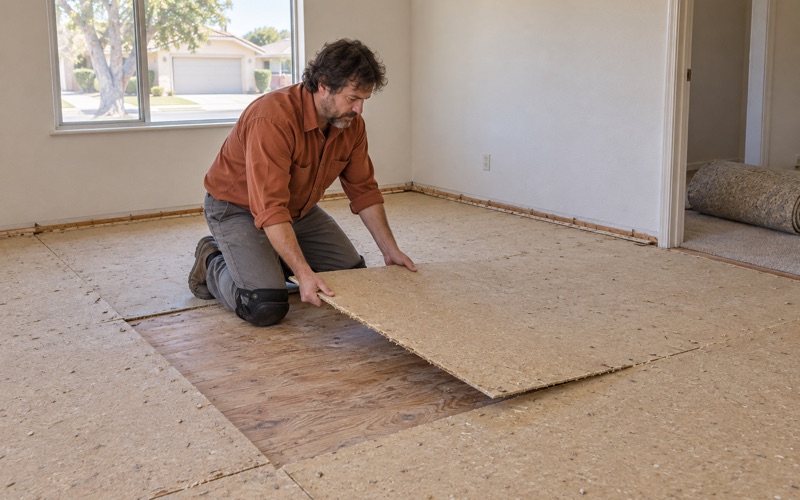
Baldwin Park Wood Flooring has handled wood-flooring in La Puente for more than 20 years, and the work here usually falls into one of two jobs: a family refinishing the house it owns, or a property owner readying a vacant apartment for the next tenant. Both begin with a corner of carpet pulled back before we write any number, so the quote covers the oak, plywood or particle board that is really there.
What happens after that differs. A homeowner usually wants a durable finish, a clear schedule and a house that is livable again quickly. A landlord wants a scope that holds up in a deposit discussion and a unit that can be shown on a set date. We quote each on its own terms instead of forcing one price sheet onto both.
Every job also gets a build-year check before sanding goes on the calendar, every finish we apply is legal to use in the South Coast air district, and every engineered floor has its wear layer measured before we promise a full sand. The sections below walk through how that plays out in a La Puente house and in a La Puente apartment.
Two Kinds of La Puente Floors: the House and the Apartment
La Puente is a compact city, but its housing answers to two very different kinds of owner. Of 9,624 occupied units, 60.4 percent are owner-occupied and 39.6 percent are rented, and the buildings those two groups live in barely overlap. That split, more than any single material, is what shapes how we plan floor work here.
Owners Live in Detached Houses
Census figures for owner households are strikingly one-sided: 87.9 percent of La Puente owners live in a detached house. Very few owners are in condos or small multi-unit buildings, so a homeowner calling us is almost always calling about a standalone house with its own bedrooms, hallway and living room to work through.
That matters for scheduling. In a detached house we can work room by room, keep part of the home open, and hand the family a written plan showing when furniture, rugs and people can return. Large and multigenerational households get that schedule before the first sander arrives, not after the dust starts.
Renters Are Split Across Building Sizes
Renters show a different pattern. 47.2 percent of La Puente renter households live in buildings of five or more units, while a sizable share of the rest rent detached houses. A rental floor job here can mean a single unit inside a larger complex or a whole house leased to one family, and the scope reads differently for each.
In a multi-unit building the unit is usually vacant, access runs through shared hallways, and neighbors share walls. In a rented house the work looks more like a homeowner job, except the person paying needs documentation for the file. We ask which situation applies on the first call so the estimate fits the property.
A Housing Stock Mostly Built Before 1960
The buildings are old in both markets. 58.3 percent of La Puente housing units were built before 1960, and 81.1 percent before 1980. Floors in that stock have usually seen several owners, several coverings and at least one round of patching, so we never assume we know what the last contractor left behind.
Age is also a compliance question. The EPA Renovation, Repair and Painting Rule applies to renovation in pre-1978 housing, and because the census bucket stops at 1980, the pre-1978 share sits somewhat below that 81.1 percent figure while still covering most of the city. We confirm a home’s build year before sanding is scheduled, since old paint and finish layers can fall under that rule.
Looking for wood-flooring closer to Valinda? See Valinda Wood-Flooring.
Refinishing a Tract House the Owner Lives In
What the Corner of Carpet Tells Us
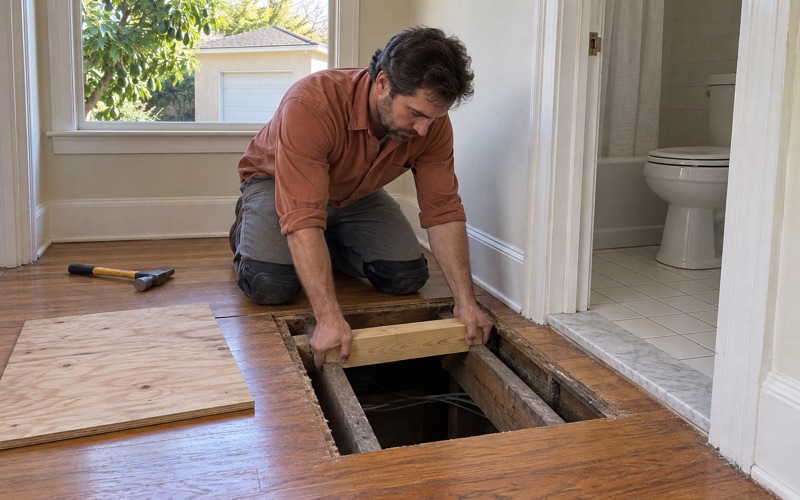
Plenty of La Puente houses have carpet, vinyl or laminate over whatever came before. We don’t guess what that is. Lifting one corner shows whether the layer underneath is solid wood, a plywood subfloor, a board subfloor or particle board, and it exposes the tack strip, carpet staples and pad stains the carpet has been hiding.
If there is wood, the next questions are thickness, damage and prior sanding. If there is particle board, we look for particleboard edge swell from past spills, because swollen edges telegraph through a new floor. Either way the estimate is written for the layer we actually saw, which keeps surprise change orders out of the middle of the job.
Tack Strip Holes and Staple Rows
Taking carpet off a wood floor leaves a predictable set of scars: tack strip holes around the perimeter, rows of carpet staples across the field, and dark carpet pad stains where padding sat against the finish for years. We treat all of that as part of a carpet-to-wood job and repair it, rather than suggesting an area rug to cover it.
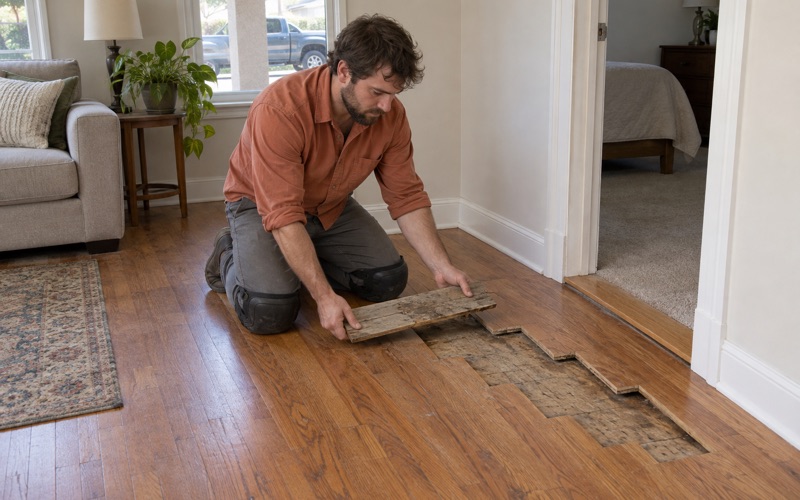
Staples come out one at a time, holes get filled or a weave-in repair where filler would show, and stains are sanded to see whether they lift. A pet urine stain or black water stain that runs deep into the grain usually means board replacement, which we price per board once sanding shows how far the damage goes.
Sanding, Finish and Getting the House Back
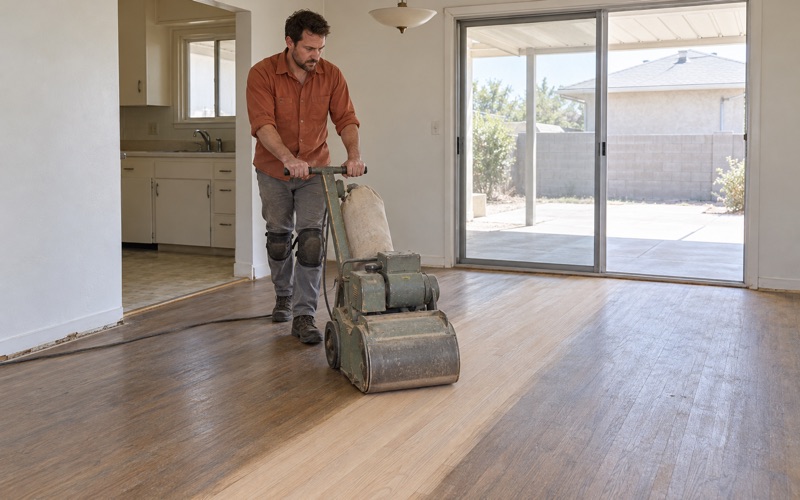
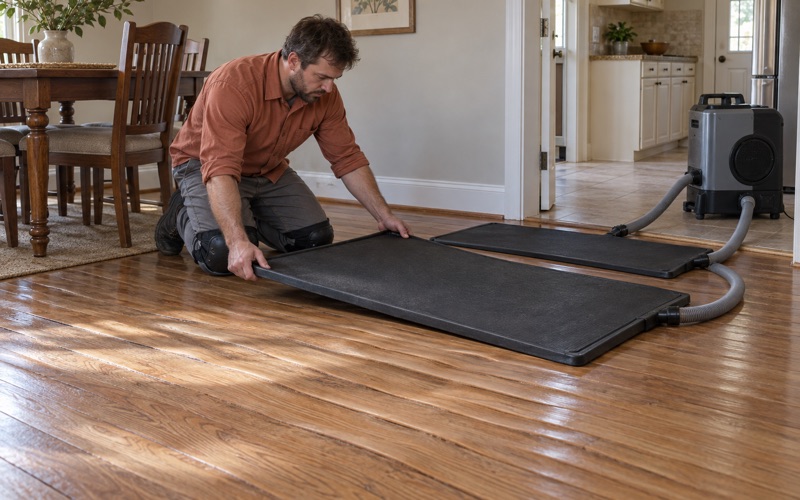
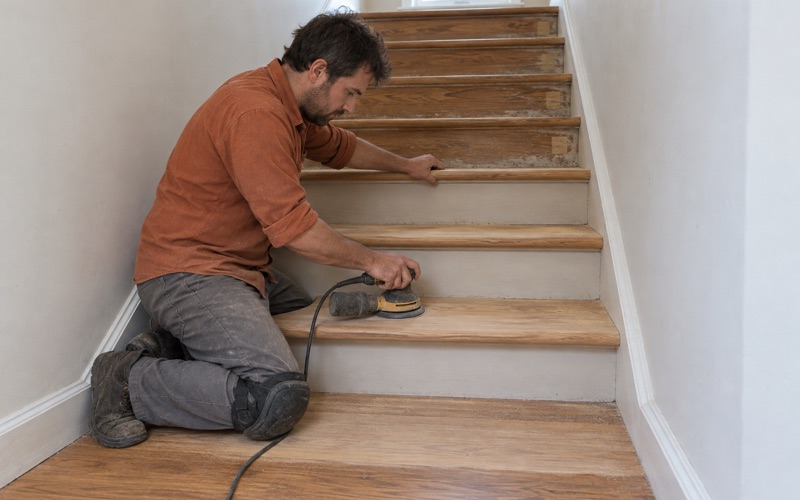
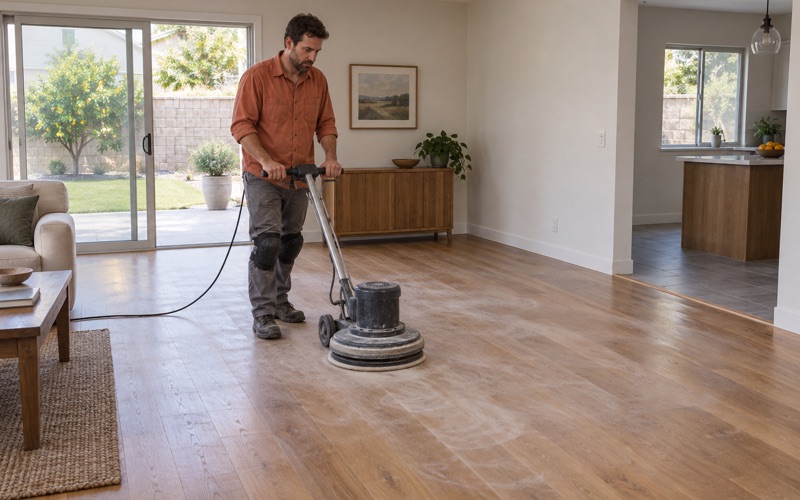
For site-finished solid hardwood we run a drum sander and edger through an abrasive grit sequence, using dustless sanding equipment to keep an occupied house cleaner. Engineered hardwood gets its wear layer thickness measured first. A thin veneer can take a screen and recoat but not a full sanding, and we say so before quoting.
Finishes come from products that meet the SCAQMD wood coatings VOC limit of 275 grams per liter, often a waterborne polyurethane in whatever sheen level the owner picks. Cure time decides when rugs and heavy furniture go back, and that date is written into the room-by-room schedule instead of being left to guesswork.
Turning Over an Apartment Floor Between Tenants
Move-Out Photos and a Written Scope
When a tenant moves out, the owner has a short window and a deposit decision to make. We start from the move-out photos, walk the unit, and write a scope listing each repair by room: deep scratches, gray boards near a patio door, sun fading, pet damage, finish peeling along a kitchen path. The landlord keeps that document with the deposit records.
California Civil Code 1950.5 governs security deposit deductions and the itemized statement, and it separates tenant damage from normal wear and tear. We don’t decide which is which, but a dated scope with photos and per-item pricing gives the owner something concrete to reference when preparing that security deposit itemized statement.
Screen and Recoat or a Full Sand
Many apartment floors don’t need a full sanding between tenants. If the finish is worn but the wood is sound, a screen and recoat renews the surface in far less time and saves wear layer for the next turnover. Where cupping, deep gouges or a cloudy finish run through the coating, sanding is the honest recommendation.
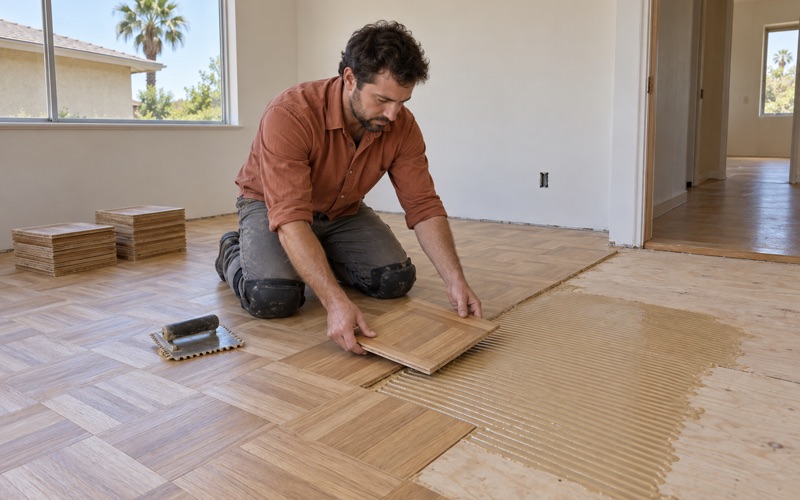
Some units carry laminate flooring or luxury vinyl plank installed as a floating floor instead of wood. Those don’t refinish; damaged planks are replaced and transitions such as a reducer, T-molding or quarter round are reset. We tell the owner which kind of floor a unit has before quoting, so the turnover budget matches the material.
Keeping a Vacant Unit on Schedule
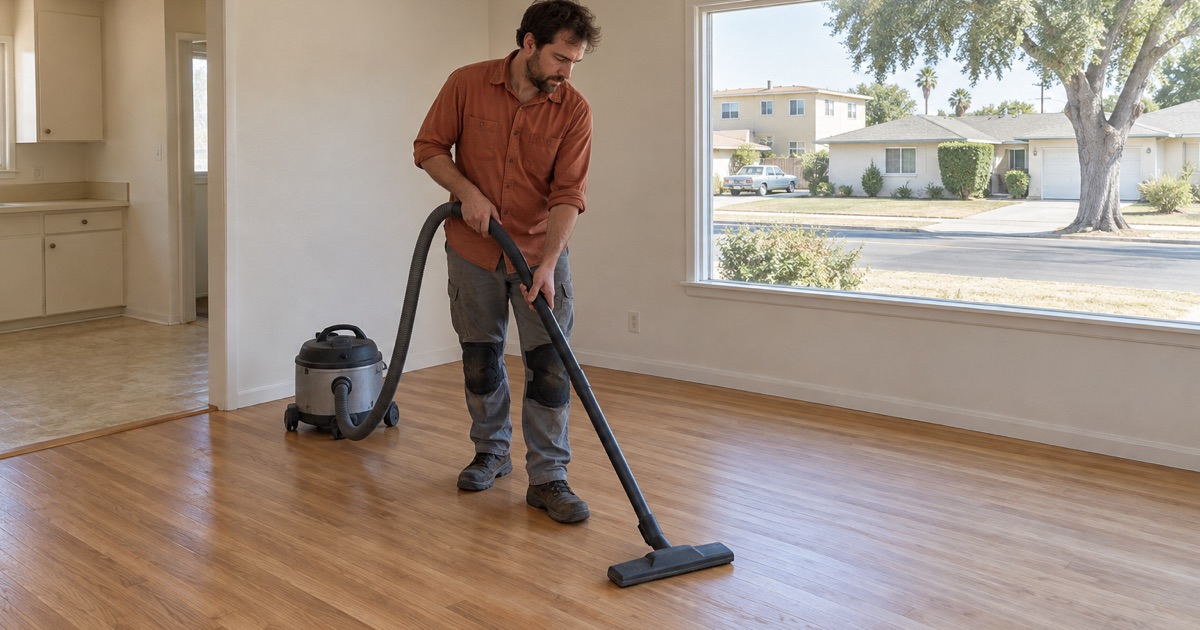
Turnover work is largely a calendar problem. We plan the unit so sanding, finish coats and cure time land before the date a new tenant or showing is booked, and we flag any board replacement or subfloor repair that could stretch it. In a larger building we also plan around shared hallways and the neighbors on the other side of the wall.
Small holes or powdery piles found during a turnover get identified before anything is torn out. Drywood termite pellets, powderpost beetle frass and old nail holes look alike at a glance but lead to very different next steps. We name what we see so the owner can decide whether a pest inspection should come first.
From Walnut Groves to the Permit Counter
How the Houses Got Here
The land under today’s streets had other uses first. In the 1930s the area was known for fruit and walnut groves, and it was home to what was called the world’s largest walnut packing plant. A small airport called the Skyranch operated in La Puente from 1944 to 1951 before it was closed and developed for housing.
That postwar conversion shows in the census counts: 5,069 of the city’s 9,958 housing units date from the 1950s, and La Puente incorporated on August 1, 1956, in the middle of that building period. Floors laid during that rush have since passed through decades of owners and tenants, which is why we inspect before we price.
Permits at 15900 E. Main Street
Permits in La Puente run through the City of La Puente Building & Safety, part of Development Services at 15900 E. Main Street. The office handles building, electrical, mechanical, plumbing, energy and accessibility permits. Its page publishes no list of exempt work and does not mention flooring, so we don’t guess on the owner’s behalf.
When a job moves past surface refinishing into structural repair, such as a rotted subfloor or a sagging floor that needs a sister joist, we check with Building & Safety about what the city requires before that work is scheduled. The answer goes into the written scope, so the homeowner or landlord knows exactly what the city expects.
Moisture Checks Before New Wood Goes Down
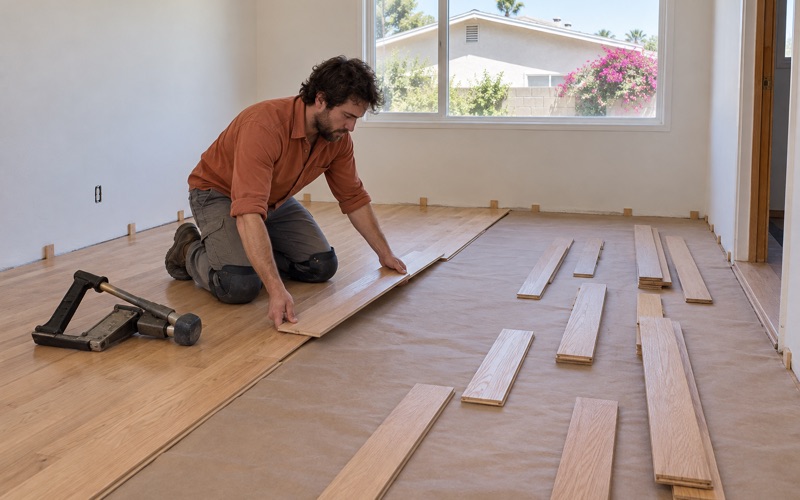
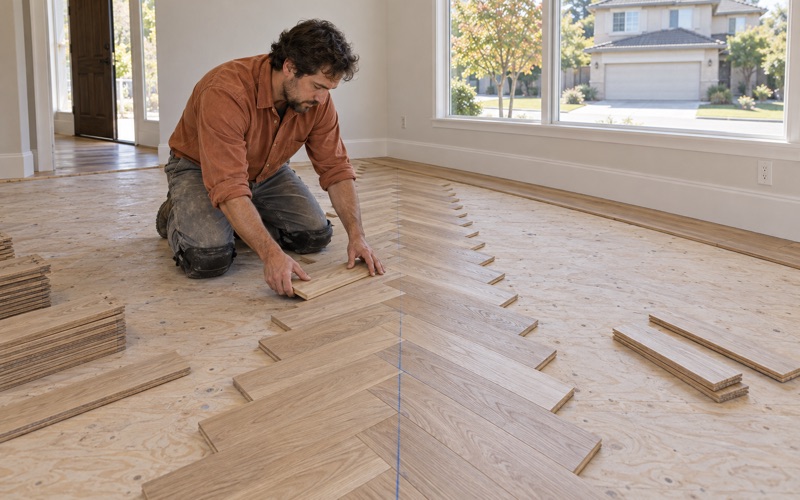
Any new solid or engineered boards, whether patching a tract house or replacing a damaged section in a rental unit, get a moisture meter reading and time to acclimate before installation. Relative humidity inside a closed-up vacant unit can differ from an occupied house, and matching the new wood to the room helps prevent seasonal gapping, crowning and buckling later.
- 20+ Years in Wood Floors
- Free Written Estimates
- Rental and Claim Documentation