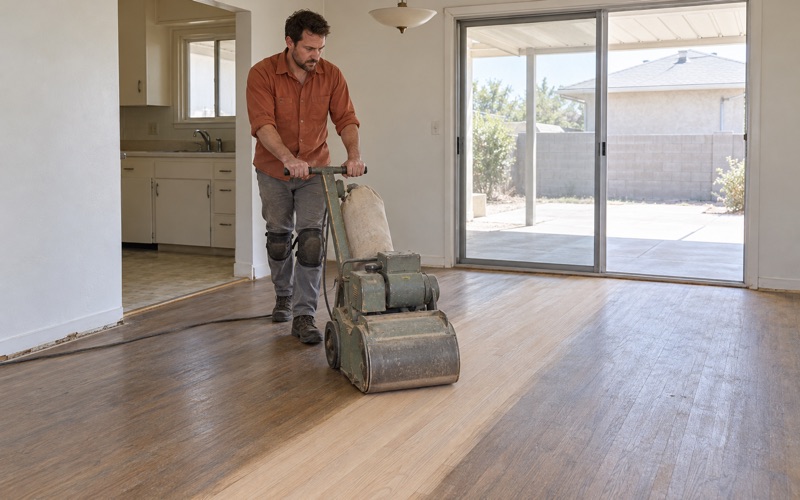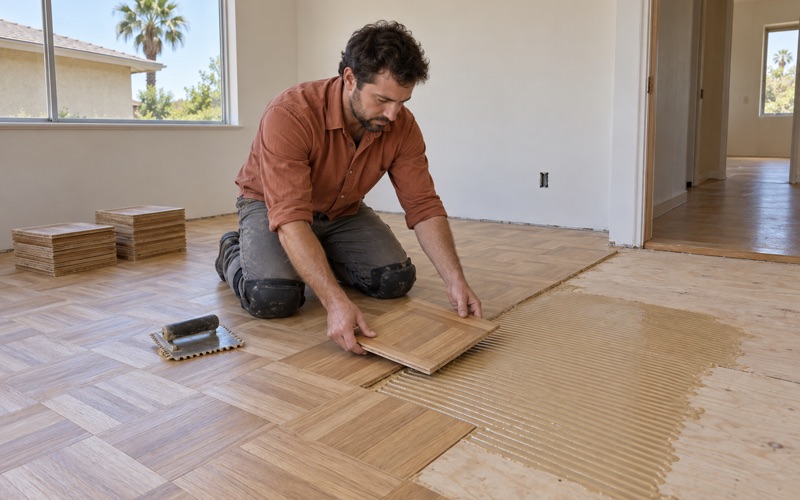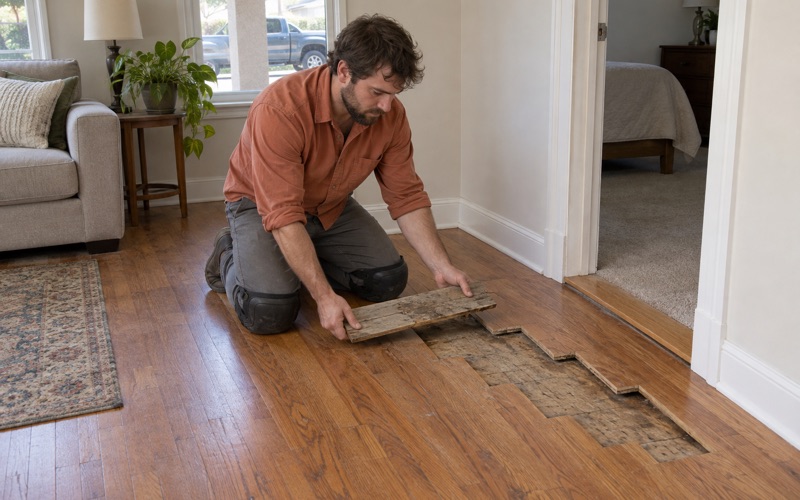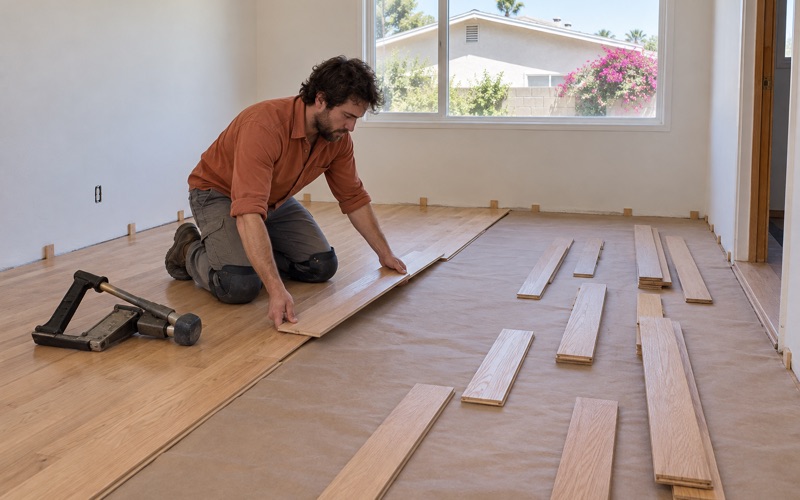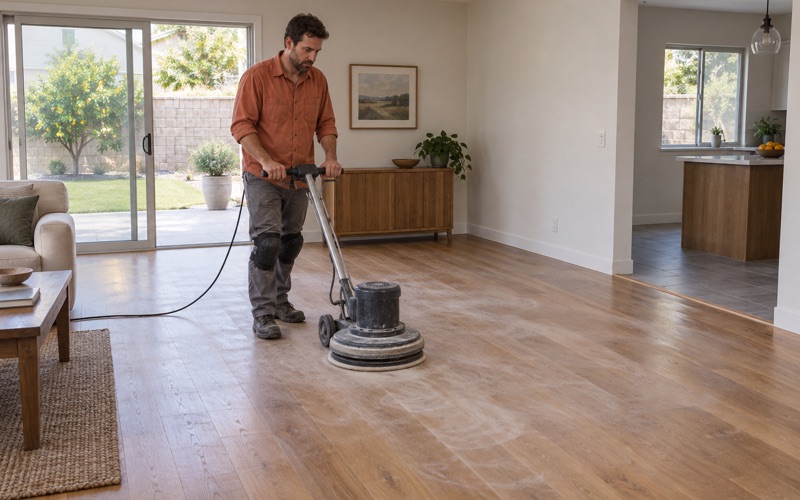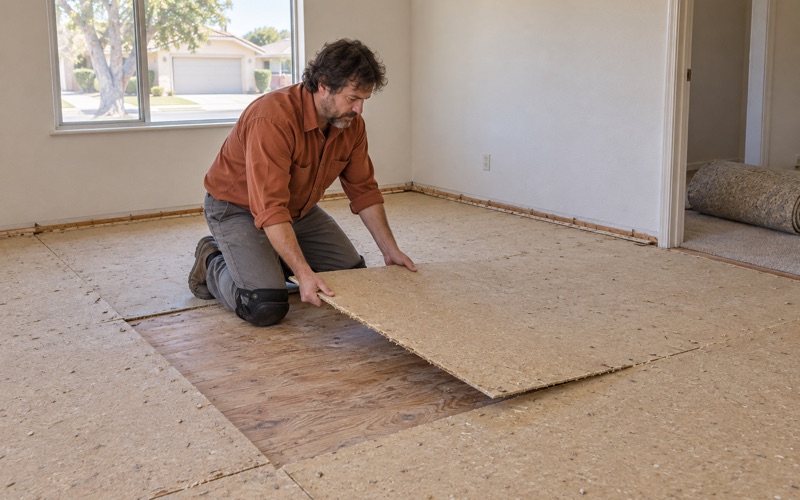
Baldwin Park Wood Flooring has handled wood-flooring in Lomita for more than 20 years, and a good share of that work happens in houses where someone is still living. Refinishing, repairing or replacing a floor around a household’s daily routine takes different planning than a job in an empty house, and we build that planning into the estimate from the first visit.
Before we quote, we lift the carpet in one corner so the price reflects whatever is actually underneath, whether that turns out to be oak strip flooring, plywood or particle board. Tack strip holes, staple rows and pad stains get repaired as part of a carpet-to-wood job. Nothing is tucked under a rug and left for the next occupant to discover.
Owners and tenants both receive the same written scope, so everyone knows which rooms close, for how long, and when furniture can go back. Below, we walk through the rental houses we work in, what a floor job looks like with people at home, what state law says about cosmetic work, and where permits for this city are handled.
Lomita’s Rental Market Is Built on Houses
Renters Outnumber Owners
Census figures shape how we schedule work here. The American Community Survey 2024 five-year estimates count 3,964 of Lomita’s 7,326 occupied housing units as renter-occupied, or 54.1 percent. Renters are the majority, which means many of the floors we are asked to look at belong to one household and are lived on by another.
The practical result is two sets of priorities on a single job. The owner is weighing durability, cost and how the floor will look at the next turnover. The tenant is wondering where the kids sleep this week and whether the kitchen stays usable. A good estimate answers both questions, in writing, before any sander comes through the door.
Detached Houses Are the Largest Rental Form
Lomita renters are not concentrated in apartment blocks. The same survey counts 1,473 renter households living in detached single-family houses, 37.2 percent of all renters and the largest single rental form in the city. Seen from the other direction, 38.7 percent of the 3,802 occupied detached houses are rented rather than owner-occupied.
A rented house is a different floor job than a rented apartment. There are more rooms, usually a hallway tying them together, sometimes a staircase, and often a family using every part of the space. Sequencing matters more, because closing the hallway can cut off a bedroom, and closing the living room can leave nowhere to set furniture from the next room.
Housing From the 1950s Through the 1970s
Much of Lomita’s housing went up in three nearly level decades. The survey places 20.2 percent of units in the 1950s, 19.9 percent in the 1960s and 22.3 percent in the 1970s, with 10.1 percent built before 1940. Houses from those eras can hide solid hardwood under wall-to-wall carpet, along with decades of carpet adhesive, paint overspray and old nail holes.
Build year also decides how we sand. The EPA Renovation, Repair and Painting Rule applies to pre-1978 rental housing, which reaches most rented houses from those decades. We check the year before any sanding is scheduled, because in an occupied house the containment and cleanup steps protect the people who walk back into that room the same evening.
Looking for wood-flooring closer to El Segundo? See Wood-Flooring in El Segundo.
Floor Work With the Tenant Still Living There
A Room-by-Room Schedule Everyone Can Read
Our written schedule lists each room, the day it closes, the day it reopens and when rugs and furniture can return. Tenants can plan meals, school mornings and sleep around it, and owners can see exactly what they are paying for. In a house with several bedrooms, we usually work from the far end toward the front door so exits stay open.
We also mark the rooms that stay untouched for the whole job. A family that knows the kitchen and one bathroom remain available through every phase handles a week of floor work far better than one guessing each morning. When a house has only one path between bedrooms, we say so up front and plan that hallway around an overnight cure window.
Finishes, Odor and Cure Time
Finish choice matters more when someone is sleeping down the hall. We select products legal to apply in the South Coast Air Quality Management District, whose wood coatings limit under SCAQMD Rule 1113 is 275 grams per liter. Waterborne polyurethane is often the practical pick in an occupied rental, with lower odor and a quicker return to light foot traffic.
Cure time is not the same as dry time. A floor can take socks on it well before it is ready for a couch, a dining table or an area rug. We put both dates on the schedule, because a tenant who drags furniture back too early leaves scuffs and dents that can end up in a deposit conversation later.
Screen and Recoat Versus a Full Sand
Not every tired floor needs a full sanding. A worn but intact finish often responds to a screen and recoat, which is quicker, quieter and far less disruptive in a lived-in house. On engineered hardwood, we measure wear layer thickness first, since a thin veneer can take a recoat but may not survive a pass with a drum sander.
Where boards are gray, cupped or marked by a pet urine stain, a recoat will not hide the damage, and we explain why. Small holes and powdery piles get identified as drywood termite pellets, beetle frass or old nail holes before anyone replaces a board, so the household is not living through a repair that misses the actual cause.
What State Law and Lomita’s 2019 Council Said
Civil Code 1946.2 and Cosmetic Improvements
California’s Tenant Protection Act, in Civil Code 1946.2, lists an intent to demolish or substantially remodel as a no-fault just cause for ending a tenancy. As amended effective January 1, 2026, the statute says cosmetic improvements alone, including painting, decorating and minor repairs, or other work that can be performed safely without vacating the property, do not qualify as substantial remodel.
In the statute, a substantial remodel means replacing or substantially modifying a structural, electrical, plumbing or mechanical system that requires a permit, or abating hazardous materials such as lead-based paint, mold or asbestos, where the work cannot be done safely with the tenant in place and requires vacancy for at least 30 consecutive days. That framing is why scheduling around tenants comes up so often.
Flooring Is Not Named, and We Are Not Lawyers
Flooring does not appear anywhere in that language. We cannot tell an owner or a tenant how a particular floor job fits under the statute, and we do not try. That question belongs with an attorney or a tenant-rights resource. What we can provide is an honest description of the work and whether it can be done in stages with people at home.
That description is often exactly what an owner’s advisor asks to see. Our written scope lists each room, the method, the expected days per area and the containment used, along with before photos where they exist. Landlords can keep it with their deposit records, and tenants can read the same plan in plain terms.
The 2019 Urgency Ordinance
Lomita has already faced this question. In October 2019 a property owner issued 60-day notices asking tenants to move out so renovations could begin, as Spectrum News 1 reported. The city council responded late that year with an urgency ordinance halting renovation-related evictions until the state law took effect on January 1, 2020.
That measure was an urgency action tied to a specific moment, and we have not located a standing local rent-stabilization rule in effect today. What the episode shows is how closely the city watches renovation around renters, and why we plan occupied-house floor work carefully instead of assuming a house will sit empty while we work.
Where Lomita Permits Are Handled
Los Angeles County Building and Safety Under Contract
Plan check, permit issuance and inspections in Lomita are provided by Los Angeles County Public Works Building and Safety under contract, from the Lomita-Lennox Building and Safety Office at 24320 S. Narbonne Ave. The City of Lomita lists its own Building and Safety Division at that same address, so owners deal with one counter for building, electrical, plumbing and mechanical permits.
When the Job Goes Below the Floor
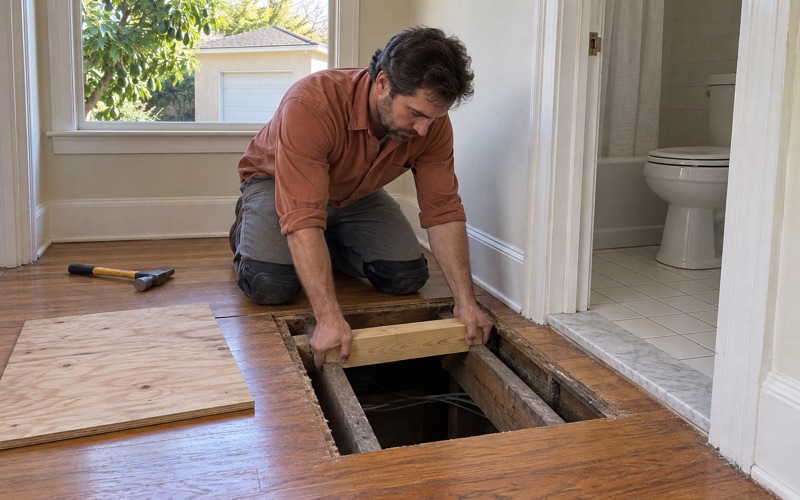
Refinishing an existing floor is surface work, but opening a floor can change the conversation. A soft spot, a sagging floor or a rotted subfloor can lead to floor joist repair or a sister joist, and structural work is something to raise with the Lomita-Lennox office before it is scheduled. We flag that possibility in the estimate rather than discovering it mid-job.
Pulling old coverings can raise material questions too. Black mastic and older 9x9 floor tile call for an asbestos survey before removal, and SCAQMD Rule 1403 governs asbestos handling during renovation across the district. That step belongs ahead of the tenant schedule, not in the middle of it, so any testing wait goes into the written plan before a room closes.
Stairs, Transitions and the Final Walkthrough
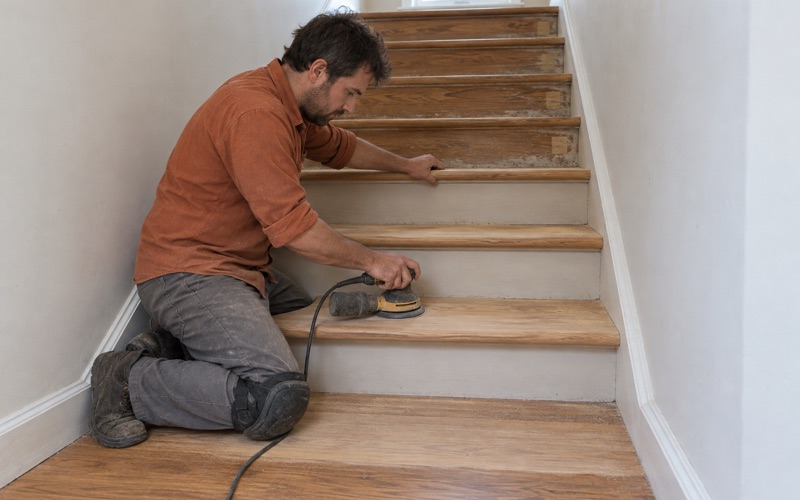
Rented houses with stairs get quoted by the tread, riser and stair nosing rather than folded into a square-foot price, so an owner can see what the staircase alone costs. Reducers, T-molding and shoe molding at each doorway are listed as well, since a loose transition is a trip hazard for whoever lives there next week.
At the end, we walk the rooms with whoever is available, owner, tenant or both, and note anything that still needs attention. Photos of the finished floor go into the same file as the scope, giving the owner a record for the next turnover and the tenant a clear picture of the condition they are living with.
- 20+ Years in Wood Floors
- Free Written Estimates
- Rental and Claim Documentation