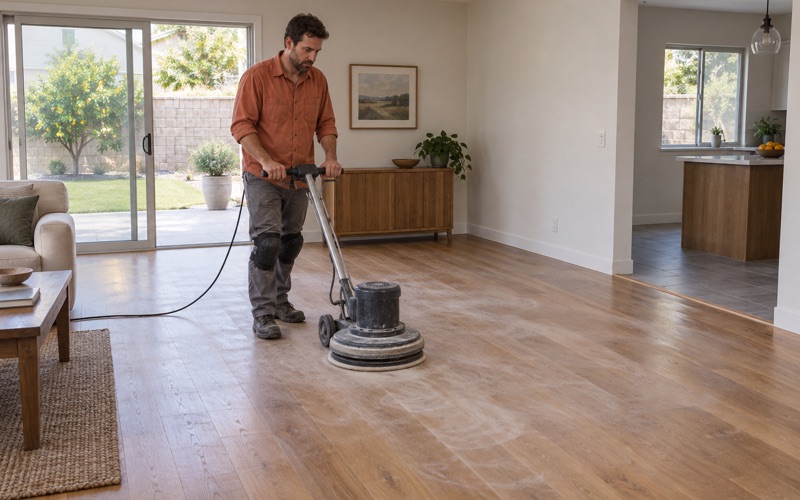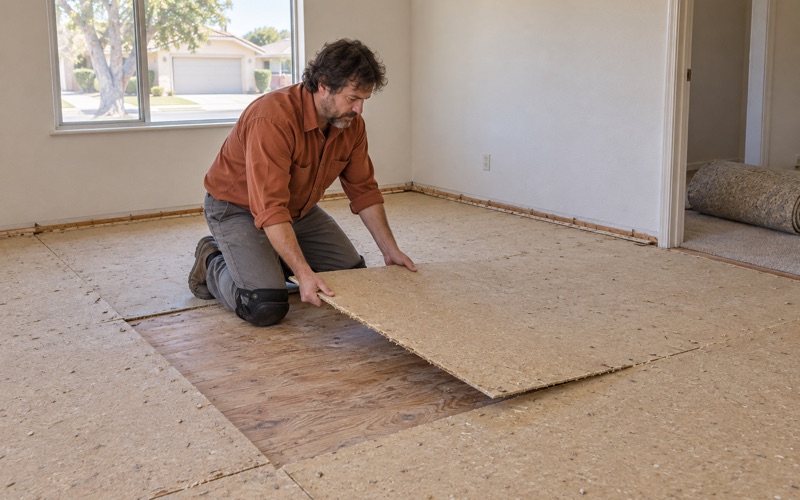
Baldwin Park Wood Flooring handles wood-flooring in Mayflower Village with more than 20 years of sanding, refinishing, repair and installation behind our crew. Before we quote anything, we fold back one corner of carpet and look at what is really underneath, whether that is oak strip flooring, a plywood subfloor or particle board, so the estimate describes the floor you actually own.
Most calls start with a practical question. Can the old floor be sanded one more time, does a soft spot need board replacement, or is a new floor the better use of the money? We answer with a moisture meter, a close look at edges and wear, and a written scope that separates what has to happen from what is optional.
Carpet-to-wood jobs include the cleanup many crews skip. Tack strip holes, rows of carpet staples and old carpet pad stain get filled, pulled or sanded out as part of the work instead of being hidden under a rug. For busy households that need rooms back on a plan, we write a room-by-room schedule showing when furniture and people can return.
Two Eras of Houses With a Gap Between Them
Census figures for Mayflower Village show an unusual housing record. Of 1,796 units in the ACS 2024 five-year estimates, 1,241 were built between 1940 and 1969, which is 69.1 percent of the housing stock. The 1940s alone account for 698 units, or 38.9 percent, and the 1950s and 1960s add 288 and 255 more.
After that the record thins out sharply. Only 25 units date from the 1980s and 15 from the 1990s, just 40 houses across two full decades. The next real layer is 245 units built from 2000 to 2009, or 13.6 percent of the stock, and 18.1 percent of all units here were built in 2000 or later.
What the gap means for a floor job
In practice, a floor call in this community lands on one of two very different houses. One is a postwar house with seventy-plus years of refinishing, patching and remodeling layered into it. The other is barely twenty years old, where the question is usually worn finish or a first replacement rather than decades of history.
That is why the build year is the first thing we ask for, not the last. It decides whether federal lead-safe rules shape the sanding plan, how much we expect to find under the carpet, and which subfloor questions are worth raising before a price goes on paper.
Owners making long-term decisions
About 73.1 percent of occupied homes in Mayflower Village are owner-occupied, according to the same census tables, and most of those owners live in detached houses. The margins on these figures are wide, but the pattern holds: most floor decisions here are made by people planning to stay, which favors repairs done once and finishes chosen to last.
Looking for wood-flooring closer to North El Monte? See Wood-Flooring Services in North El Monte.
Floors in the Postwar Core
The 1940s through 1960s houses are where we slow down and look before we plan. Seven decades leave room for several sandings, a carpet era, a sheet vinyl or tile era and a few owners’ own repairs, all stacked in one room. We lift carpet, check thresholds and look at heat registers before assuming what the original floor was.
Lead-safe planning before sanding
Houses built before 1978 fall under the EPA Renovation, Repair and Painting Rule when work disturbs painted surfaces, and 79.7 percent of units here predate 1980. Old finish layers, painted baseboards, shoe molding and quarter round are exactly what a sanding job touches, so the plan has to account for them before a drum sander arrives.
Checking the build year first lets us set containment, dust control and cleanup to match the house instead of running every job the same way. In a 1940s house it also changes the order of work, since trim removal and edge sanding along painted walls are where old paint is most likely to be disturbed.
Thin boards, old repairs and insect evidence
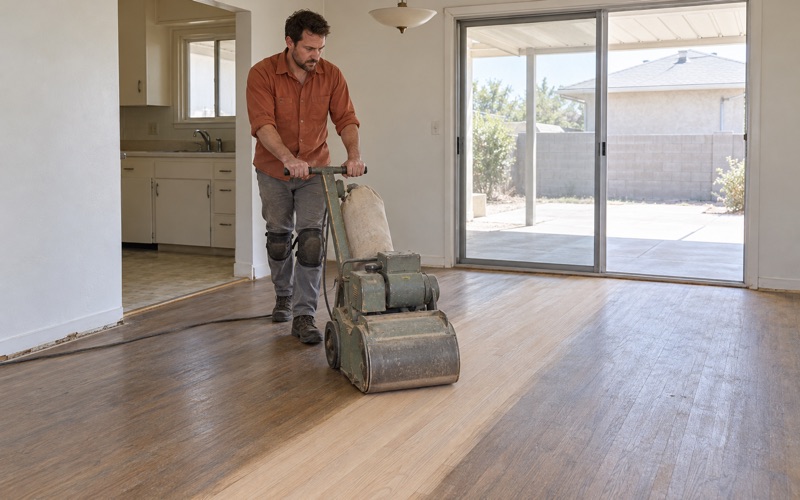
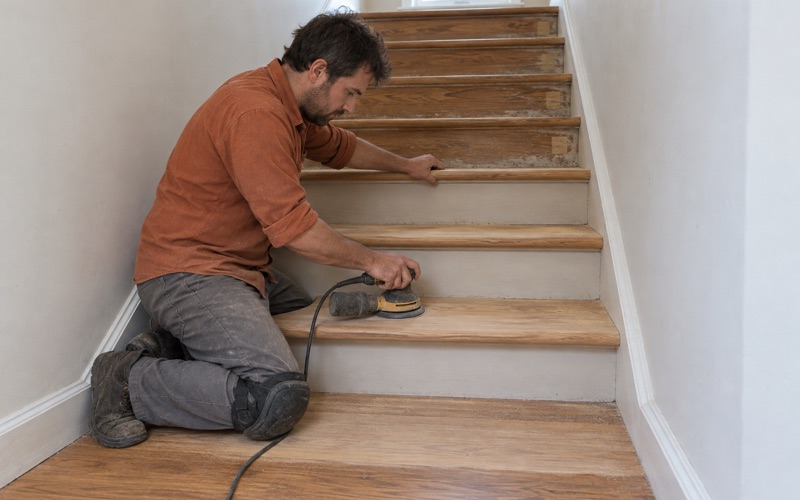
Postwar oak strip flooring can often take another sanding, but not always. Earlier crews may have taken the boards thin, left edger marks or sanded through near doorways. We check a board edge at a floor vent or threshold before promising a full sand, and recommend a screen and recoat when the remaining wood cannot spare more.
Small holes and powdery piles along a baseboard need a name before any board comes out. Drywood termite pellets, powderpost beetle frass and plain old nail holes look alike to most owners but call for different next steps. With active insect evidence, we suggest a Wood Destroying Pests and Organisms Inspection Report before replacing anything.
What turns up under old carpet
Rooms that spent decades under carpet usually kept the wood protected but picked up damage of their own. Tack strip holes ring the perimeter, staples sit in rows and pad stains shadow the traffic lanes. Where black mastic or 9x9 floor tile shows up instead of wood, we stop and talk through an asbestos survey under SCAQMD Rule 1403 before any removal.
Floors in Houses Built in the 2000s
The 245 houses from 2000 to 2009 bring a different set of questions. Nobody is peeling back seven decades of remodeling in these homes. The floors are roughly twenty years into their life, which is often when the original finish wears through in kitchens and hallways and owners start weighing a refinish against replacement.
Identify the floor before pricing it
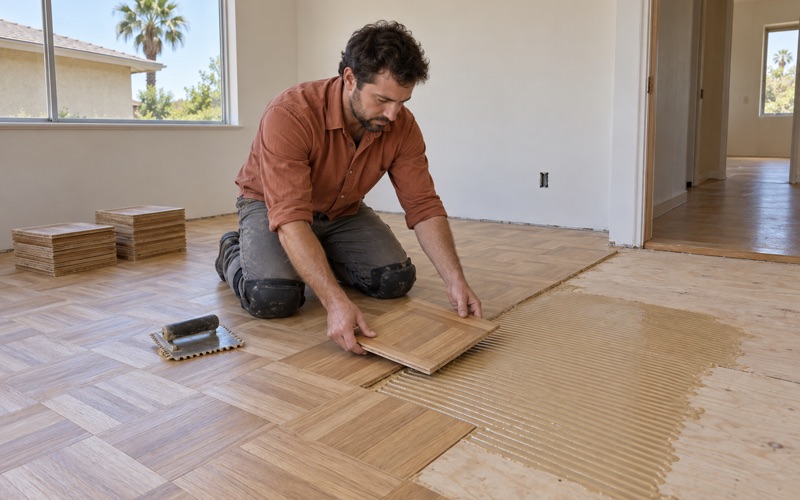
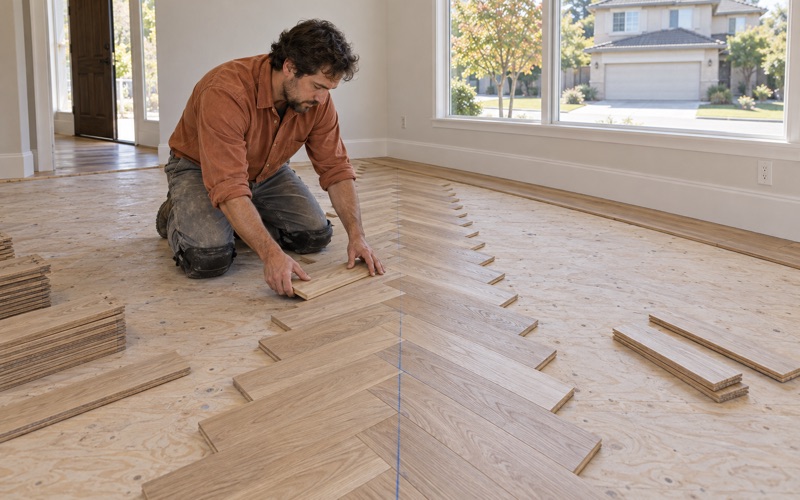
We don’t assume what a 2000s house was built with. Solid hardwood, engineered hardwood, laminate flooring and luxury vinyl plank can look alike from standing height, and each allows a different repair. A look at an exposed edge, a stair nosing or a floor register usually settles the question before any price is written down.
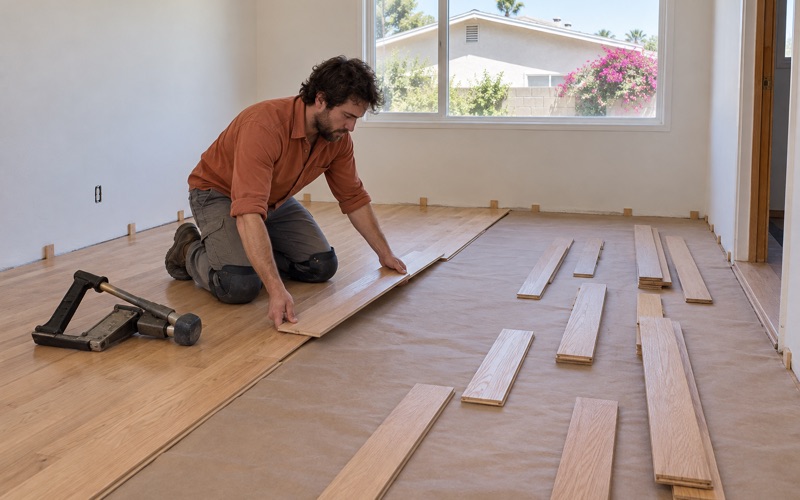
On engineered hardwood we measure the wear layer thickness before promising a full sanding. A thin veneer can take a screen and recoat to refresh the finish, but a drum sander can cut through it in a single pass. Laminate and other floating floors cannot be sanded at all, so worn areas there become board replacement or a new floor.
Wear patterns at the twenty-year mark
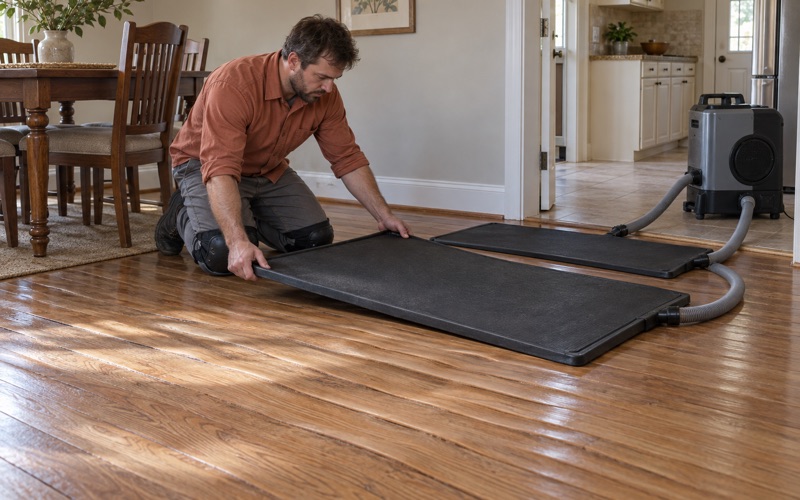
Floors of this age tend to show wear in predictable places: gray boards in front of the kitchen sink, sun fading near sliding doors, finish peeling where a pet bowl sat, and seasonal gapping that opens during dry months. Each has a different cause, so the moisture reading and the location of the damage decide whether we recoat, repair or replace.
A cloudy finish or white haze over an otherwise sound floor often responds to a buff and coat instead of a full sand. That leaves more wood on the floor for the future and costs less now. We also say plainly when recoating would only hide a problem that really needs sanding or board work.
Finishes that are legal to apply here
Whatever the age of the house, the finish has to be legal to apply in the South Coast Air Quality Management District, where the wood coatings VOC limit under SCAQMD Rule 1113 is 275 grams per liter. We pick waterborne polyurethane, oil-modified polyurethane or hardwax oil from compliant products and give you a cure time before rugs return.
Arcadia and Monrovia ZIPs on County Land
Mayflower Village mail carries an Arcadia 91006 or Monrovia 91016 ZIP code, but the community is unincorporated Los Angeles County territory and has been counted as its own census-designated place since the 1980 census. The postal city printed on your mail does not decide who reviews construction work on the house, a point that confuses plenty of owners.
County jurisdiction for building work
Building work here falls under Los Angeles County Public Works, Building and Safety, and Los Angeles County Code Title 26, which adopts the 2025 California Building Code with county amendments. The county runs a San Gabriel Valley office at 125 S. Baldwin Ave. in Arcadia, though it is worth confirming which county office handles your address when you call.
When a job reaches past the floor surface into subfloor, joists or framing, we raise the permit question with the county instead of guessing at an answer. Telling the county that the home sits in unincorporated territory, not in the city named on the envelope, gets a structural repair question to the right reviewer from the start.
Earthquake Brace + Bolt eligibility by ZIP
Both ZIP codes serving Mayflower Village, 91006 and 91016, appear on the 2025 California Earthquake Brace + Bolt list for Southern California. The program sets eligibility by ZIP code only, with a city shown for reference, so a Mayflower Village address is not ruled out because it is unincorporated or because its postal city differs from where it sits.
A listed ZIP is where eligibility starts, not where it ends. Whether a particular house fits the program depends on how it was built, and the program makes that call rather than a flooring crew. We can’t tell you a home qualifies, and we don’t assume what kind of foundation sits under a floor we haven’t opened.
When a floor problem points below the boards
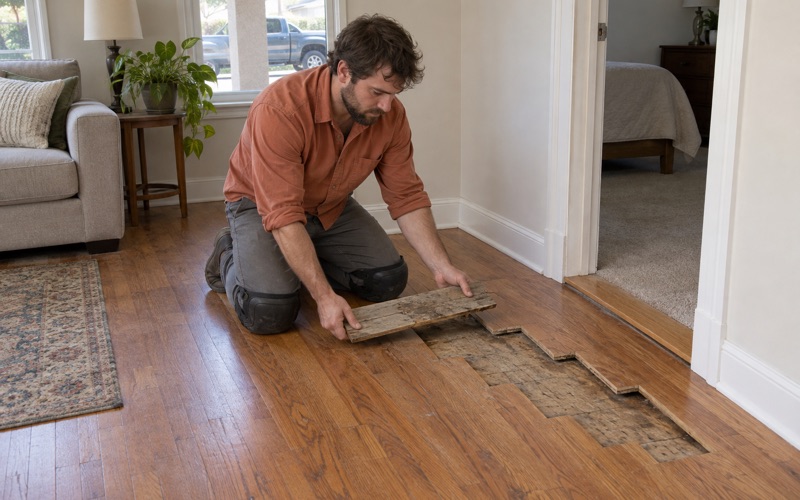
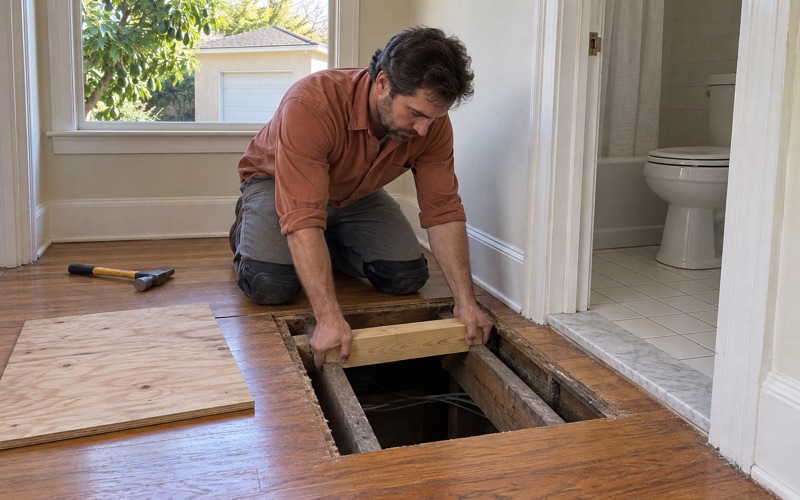
A sagging floor, a soft spot, nail pops or squeaks that keep coming back can all trace to framing instead of the wood on top. Where the structure is accessible, we check floor joists and subfloor for rot or movement before replacing boards, and a sister joist or rotted subfloor repair goes into the scope as its own line.
If seismic retrofit work and floor work are both planned for the same year, tell us early. Sequencing matters, because refinishing a floor and then sending another crew through the house invites scratches and dust nibs in a fresh finish. A written schedule that puts the messier work first protects the floor you just paid to refinish.
- 20+ Years in Wood Floors
- Free Written Estimates
- Rental and Claim Documentation