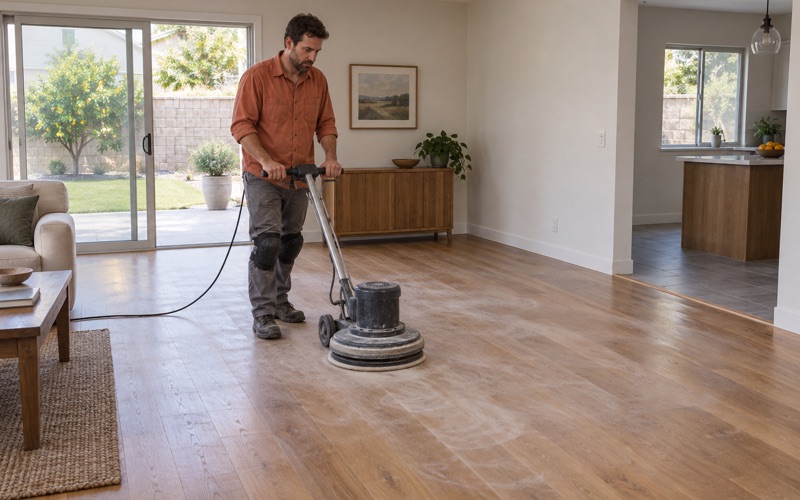
Baldwin Park Wood Flooring handles wood-flooring in Monrovia with more than 20 years of sanding, repairing and installing floors behind us, and every job starts with one question: how old is this floor, and how was it built? The answer decides whether a room gets a sanding, a targeted repair or a new floor, so we settle it before a price goes on paper.
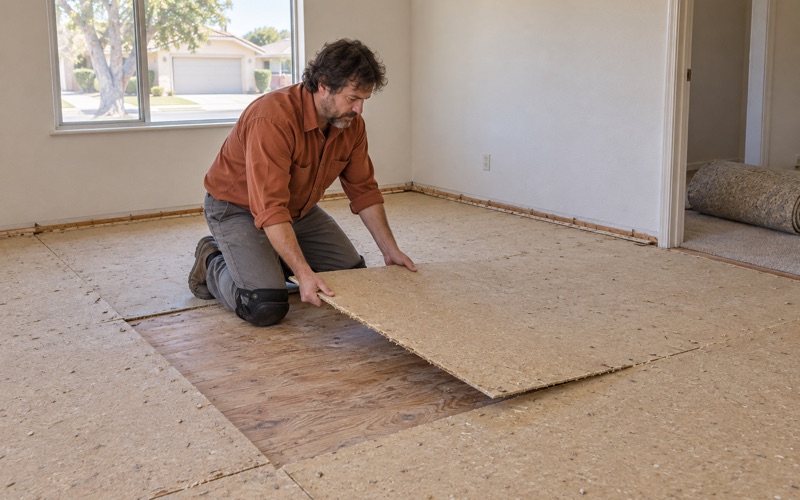
That is why we pull the carpet back in one corner before quoting, so the estimate reflects the oak, plywood or particle board actually sitting there. It is also why we check the build year before scheduling any sanding, since the date of the house shapes which rules apply to the old finish and to the paint on the trim.
The sections below walk through how we read a floor’s generation, what the city’s own preservation rules do and do not tell us, and how the right choice shifts from an early strip floor to a recent engineered install. Each decade leaves different evidence underfoot, and reading it correctly costs far less than guessing wrong.
A City Whose Floors Come From Every Decade
What the housing count shows
Monrovia’s housing stock does not belong to one era. Census estimates count 14,855 housing units in the city, and 16.7 percent of them were built in 1939 or earlier. Another 19.4 percent date to the 1950s, 22.4 percent to the 1970s and 1980s combined, and 11.8 percent to 2000 or later (ACS 2024 5-year, table B25034).
For a flooring contractor that spread matters more than any one figure, because a crew cannot walk in assuming what is under the carpet. A prewar strip floor, a postwar oak floor and a post-2000 engineered plank each call for a different first move, and the wrong assumption usually shows up later as a change order.
Why we date the floor before the house
The age of the house is a starting clue, not the whole answer. An older home may carry a floor laid decades after it was built, and a newer addition may sit beside original boards. We look at board width, fastening, the subfloor and the finish to decide which generation of floor is actually in each room.
That identification drives everything after it. It tells us whether the boards are solid hardwood thick enough for another sanding, whether an engineered veneer can only take a screen and recoat, and whether a layer of parquet, laminate or luxury vinyl plank has been hiding an older floor. The quote follows from what we find, room by room.
Pre-1978 layers and the lead-safe rule
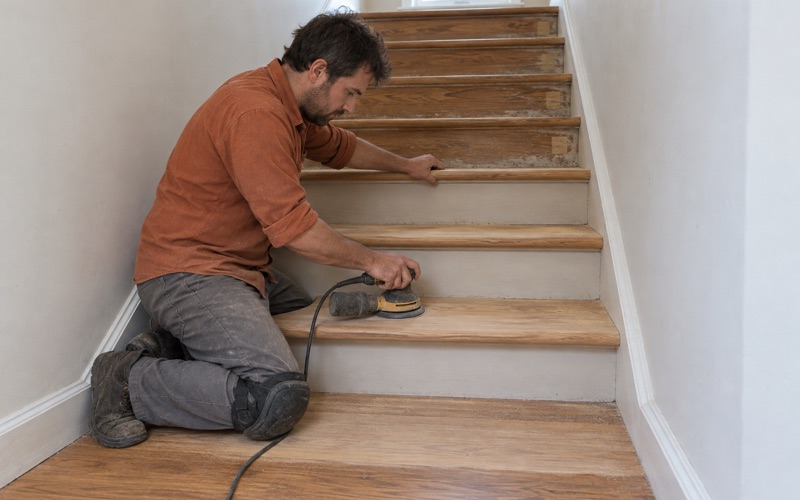
Census estimates put 70.1 percent of Monrovia’s units in buildings from before 1980. The EPA Renovation, Repair and Painting Rule covers pre-1978 housing, and sanding near painted baseboards, shoe molding or stair risers in those homes can disturb old coatings. We confirm the build year before any sanding is booked, so containment and cleanup are planned from the start.
The 1978 cutoff and the 1980 census boundary do not line up exactly, so that percentage is a guide rather than a count of covered homes. For a specific house, the build year on record settles the question, and we treat that check as part of the estimate instead of a step added after the drum sander arrives.
Looking for wood-flooring closer to Hacienda Heights? See Wood-Flooring in Hacienda Heights.
Reading an Older Floor Before Anyone Sands It
A corner of carpet tells us a lot
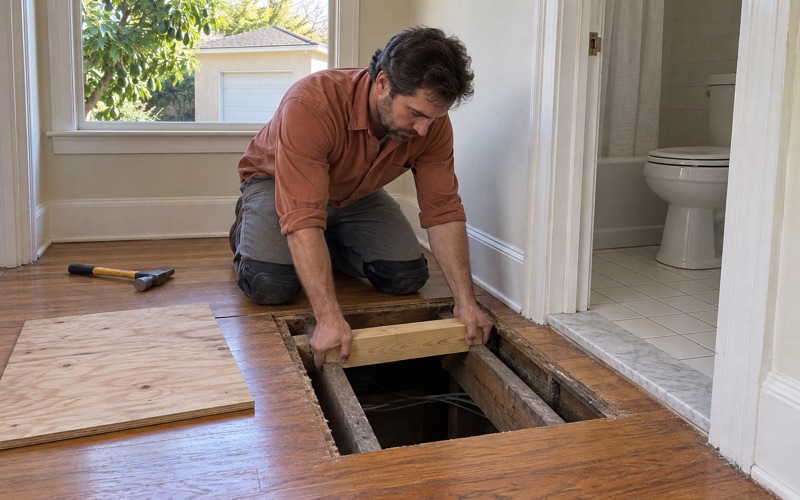
Much of the older flooring we see sits under wall-to-wall carpet. We fold back one corner, usually in a closet or along a wall, to see whether there is oak strip flooring, a plywood subfloor, particle board or a layer of black mastic and 9x9 floor tile underneath. The estimate is written for that material, not for a guess.
The same look shows the damage carpet leaves behind: tack strip holes around the perimeter, rows of carpet staples, and a carpet pad stain where the pad broke down. When a carpet-to-wood job goes ahead, we repair those marks as part of the scope rather than leaving them for a rug to cover.
Boards, nails and subfloor clues
Narrow red oak strips blind-nailed over a diagonal board subfloor point toward an older install. Wider planks over plywood, or a floating floor with no fasteners at all, point toward something much newer. Hollow spots, squeaks and nail pops tell us how the floor is held down and whether the structure below has moved over the years.
Small holes and powdery piles get a closer look before any board comes out. Drywood termite pellets, powderpost beetle frass and plain old nail holes can look alike at a glance, and each one leads to a different answer. Replacing boards without knowing which we are dealing with only moves the problem somewhere else.
How much wood is left to sand
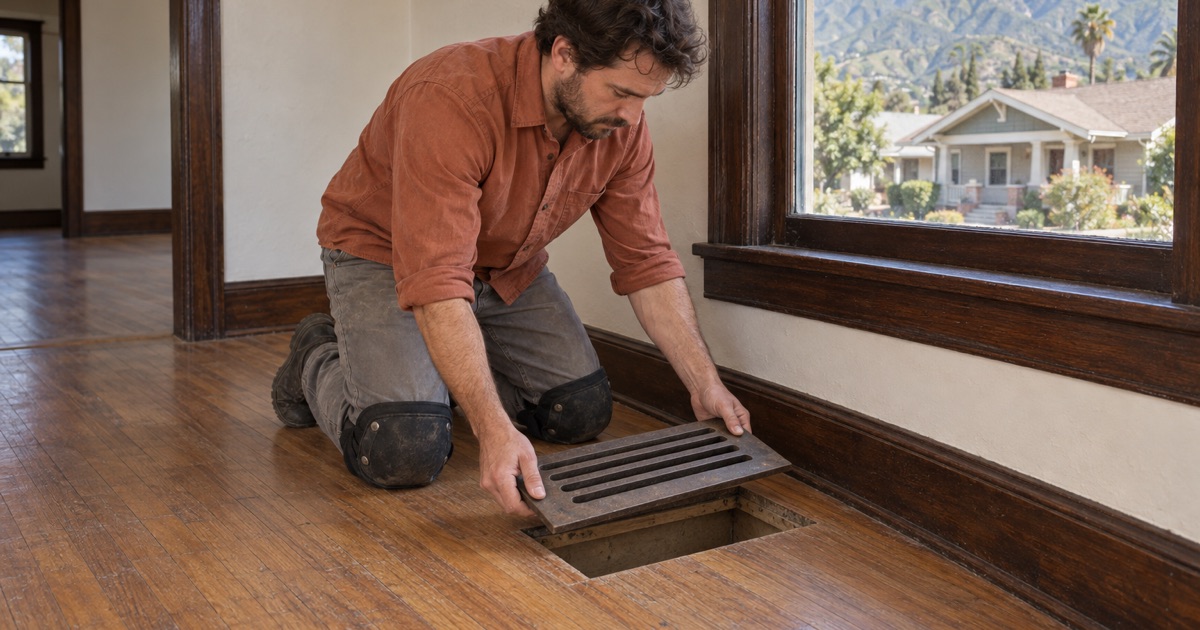
A solid hardwood floor that has been sanded several times may have little wood left above the tongue. We check an exposed edge at a floor vent or threshold to see the remaining thickness before recommending a full sand. On engineered hardwood we measure the wear layer thickness, because a thin veneer can take a screen and recoat but not a sanding.
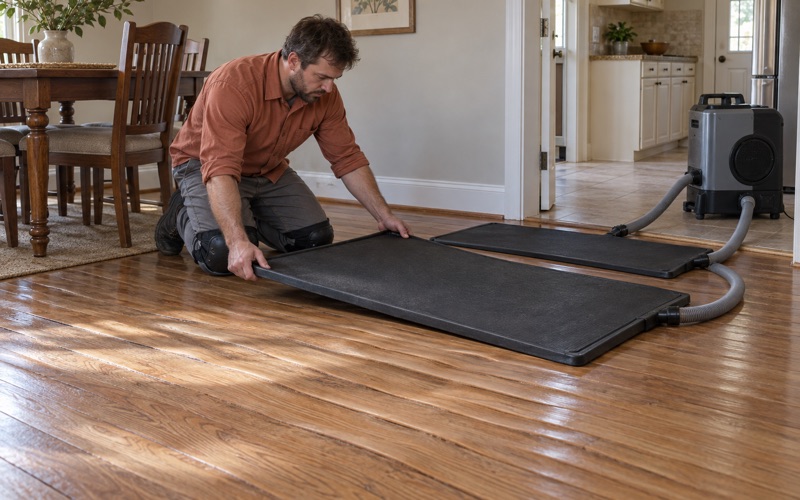
Old finishes tell their own story. An orange floor finish or a sticky finish often marks an aging oil-based coat, while finish peeling or a white haze can point to a recoat that never bonded. Knowing what is on the floor now decides how aggressive the abrasive grit sequence has to be at the start.
Prewar Floors and Monrovia’s Pre-1940 Review
What the city’s preservation rules say
Monrovia adopted its historic preservation ordinance in 1995, and the Wildrose Tract is its one historic district. According to the Los Angeles Conservancy, the city also reviews demolition requests for all pre-1940 structures and can place a 180-day hold on issuing demolition permits. A Mills Act property tax abatement program is available to landmarked properties.
That review concerns demolition requests. It is not a flooring rule, and we do not present it as one. What it does show is that the city treats its prewar buildings as worth a second look, which is a fair signal for owners weighing how much original material to keep inside those homes.
Interior floors remain an open question
We have not read the ordinance text itself, so we do not tell owners that interior floors are or are not reviewed. A 2010 Monrovia Patch column described landmark review as covering the exterior within public view, and said it was only hoped that Mills Act owners would keep interiors historically appropriate. That is a dated secondary source, not settled law.
If a house is landmarked, under a Mills Act contract or inside the Wildrose Tract, the owner should confirm the current rules with the city before work begins. Permit questions on any project go to the City of Monrovia Community Development Department, Building and Safety Division, which is the office that can answer them.
Working on a prewar strip floor
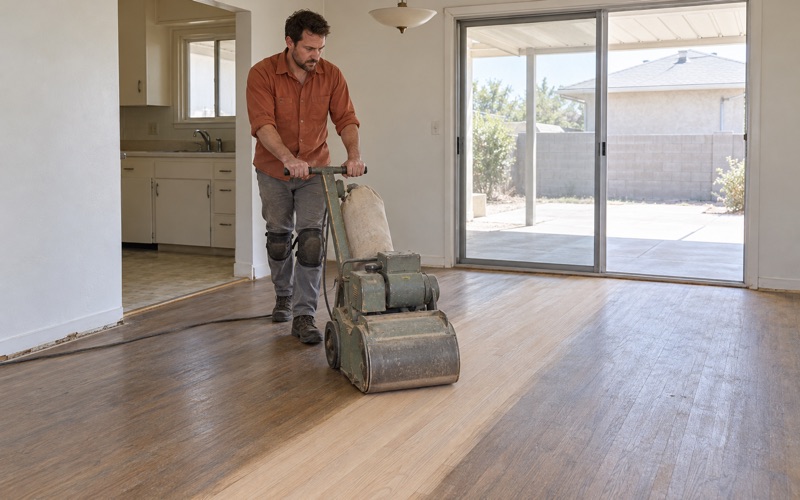
Floors in prewar houses have often been sanded more than once, patched at old wall lines and refinished with several generations of coating. We map those patches, test the finish and check board thickness before recommending a sanding. Where the tongues are close to showing, a careful buff and coat may keep the floor in service longer than another sanding would.
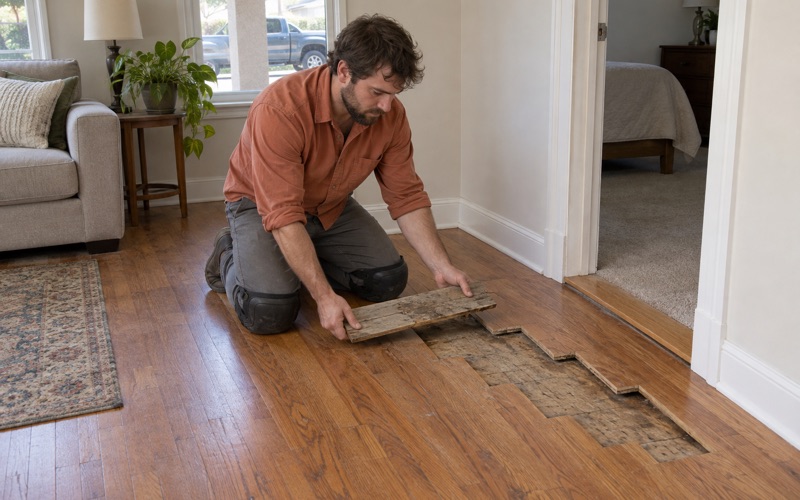
When boards are damaged, a weave-in repair with matching strips keeps the original floor instead of dropping in a square of new plank. We choose stain and sheen level after a test patch, because aged red oak and white oak rarely take color the way new boards do, and a mismatch shows plainly in daylight.
Postwar, Later and Newer Floors: Choosing the Right Fix
1950s and 1960s oak
Floors from the 1950s and 1960s are often oak strip flooring that spent decades under carpet. Many still have enough wood for a full sand once the tack strip holes and staple rows are filled. Refinishing is usually the first option we price for these rooms, with board replacement reserved for spots where water or pests have reached the wood.
These houses fall under the pre-1978 lead-safe rule, so containment around painted trim is part of the plan. For the finish, we use products legal in the South Coast air district, where the wood coatings limit is 275 grams per liter, and choose between waterborne polyurethane and oil-modified polyurethane with the household’s cure time in mind.
1970s and 1980s layers
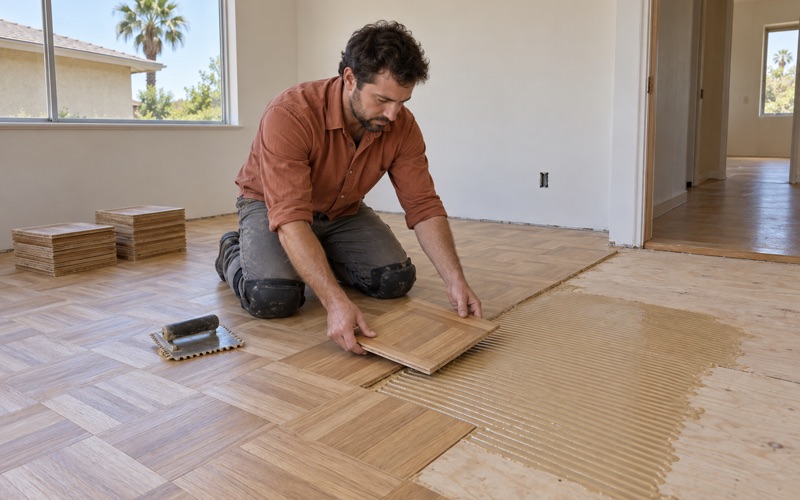
Homes from the 1970s and 1980s bring the widest mix: parquet tile set in adhesive, linoleum adhesive left from sheet flooring, and plywood or particle board subfloor under carpet. Loose parquet can often be reset, while particleboard edge swell from an old leak usually means that section of subfloor has to be replaced before any wood goes down.
Old black mastic and 9x9 floor tile call for an asbestos survey before anyone scrapes or grinds, in line with SCAQMD Rule 1403. We do not treat those layers as simple demolition. Once the subfloor is sound, a new solid or engineered hardwood floor is often a cleaner answer than trying to save a worn-out parquet floor.
Floors installed after 2000
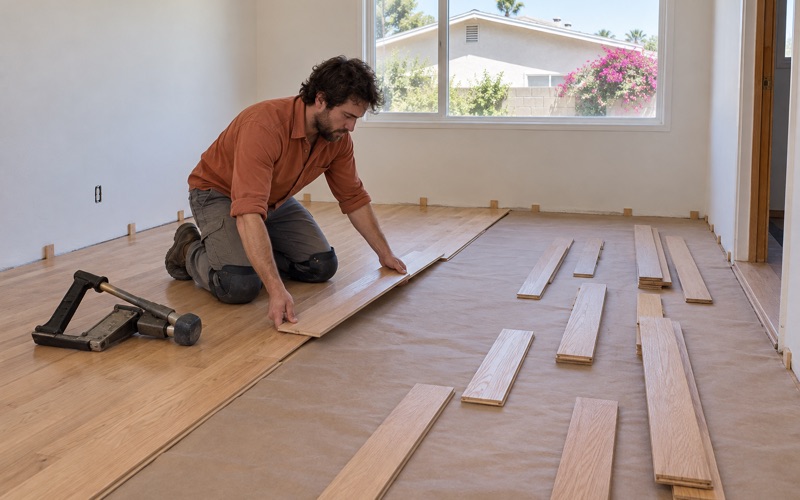
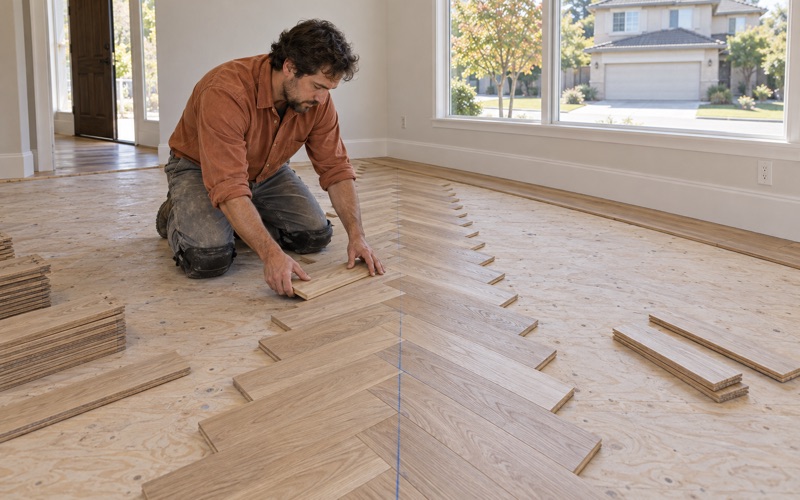
Newer homes and remodels often carry prefinished engineered hardwood, laminate flooring or luxury vinyl plank. Many engineered floors have a wear layer too thin for a drum sander, so a screen and recoat is the usual refresh. Laminate and vinyl cannot be refinished at all, which makes board replacement or a new floor the realistic choice.
On a floating floor, cupping, crowning or buckling usually traces back to moisture or a missing expansion gap, and we check with a moisture meter before replacing anything. For glue-down engineered planks over slab-on-grade, an ASTM F2170 in-situ relative humidity test comes before a new install, so the same failure does not return.
Rental floors between tenants
Renters occupy 53.7 percent of Monrovia’s occupied units, and 2,604 renter households rent a detached house (ACS B25003 and B25032). Those rental floors can come from any of the eras above, so the same identification step applies between tenants. We quote with move-out photos and a written scope a landlord can keep with the deposit records.
That paperwork helps separate normal wear and tear from damage when a security deposit itemized statement is prepared under California Civil Code 1950.5. A pet urine stain or black water stain that has soaked into the wood usually needs board replacement, while light traffic wear on a sound floor can often be handled with a screen and recoat.
- 20+ Years in Wood Floors
- Free Written Estimates
- Rental and Claim Documentation