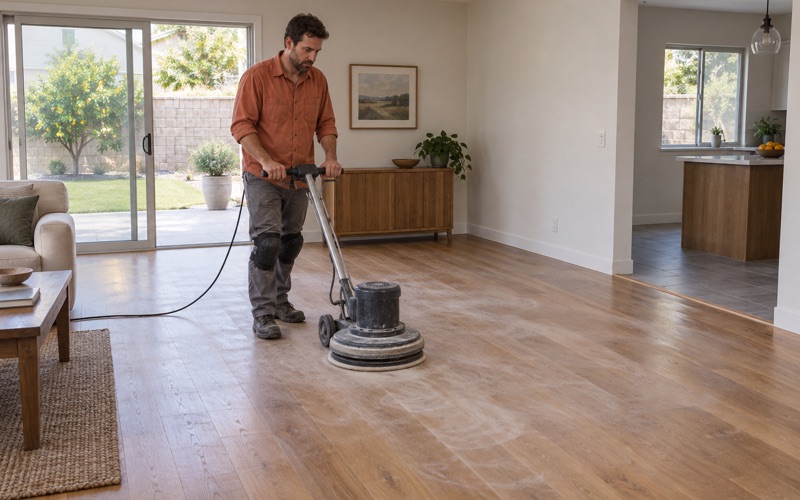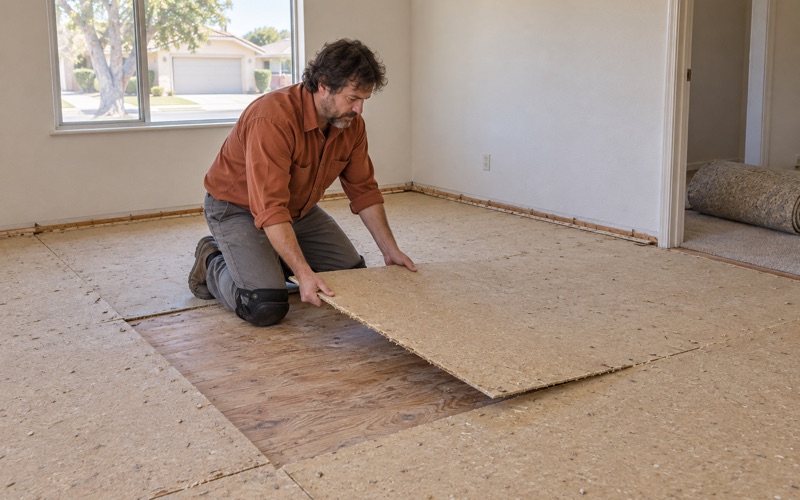
Baldwin Park Wood Flooring handles wood-flooring in Santa Fe Springs with more than 20 years of repair and refinishing work behind us, and many of the floors we see here need fixing before they need a new coat. Loose boards, soft spots, old pet stains and small holes come first. Sanding comes after the floor underneath is sound.
Before we write a number, we lift the carpet at one corner and look at what is really there, whether that is oak strip flooring, plywood or particle board. That look ties the estimate to the actual floor instead of a guess. When a room has been carpeted for decades, the tack strip holes, staple rows and pad stains go into the same scope rather than under a rug.
We also sort out what made a hole before we pull a board. Drywood termite pellets, beetle frass and old nail holes can look alike at a glance, and each one leads to a different repair. The sections below cover how that plays out in older owner houses, in rental units, and under the coating rules our crews follow.
What the City Says Its Older Houses Need
A housing stock built largely in one decade
Census figures show how much of the housing here comes from one era. The ACS 2024 five-year estimates count 2,682 of 5,927 housing units, or 45.3 percent, built from 1950 through 1959, and 50.6 percent built before 1960. The city incorporated on May 15, 1957, and its housing element notes that most residential growth happened during the 1950s.
For a floor, that age matters in plain ways. A house from that decade may have had its original oak sanded several times, covered with carpet, or patched after a plumbing job. We do not assume which of those happened. We check the boards, the wood left above the tongue and any old patches before deciding whether a refinish is still realistic.
Termite repairs on the city’s own rehab list
The city’s 2013 public-review draft of its housing element describes much of the aging stock as needing rehabilitation. Its list of typical improvements includes roof replacement, pipe and sewer line replacement, and ‘termite damage repairs, and extermination.’ That is a general list from housing staff, not a survey of floors, and it does not say how many houses have that kind of damage.
What it does tell us is that termite repair is a recognized category of work in the older houses here, so we look for signs of it rather than guess. If a Wood Destroying Pests and Organisms Inspection Report already exists from a sale or a tent fumigation, we read it before quoting. It can explain a replaced threshold or a patched hallway that would otherwise be a mystery.
Repair first, refinish second
Because of that history, our jobs in these houses tend to be restoration work rather than a first-time refinish. A board with kick-out holes or crushed fibers under the finish cannot be sanded back to health. It has to come out, and the replacement has to match in species, width and grain direction so it disappears once the whole room is sanded and coated.
That order also protects the budget. Sanding a floor and then finding a soft spot means a second round of sanding over the repaired area, plus extra finish coats. Finding it first, with a moisture meter and a slow walk across the room listening for hollow spots and squeaks, lets us quote one sequence of work from start to finish.
Looking for wood-flooring closer to Commerce? See Wood-Flooring Services in Commerce.
Repairing Damaged Boards Before a Refinish
Telling pellets from frass from nail holes
Small holes and fine powder near a baseboard can mean several different things. Drywood termite pellets are hard, ridged and fairly uniform, and they tend to collect in small piles below kick-out holes. Powderpost beetle frass is softer and closer to flour. Old nail holes from a previous carpet install are clean and evenly spaced along a wall line.
We identify which one we are looking at before replacing anything. Active insects are a pest control question, and we ask the homeowner to settle that first so new boards are not laid over an ongoing problem. Old, inactive damage is our job, and the repair plan depends on how far the damaged wood runs under the surface.
Weave-in repairs on oak strip floors
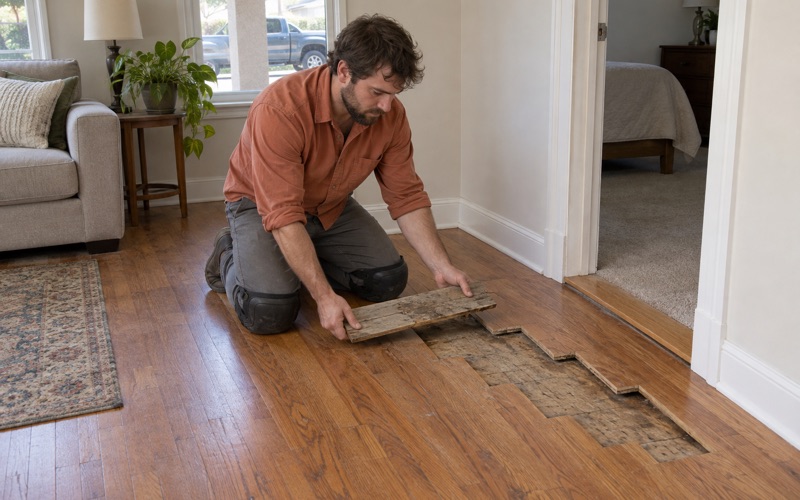
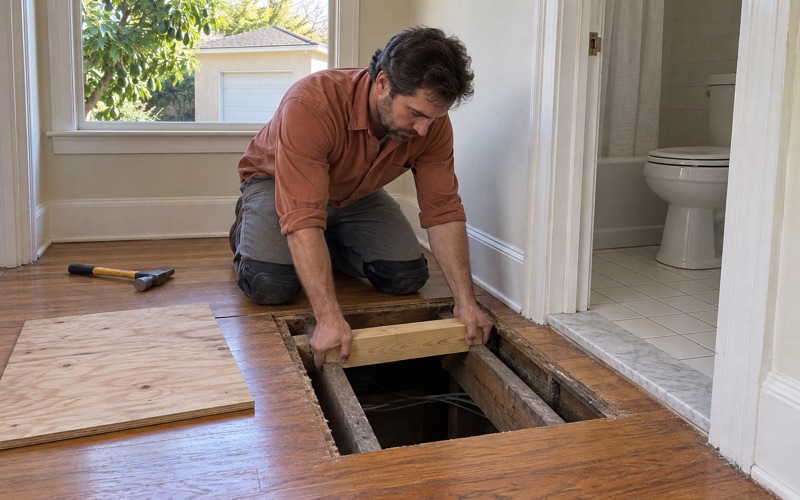
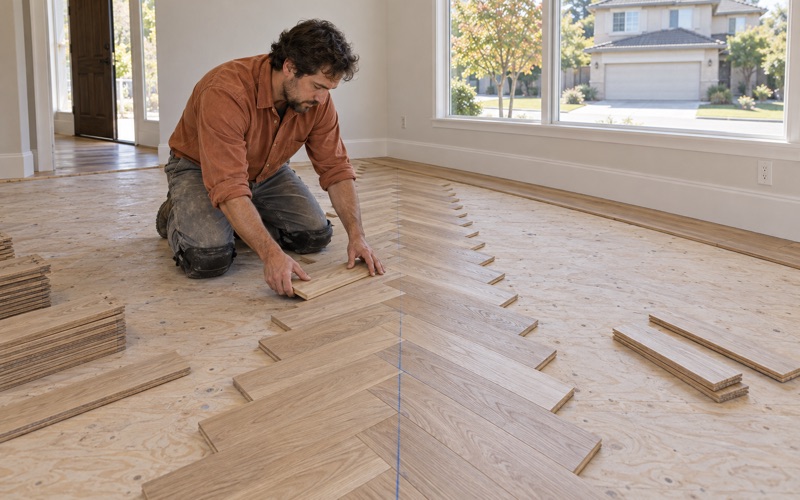
Oak strip flooring from that era can usually be fixed with a weave-in repair, where damaged boards are cut out at staggered lengths and new boards are toothed into the existing rows. Done correctly, the joints fall in a random pattern like the original install. Done as a straight-line patch, the repair shows through every finish coat for as long as the floor lasts.
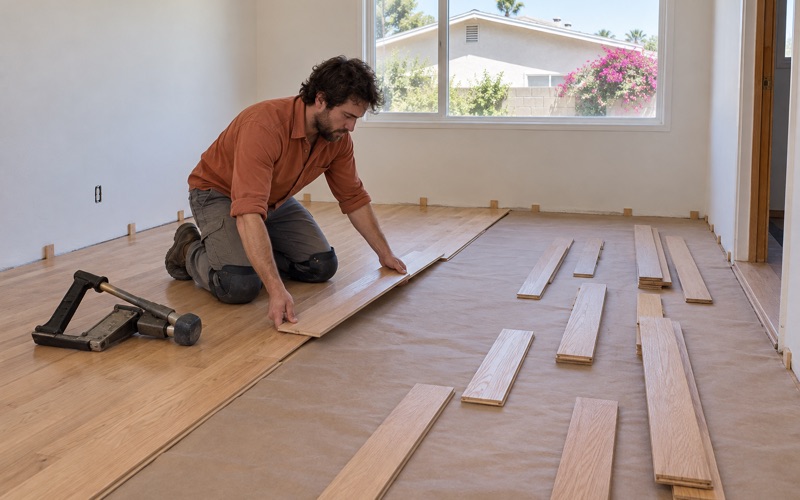
We match red oak to red oak and white oak to white oak, since the two take stain differently and a mismatch turns obvious once color goes on. Salvaged boards from a closet can be the closest match for an older floor. New boards go down on a proper nailing schedule, with cleats sized for the tongue so it does not split.
Subfloor and joist problems are a separate step
Sometimes the damage runs past the flooring. A sagging floor, a soft spot that moves under a heel, or a rotted subfloor near a bathroom points to structure rather than surface. Replacing top boards over a failing subfloor or floor joist only hides the problem until the new boards start to cup, crown or pop their nails.
Structural repair such as sistering a joist or replacing subfloor sections can involve permit review, so we do not treat it as a routine flooring task. We check with the City of Santa Fe Springs Building & Safety Division before that part of the work is scheduled. Its counter at 11710 E. Telegraph Road issues permits, and the city currently uses the 2025 California Building Standards Code.
Owner Houses and Rentals in an Industrial City
A small residential share of a working city
Santa Fe Springs is one of the Gateway Cities of southeast Los Angeles County, and most of its land serves industry and commerce. The housing element states that less than ten percent of the city’s nine square miles is designated residential, with neighborhoods historically concentrated in the western portion and small pockets along the eastern boundary.
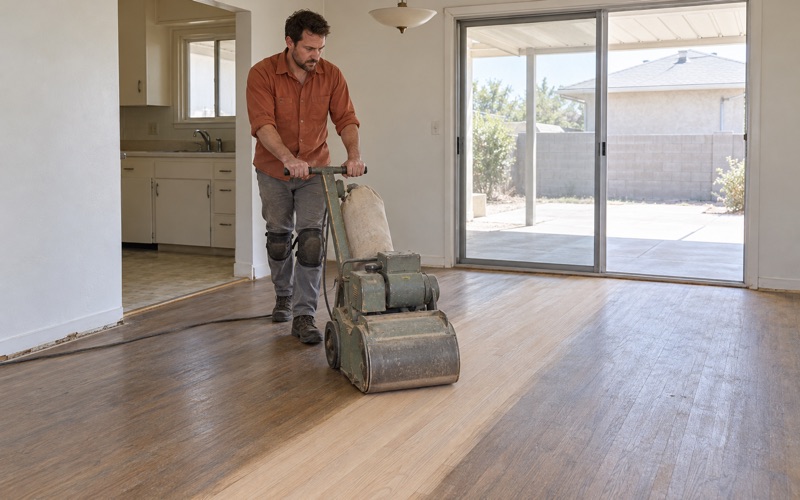
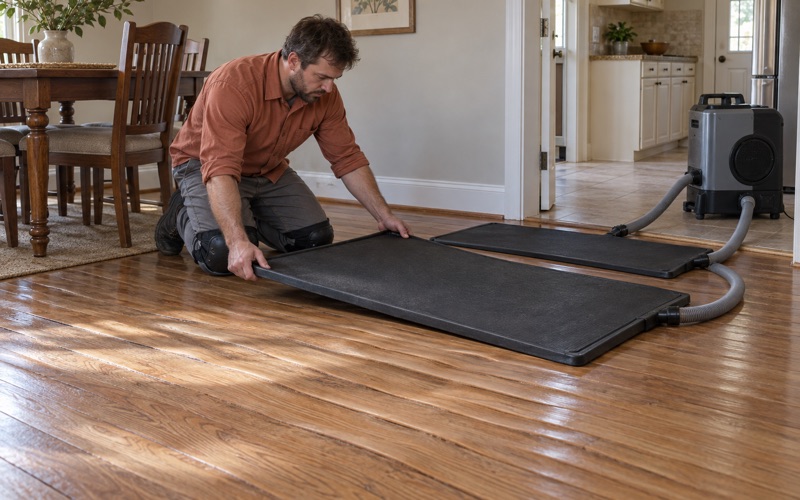
That shapes how a job runs. With so little land set aside for homes, residential streets can sit near commercial and industrial parcels, so we plan deliveries and debris removal around a tight footprint. Dustless sanding with vacuum-connected drum sanders and edgers keeps fine dust inside the collection system instead of drifting through the house or onto the next driveway.
Detached houses lived in by their owners
Owners here mostly live in detached houses. ACS 2024 five-year table B25032 counts 2,917 of 3,466 owner households, or 84.2 percent, in one-unit detached homes. For us that usually means talking with the person who will live on the finished floor, and that changes the priorities of a restoration compared with a quick cosmetic job.
Owners who plan to stay ask different questions than sellers. They want to know how the finish will hold up, how many more sandings the boards can take, and where family members will sleep while coatings cure. We hand them a written room-by-room schedule showing when furniture, rugs and people can return to each space.
Rental units and the city’s inspection program
Of the 5,716 occupied units here, 2,250 are renter-occupied. The 2013 housing element draft described a rental inspection program that called for annual inspection of rental units, alongside a property maintenance ordinance carried out by the Code Enforcement Division. That description is dated, and we have not confirmed how the program runs today, so landlords should check current requirements with the city.
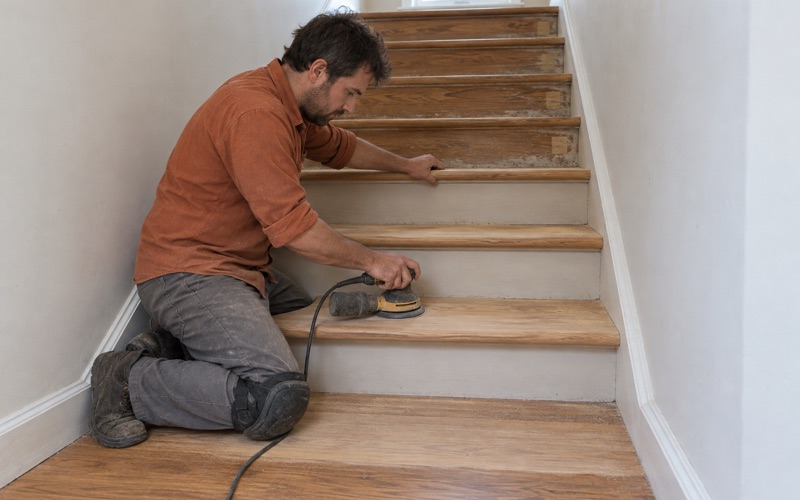
What we can offer between tenants is documentation. We quote a rental floor with move-out photos and a written scope a landlord can keep with the deposit records, which helps separate normal wear and tear from damage on a security deposit itemized statement under California Civil Code 1950.5. Stairs are priced by tread, riser and nosing rather than folded into square footage.
Finish and Coating Rules That Apply Here
South Coast AQMD limits on wood coatings
Santa Fe Springs sits within the South Coast Air Quality Management District, the air pollution control agency for all of Orange County and the urban portions of Los Angeles, Riverside and San Bernardino counties. Its Rule 1113 sets VOC limits for coatings, and the wood coatings limit under that rule is 275 grams per liter.
We choose sealers, stains and topcoats from products that are legal to apply in the district. Waterborne polyurethane is a common choice for that reason, and it stays clear rather than ambering the way some older finishes did. Oil-modified polyurethane and hardwax oil can still suit certain floors, as long as the specific product meets the limit for its category.
Lead-safe checks on older finish layers
Given how much of the housing here predates 1960, floors in the oldest houses can carry decades of finish, paint overspray and patching. Pre-1978 housing falls under the EPA Renovation, Repair and Painting Rule when painted surfaces are disturbed, so we check the build year before any sanding date goes on the calendar.
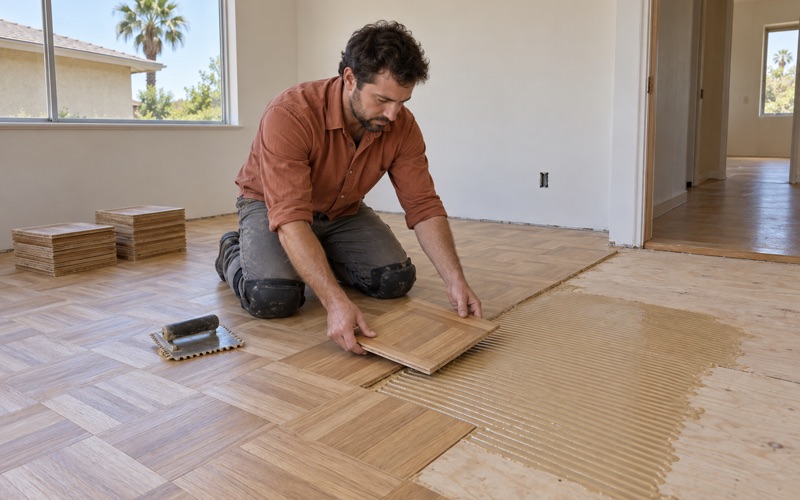
That check shapes containment, cleanup and who stays in the house during the dusty stages. It also matters for old adhesive. Black mastic under 9x9 floor tile from that era can call for an asbestos survey under SCAQMD Rule 1403 before removal, so we flag it before anyone starts scraping toward the wood below.
Screen and recoat, or a full sand
Not every older floor needs a full sanding. If the boards are sound and the finish is only dull or lightly scratched, a screen and recoat adds fresh finish without removing wood. On engineered hardwood, we measure the wear layer before promising a sand, since a thin veneer can take a recoat but not a pass with a drum sander.
Where a solid floor has already been sanded several times, we look at the board edges and the wood above the tongue before choosing. Cutting too deep risks sand-through and exposed nail heads. When enough wood remains, a careful grit sequence, stain if wanted and fresh coats of finish can carry a repaired 1950s floor into many more years of daily use.
- 20+ Years in Wood Floors
- Free Written Estimates
- Rental and Claim Documentation