Baldwin Park Wood Flooring handles wood-flooring in South Monrovia Island for owners and landlords alike, and after 20+ years in the trade we know the floor we get called about is often in a house sitting between tenants. Refinishing, board repair, carpet removal and new installation all start the same way: with a look at what is actually under the room before anyone names a price.
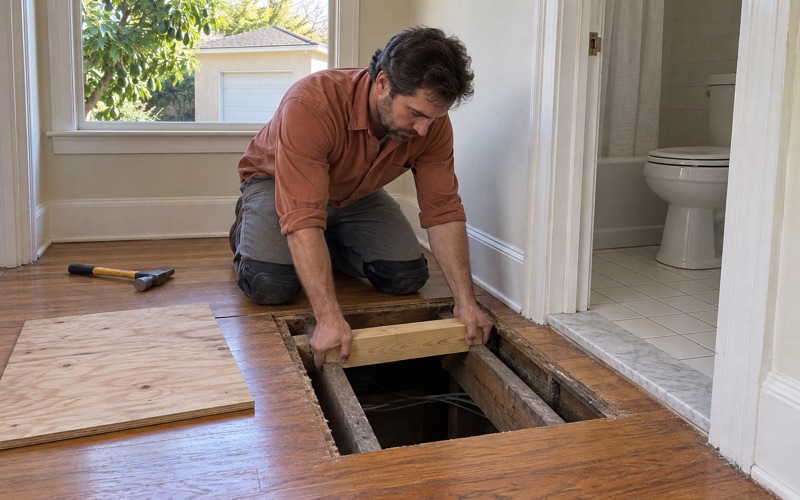
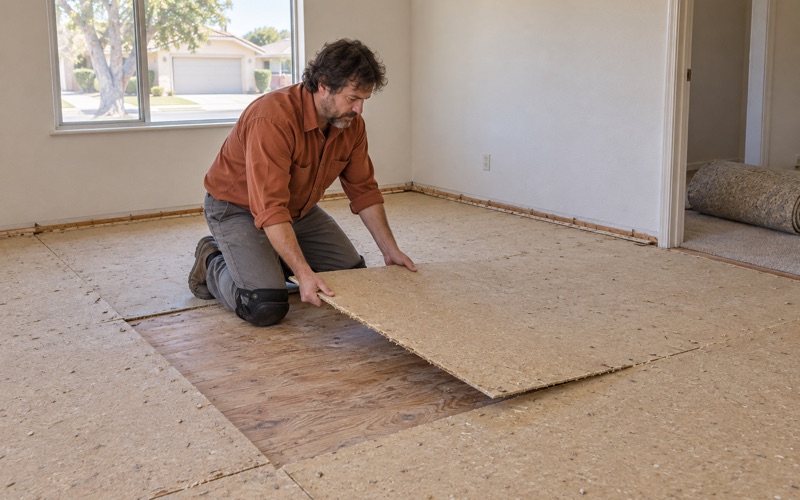
That look is literal. We fold back a corner of carpet before quoting, so the number reflects oak strip flooring, a plywood subfloor or particle board rather than an assumption. On an engineered floor we measure the wear layer first, because a thin veneer can handle a screen and recoat but will not survive a full sanding with a drum sander.
Every finish we apply is chosen from products legal in the South Coast air district, where the wood coatings limit sits at 275 grams per liter. The sections below cover how rental turnover shapes the work, what floors in older houses tend to hide, how attached homes change the job, and who handles building questions for these homes.
Houses People Rent, Not Apartments
A third of households rent
The rental picture here is unusual. According to the Census Bureau’s 2024 five-year American Community Survey, 544 of the 1,608 occupied housing units in South Monrovia Island are renter-occupied, about 33.8 percent. The margin of error on a community this small is wide, plus or minus 163 households, so we treat that share as a general shape rather than a precise count.
What stands out is the kind of home being rented. Of those 544 renter households, 408 rent a whole detached house, three quarters of all renters, while only 52 live in buildings with two or more units. A floor call here is far more likely to involve a living room, a hallway and several bedrooms than a single apartment unit.
Why a detached rental changes the floor job
A rented house gets used like an owned one, with kids, pets, patio traffic and furniture dragged along the same path for years. The difference is the timeline. The owner often sees the floor only at move-out, when pet urine stains, gray boards by the back door and sun fading around a missing rug all surface at once.
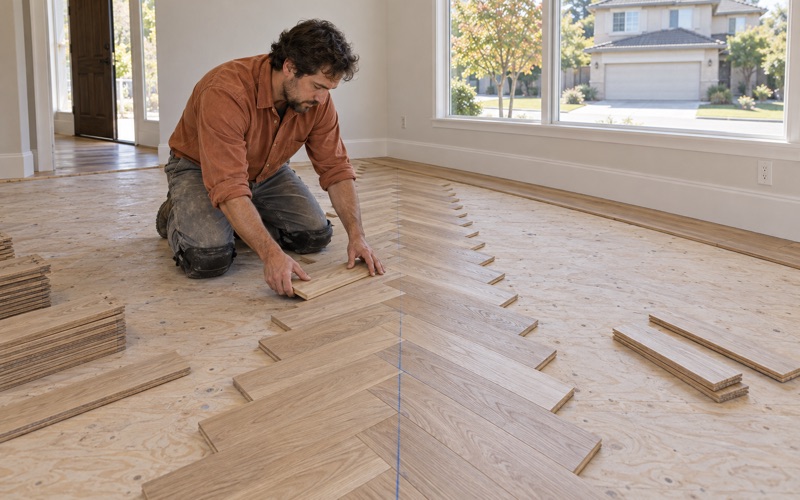
That makes the scope bigger than a typical apartment turn. Instead of one room of luxury vinyl plank, a landlord may be weighing a whole-house refinish of red oak strip, a few board replacements at the kitchen threshold and new quarter round where baseboards were pulled. We price each piece separately so the decision can be made room by room.
Owners who live in their homes
Two thirds of occupied units here are owner-occupied, 1,064 of them, and every one of those is a detached or attached single-family home. Owners tend to call about the same era of floor for different reasons: carpet they finally want gone, a cloudy finish after decades of wear, or squeaks and nail pops that have grown louder down the hallway.
Looking for wood-flooring closer to Mayflower Village? See Wood-Flooring in Mayflower Village.
Turning a Floor Over Between Tenants
Refinish or replace
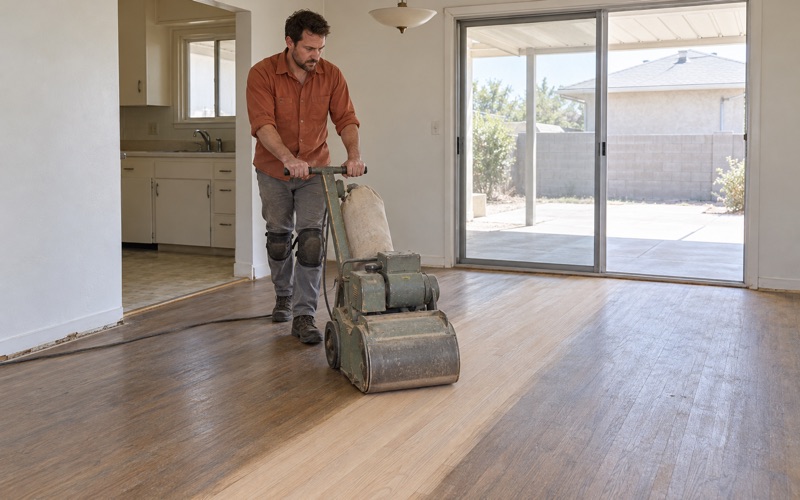
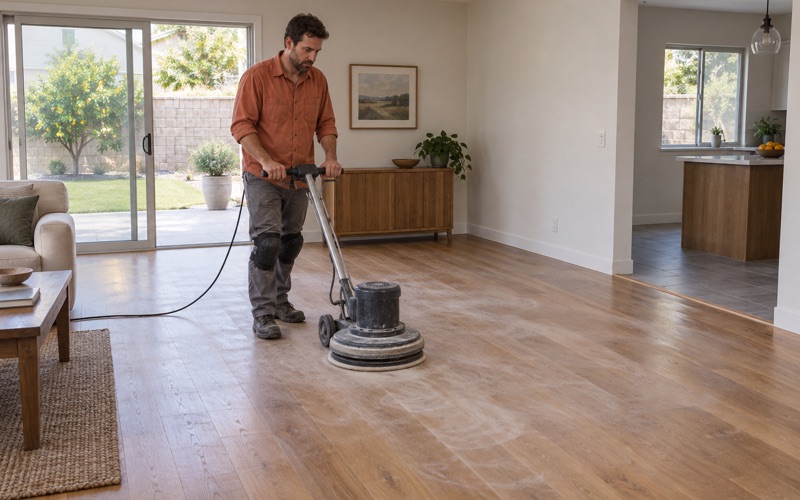
The central landlord question is whether the existing hardwood can be sanded again. Solid oak strip from the middle of the last century often has sanding left in it, and a full sand with fresh waterborne polyurethane can bring back a worn floor for far less than replacement. Deep black water stains, soft spots or sand-through from an earlier refinisher push the answer toward repair instead.
When a floor is only dull rather than damaged, a buff and coat between tenants may be enough. It takes less time off the rental calendar, since no bare wood is exposed, and it preserves board thickness for a later full sanding. We tell a landlord plainly which of those options the floor in front of us will actually support.
Paperwork a landlord can keep
Turnover work tends to end up next to a security deposit itemized statement, so we build the quote with that in mind. We work from the move-out photos, note each stain or gouge by room, and write a scope the owner can file with the deposit records. What counts as normal wear and tear under California Civil Code 1950.5 remains the owner’s decision, not ours.
The written scope also helps when a vacant house is on a tight schedule. We list which rooms get sanded, which need a board replacement, how long the finish cure time runs before furniture goes back, and when the house can be shown. A property manager can pass that sheet to the cleaning crew or the next tradesperson without a phone call.
Carpet pulled for the next tenant
Many turnovers begin with worn carpet coming out. Underneath we often find tack strip nailed through the perimeter of the oak, rows of carpet staples, and a carpet pad stain where a pet or a leak soaked through. We fill tack strip holes, pull every staple and treat the stains as part of the carpet-to-wood job, so the next tenant is not walking over old damage.
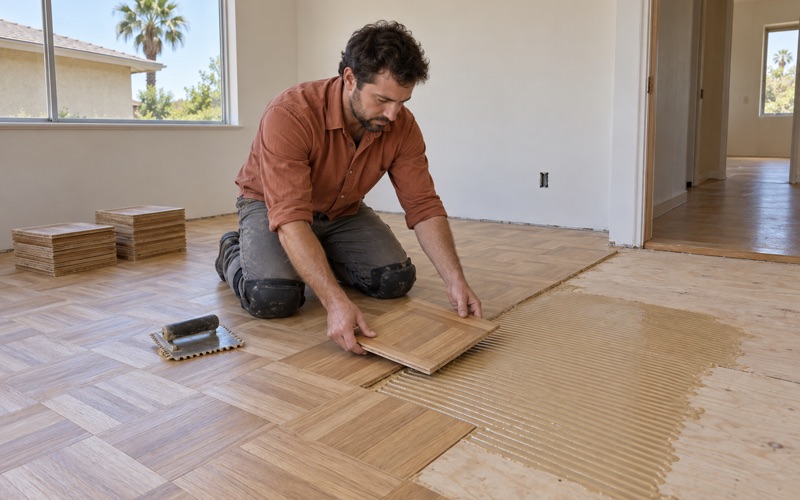
Where the layer under carpet is particle board instead of hardwood, the quote changes. Particleboard edge swell from past spills leaves raised ridges that telegraph through a new floor, so those panels have to be cut out or flattened before any engineered hardwood or floating floor goes down. We would much rather find that at the estimate than halfway through an install.
Floors in 1940s and 1950s Houses
A postwar housing stock
The build dates explain much of what we find. Census figures show 651 of the 1,608 units, 40.5 percent, were built from 1940 to 1949, and another 461 went up in the 1950s. Together, 69.2 percent of the housing stock dates from 1940 through 1959. Los Angeles County Planning describes the wider South Monrovia Islands group as mostly post-WWII tract housing.
Houses from that period commonly carry site-finished oak strip flooring, sometimes covered in later decades by 9x9 floor tile, linoleum adhesive or wall-to-wall carpet. The original floor may already have been refinished several times, so we check how much wood remains above the tongue before promising another full sanding. Where boards are too thin, a screen and recoat or a weave-in repair keeps the floor in service.
Old adhesives and lead-era finishes
About 84.3 percent of homes here were built before 1980, and that matters for sanding. The EPA Renovation, Repair and Painting Rule applies to pre-1978 housing, and paint overspray along baseboards or old finish layers can bring a job under it. We check the build year before a sander is scheduled, which counts most in a rental where a new family may move in days later.
Black mastic under old tile calls for the same caution. Some older floor adhesives and 9x9 tiles can contain asbestos, and SCAQMD Rule 1403 governs how asbestos-containing material is handled during renovation. When we lift old tile to reach the oak underneath, an asbestos survey comes before any scraping, grinding or sanding rather than after the dust is already in the air.
Pests, squeaks and seasonal movement
Small holes and powdery piles along a baseboard are not always the same problem. Drywood termite pellets, powderpost beetle frass and old nail holes each call for a different response, and we identify which one we are looking at before any board is pulled. A Wood Destroying Pests and Organisms Inspection Report from a pest company settles the question when there is doubt.
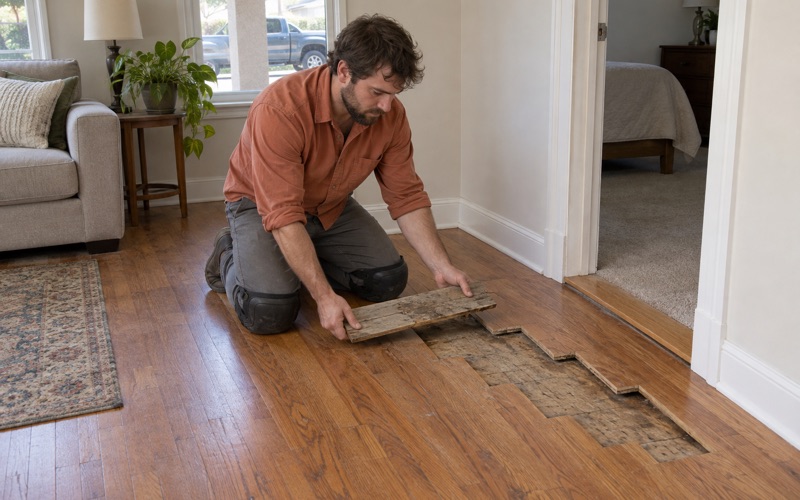
Squeaks, hollow spots and seasonal gapping are the other common signs of age. Drier months open small gaps between strips and damper stretches close them, so we take moisture meter readings and let replacement boards go through acclimation before they are woven in. The goal is a repair that moves like the floor around it through the whole year.
Attached homes and small buildings
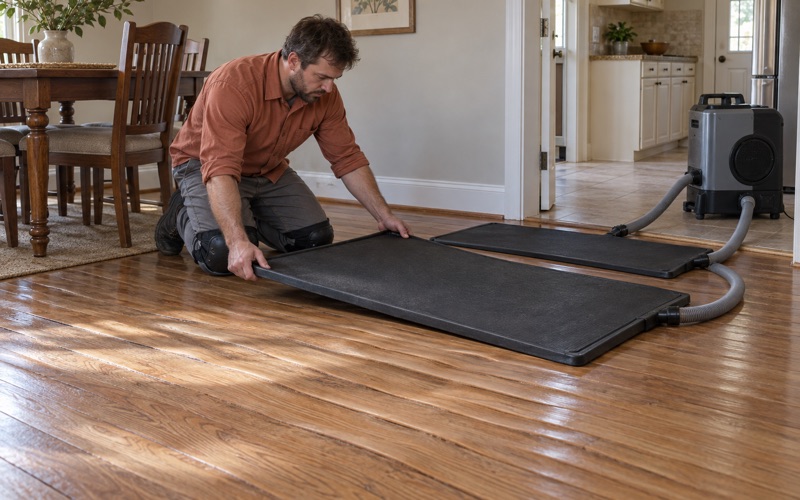
Not every house here stands alone. The census counts 176 one-unit attached homes, 10.9 percent of the stock, along with a handful of two-unit buildings. Attached units share a wall with a neighbor, so we plan dustless sanding, keep loud equipment to working hours and seal off the room being finished, since the household next door still lives through the job.
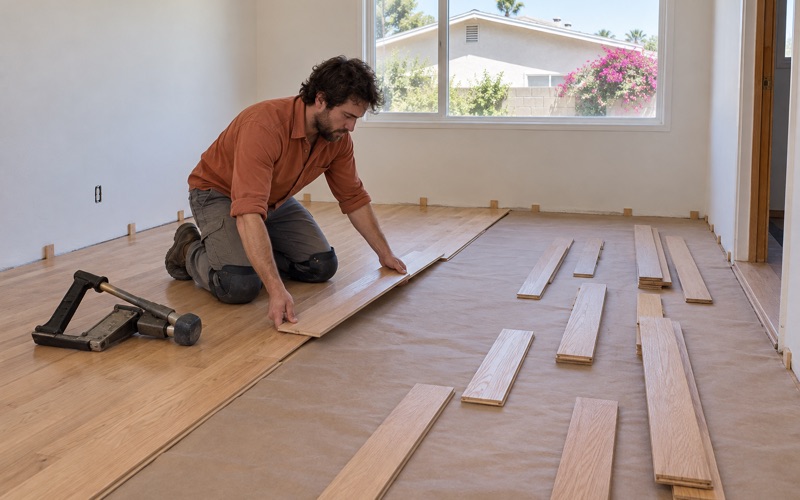
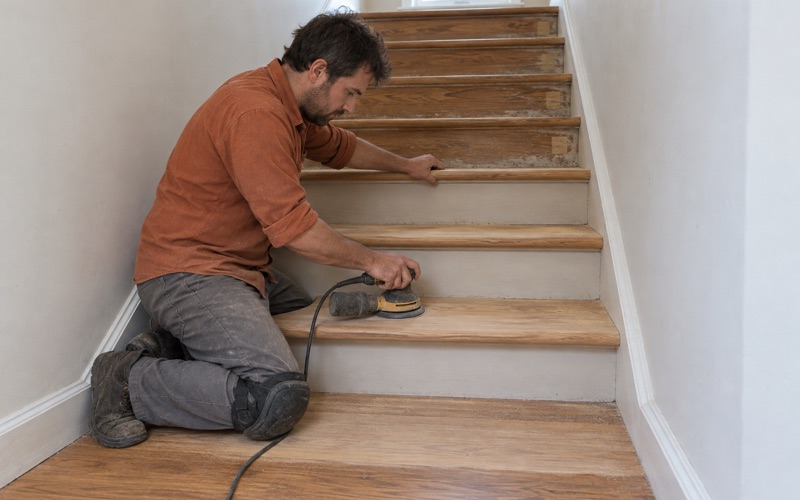
Shared walls also change how the edge of a floor is handled. We leave the expansion gap an engineered or floating floor needs along the party wall and cover it with shoe molding rather than pinning the boards tight. On stairs inside these units, we quote each stair tread, riser and nosing separately instead of folding them into a square-foot price.
A County Island Between Monrovia and Duarte
Who handles building questions
South Monrovia Island is an unincorporated census-designated place in Los Angeles County, bounded by Monrovia to the west and north, Duarte to the east and Irwindale to the south. It first appeared as a CDP in the 2010 census. Despite the name and the surrounding cities, these homes fall under county jurisdiction rather than either neighboring city.
Building questions go to Los Angeles County Public Works, Building and Safety, which keeps a San Gabriel Valley office at 125 S. Baldwin Ave. in Arcadia, though the county locator does not say which office covers this community. The county code is Title 26, adopting the 2025 California Building Code with county amendments. Whether a given subfloor or joist repair needs a permit is something we confirm with the county first.
Earthquake retrofits and floor timing
Floor work sometimes lines up with a seismic retrofit. California Earthquake Brace + Bolt sets eligibility by ZIP code, and ZIP 91016 appears on the 2025 Southern California list. Not every parcel here carries that ZIP, so an owner should confirm the home’s own address with the program. If cripple wall bracing is planned, doing it before a refinish keeps new dust off a fresh finish.
School-day schedules
The western part of the community is in Monrovia Unified and the eastern part in Duarte Unified, and households with kids often want the loudest work done while school is in session. We sequence sanding, sealing and final coats around that, and a written room-by-room schedule shows when rugs, furniture and people can return to each part of the house.
- 20+ Years in Wood Floors
- Free Written Estimates
- Rental and Claim Documentation