
Baldwin Park Wood Flooring has repaired subfloors for more than 20 years, replacing rotted plywood, swollen particle board and weakened joists under the floors of Baldwin Park, CA homes. We also serve surrounding cities including West Puente Valley, Vincent, South Monrovia Island, Mayflower Village and North El Monte.
The subfloor is the layer nobody sees and everything depends on. When it softens, sags or moves, the hardwood, tile or vinyl on top starts to squeak, crack, gap or lift, and replacing only the visible floor just repeats the failure. A proper repair starts under the surface.
We find the cause, whether that is a slow plumbing leak, a damp crawl space, insect damage or the wrong material under old carpet, then repair the structure and put the finished floor back so it stays flat and quiet.
Signs Your Subfloor Needs Repair
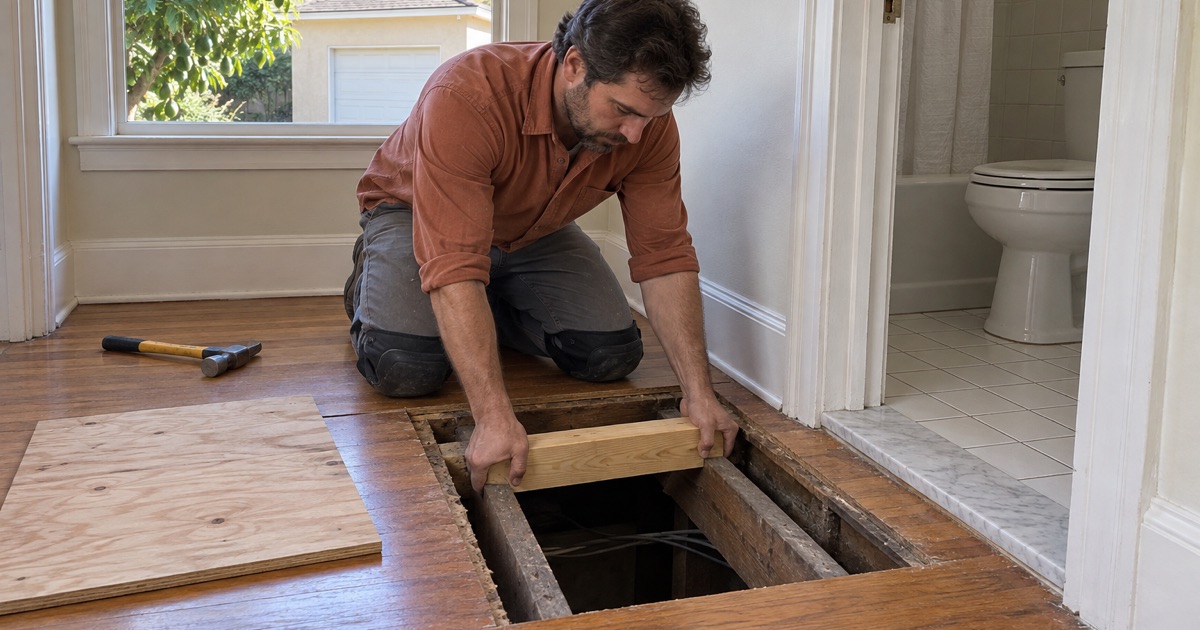
Soft Spots and Spongy Areas
A soft spot usually marks a section of rotted subfloor, most often beside a toilet, tub, shower, dishwasher, sink or water heater, or inside an exterior door where rain gets in. Water wicks into plywood or particle board slowly, so the damage underneath is typically larger than the soft area you can feel.
We probe the area and check from below when there is crawl space access. Knowing the full extent before cutting keeps the repair to one visit instead of a patch that has to be reopened.
Sagging, Bouncing and Sloping Floors
A floor that dips in the middle of a room, bounces when someone walks by, or slopes toward one wall points to a structural problem rather than a surface one. Undersized or damaged floor joists, a notched joist cut for old plumbing, or supports that have settled beneath a raised foundation are the usual causes.
On older homes, framing changes from past remodels are also common. A wall removed without adding support above it can leave the floor carrying more load than its joists were built for.
Squeaks, Loose Boards and Cracked Tile
Finished floors fail in patterns when the subfloor moves. Hardwood squeaks and loosens across the same area, and tile cracks along a line that follows a joist or a panel seam. Nail pops that keep returning after being set usually mean the subfloor is shifting beneath the fastener.
We read these patterns before lifting anything. A crack line that runs across several tiles in one direction, or a row of hardwood boards loosening along the same line, tells us where to look for a panel seam without blocking or a joist that has moved.
Subfloor Materials We Repair
Plywood and OSB Subfloors
Plywood and OSB are the standard subfloor panels in most homes. Both hold fasteners well when dry, but OSB swells at its edges when wet, and plywood can delaminate after repeated leaks. We cut damaged panels back to the nearest joists or add blocking beneath the cut edges, then install replacement panels of the same thickness.
New panels are glued and screwed to the framing, which prevents the movement that caused squeaks in the first place. The seam is checked for flatness before any finished flooring goes back down.
Particle Board Under Old Carpet
Particle board was often laid as an underlayment beneath carpet and vinyl. It crumbles around fasteners and swells permanently at the edges when it gets wet, a condition known as particleboard edge swell. The National Wood Flooring Association’s nail-down guidelines exclude particleboard as a base for hardwood.
When a carpet-to-hardwood project uncovers particle board, we remove it and lay plywood in its place. It adds a step, but it is the difference between a hardwood floor that stays tight and one that loosens within months.
Board Subfloors in Older Homes
Many older houses have board subfloors, individual planks laid diagonally or straight across the joists, instead of sheet panels. Loose or cupped boards cause squeaks and uneven floors, and a single rotted board can be replaced without disturbing the rest. For new hardwood, we may add a plywood layer over the boards for a flat, uniform base.
Joists, Crawl Spaces and Raised Foundations
Sistering and Reinforcing Floor Joists
A cracked, notched or rotted floor joist can often be repaired by sistering, fastening a new full-strength joist alongside the damaged one. Where a joist has sagged, it may need to be jacked back into position before the sister is attached. Blocking between joists adds stiffness to bouncy floors.
South Coast AQMD Rule 1403 treats removing even a single load-bearing framing member as demolition rather than renovation, which carries its own asbestos survey and notification steps. We account for that before structural work begins.
Crawl Space Moisture and Ventilation
On a raised foundation, the crawl space controls the health of the subfloor above it. Standing water, blocked vents, leaking drain lines or missing vapor retarder raise the moisture level in the framing. We look for those conditions during the inspection and recommend correcting them before new wood is installed.
Repairing rot without fixing the moisture that caused it only resets the clock. Moisture meter readings in the framing tell us when the wood has dried enough to repair or cover.
Cripple Walls and Earthquake Retrofits
Many raised-foundation homes rest on short cripple walls between the foundation and the first floor. California’s Earthquake Brace + Bolt program lists Baldwin Park’s 91706 ZIP code as eligible, and retrofit work is often done from the same crawl space where we reach the subfloor.
When a retrofit is planned, coordinating floor repair and retrofit access can save opening the same area twice. We work around a retrofit contractor’s schedule so neither job undoes the other.
Water, Pests and Getting the Floor Back
Subfloor Damage From Leaks and Water Losses
A failed supply line, a leaking wax ring under a toilet or a flooded room can soak the subfloor long before the finished floor shows it. We document damage with photos and moisture readings, which homeowners often need for an insurance claim, and allow the framing to dry before sealing it in.
Mold-stained or crumbling panels are removed rather than covered. Replacing them is far less expensive than the new finished floor that would fail on top of them.
Termite and Wood-Boring Beetle Damage
Drywood termites leave kick-out holes and small piles of termite pellets, while powderpost beetles leave fine frass. Both can damage joists and subfloor panels as well as finished flooring. We identify the evidence and recommend a licensed pest inspection, then schedule structural repair after treatment is complete.
Subfloor Repair for Rental Properties
California law treats floors in rental housing seriously. Civil Code 1941.1 includes floors, stairways and railings maintained in good repair among habitability requirements, and Health and Safety Code 17920.3 lists defective or deteriorated flooring or floor supports as a structural hazard. Landlords get a written scope and photos of the completed repair.
Reinstalling Hardwood, Tile and Vinyl After Repair
Once the subfloor is sound, we reinstall or replace the finished floor. Salvageable hardwood boards are numbered as they come up and woven back into place, and new boards are blended in by refinishing the area. Tile and vinyl areas are prepared flat so the new surface bonds properly and stays level.
The written schedule covers the whole sequence, from removal and repair through drying time and reinstallation. Households know in advance which rooms will be closed and for how long, which matters most when the damaged area is a bathroom or kitchen the family uses every day.
- 20+ Years in Wood Floors
- Free Written Estimates
- Rental and Claim Documentation