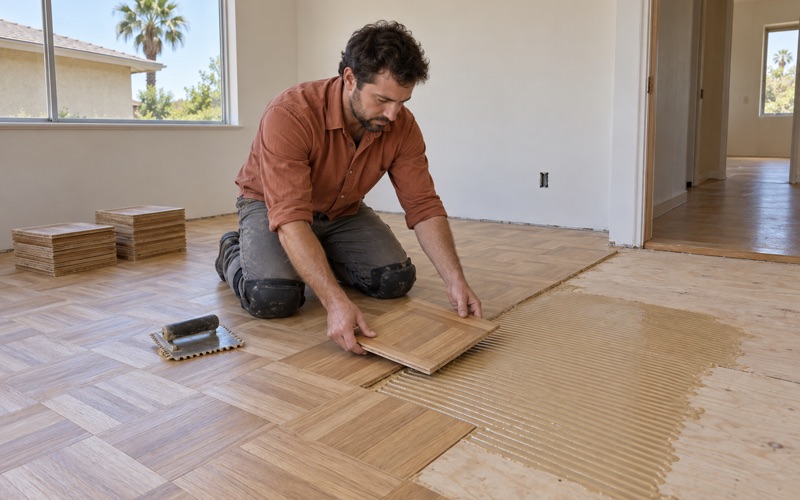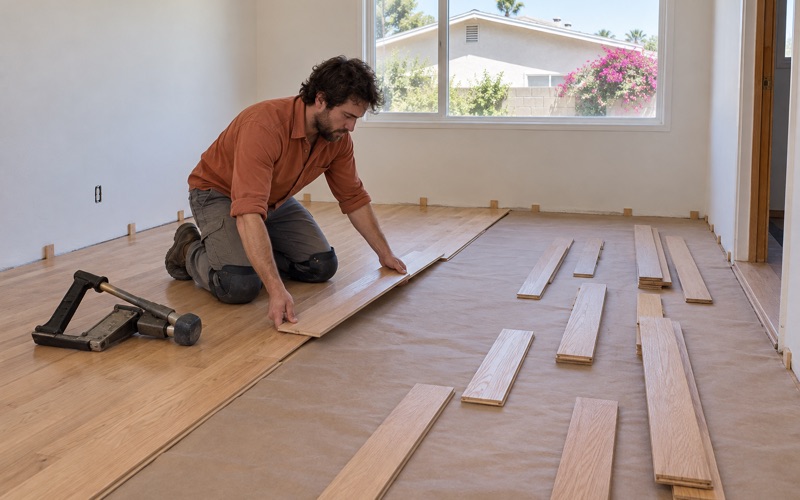
Baldwin Park Wood Flooring handles wood flooring in Temple City with more than 20 years of sanding, repair and installation behind every quote. Much of what we are called for here is a house between occupants: a tenant has moved out, the carpet is tired, and the owner wants to know whether the floor underneath can be saved before the next lease starts.
We answer that by looking, not guessing. A corner of carpet comes back before any number is written, so the estimate describes the oak, plywood or particle board that is really there. On engineered boards we measure the wear layer first, because a thin veneer can take a screen and recoat but will not survive a full sanding.
For owners who manage their own rentals, the paperwork matters as much as the finish. Every turnover quote comes with move-out photos and a written scope that can sit in the file next to the deposit records, and the schedule states which rooms are off limits and for how long, so a showing or a move-in date can be planned around it.
Temple City Renters Mostly Rent Whole Houses
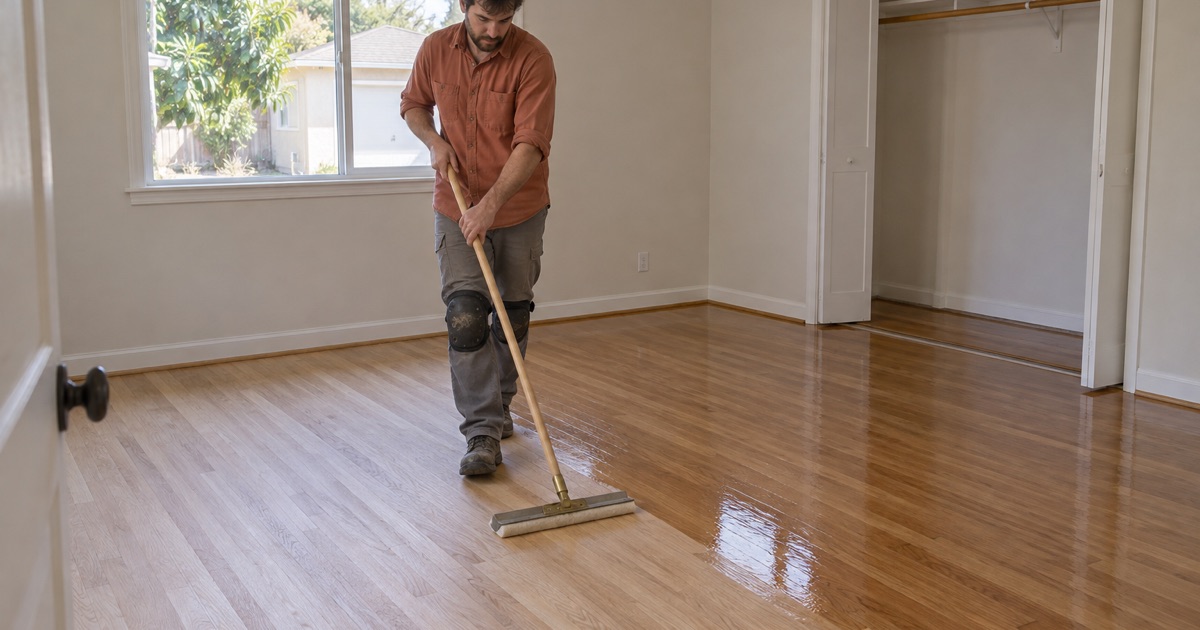
The housing numbers explain why our Temple City turnover work looks the way it does. It is rarely a hallway of identical apartments; it is usually one house at a time, each with its own history of rugs, pets and furniture.
A rental market made of detached houses
According to the Census Bureau’s ACS 2024 five-year estimates, Temple City has 4,244 renter households, and 2,704 of them, 63.7 percent, live in detached houses. Only 20.3 percent of renter households live in buildings of five or more units. Across all 11,992 housing units in the city, 80.5 percent are one-unit detached houses.
That changes the shape of a rental floor job. Instead of a single living room and a bedroom in a stacked building, a turnover here often means several bedrooms, a hall, a dining room and sometimes a set of stairs, all in one house that a family lived in for years.
What a house rental asks of the floor
A house tenant lives on a floor differently than an apartment tenant. There are more rooms to furnish, more doors to the yard, and more chance of a dog or a potted plant sitting in one spot for three years. We see gray boards by back doors, pet urine stains in bedroom corners and sun fading where a rug protected everything but a border.
So we walk every room at move-out rather than pricing the house by square footage alone. A clean family room and a stained back bedroom may need very different treatment, and a written scope that separates them keeps the landlord from paying for a full sanding where a screen and recoat would do.
Looking for wood-flooring closer to Duarte? See Wood-Flooring Services in Duarte.
Turning a Rented House Over Between Tenants
Quoting from the move-out photos
Our turnover quotes start with photos taken at the move-out walk, room by room, with close shots of any damage. The written scope names each room, the work planned there and the reason, whether that is sun fading, a pet stain, finish peeling at a doorway or a board lifted by a leak.
Whether a particular mark counts as normal wear and tear or damage is a question for the landlord and the lease, not for us. What we provide is a clear record of what the floor showed before work began, dated and itemized, which a landlord can keep alongside a security deposit itemized statement if one is prepared.
Carpet pulled up, tack strip and pad stains repaired
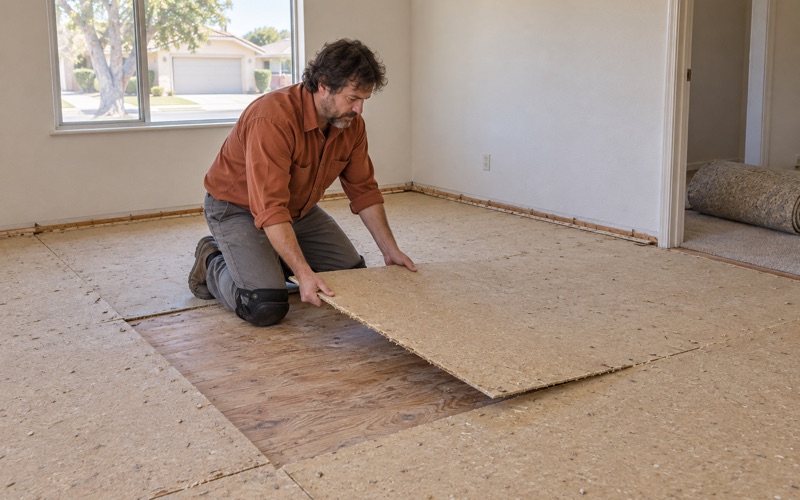
Many Temple City rentals were carpeted over hardwood at some point, and the next owner often wants the wood back. Pulling carpet leaves a ring of tack strip holes along every wall, rows of carpet staples, and dark carpet pad stains where padding sat against the finish for decades.
We repair those as part of the job instead of leaving them for a rug to hide. Staples come out individually, tack strip holes are filled or the edge boards replaced, and pad stains are sanded to see how deep they go. If a stain has reached into the wood, we tell the owner before we promise it will disappear.
Stairs and doorways that take the most traffic
Two-story houses carry stairs that tenants use dozens of times a day. We price stairs by the stair tread, the riser and the stair nosing rather than hiding them in a square-foot rate, because a worn nosing and a sound tread need different work and a landlord should see that difference.
Doorways and transitions get the same attention. Loose reducers, cracked T-molding and gaps under shoe molding are small items, but they are what a new tenant notices on the first walk-through, and fixing them during a turnover costs less than a separate visit later.
The 1940s and 1950s Floors Under Those Rentals
A city built mostly at mid-century
The ACS year-built counts show 46.8 percent of Temple City’s housing units went up between 1940 and 1959, and the 1950s alone account for 29.4 percent, the largest single decade. Houses from that period commonly have site-finished oak strip flooring, often red oak, laid over a board subfloor or plywood depending on the builder.
Those floors have usually been sanded before, sometimes more than once. Before promising another refinish, we check board thickness at a floor register or threshold, look for sand-through at high spots, and note any old repairs, since a floor that has lost too much wood above the tongue cannot take another aggressive cut.
Build year checked before any sanding
By the same Census data, 74.6 percent of Temple City’s units were built before 1980. The EPA Renovation, Repair and Painting Rule applies to pre-1978 housing, and old paint overspray along baseboards or older finish layers can be part of what a sander disturbs.
That is why we confirm the build year of each house before we put a sanding day on the calendar. Once the year is known, the landlord hears how the work will be set up and what dust control, containment and cleanup it calls for, so a tenant move-in date is not pushed back by a surprise after the drum sander has already been run.
Older houses also hide older flooring. Under carpet or vinyl we sometimes find 9x9 floor tile set in black mastic, and those materials are not something to sand or scrape on a guess. Where that turns up, the work stops at that room until an asbestos survey says how it can proceed under SCAQMD Rule 1403, and the landlord gets that news in writing rather than on the phone.
Finishes that fit the South Coast air district
Temple City sits within the South Coast Air Quality Management District. Under SCAQMD Rule 1113, wood coatings are limited to 275 grams per liter of volatile organic compounds, and we choose our sealers, stains and polyurethane from products that meet that limit.
For turnovers we most often recommend a waterborne polyurethane, because its lower odor and shorter recoat window suit a house that needs to be shown quickly. Cure time still matters, though. The written schedule tells the landlord when light foot traffic is fine and when furniture and rugs can safely return.
Refinish or Replace in a Rental House
When refinishing is still the right call
Most solid oak floors in older Temple City houses can be refinished rather than replaced. A full sand through the abrasive grit sequence removes gray boards, shallow scratches and most surface stains, while a screen and recoat is enough when the finish is dull but the wood beneath it is unmarked.
For a landlord, the practical question is how long the result will last under the next tenant. A properly sanded floor with three coats of finish holds up far better than a quick buff and coat over worn areas, and we lay out both options in the quote so the choice is made with the costs side by side.
When boards have to come out
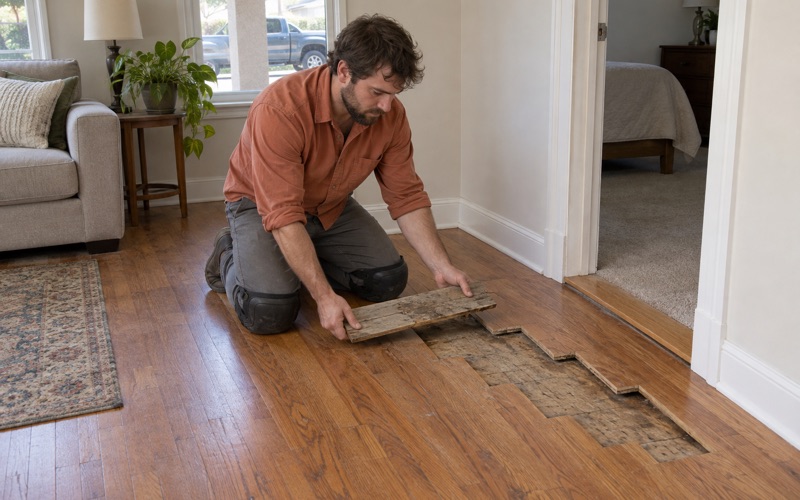
Some damage is past sanding. Black water stain from a long leak, pet urine that has soaked through the grain, cupping and buckling after a water loss, or a soft spot that signals a rotted subfloor all call for board replacement or a weave-in repair with matching oak.
Small holes and powdery piles get identified before anything is torn out, since drywood termite pellets, powderpost beetle frass and old nail holes lead to very different next steps. When joist or subfloor repair is structural, we check permit requirements with the City of Temple City Building and Safety Division rather than assume an answer.
Replacing boards in a rental is also a question of what happens next. Laminate or luxury vinyl plank can look like a cheaper fix, but a floating floor over a room of sound oak removes the option to refinish later. We price a weave-in repair against a full replacement so the landlord can compare the two over more than one tenancy.
Owner-occupied houses on the same streets
Owners live in houses too, and in larger numbers. Of Temple City’s 7,210 owner households, 6,637, or 92.1 percent, live in detached houses. The city incorporated in 1960 and adopts the Los Angeles County building codes by reference, with the 2023 county codes adopted through Ordinance 22-1066.
An owner living in the house usually wants something different from a landlord between tenants: a stain color, a wider plank addition, or a finish chosen for long life rather than a fast return. For large and multigenerational households we write a room-by-room schedule so people, furniture and rugs can move back in stages while work continues elsewhere.
Owners also tend to ask about adding wood where a rental once had carpet or laminate flooring. Matching new red oak or white oak strip to a mid-century floor takes test boards and a stain sample on the actual wood, because a new board and a sixty-year-old board rarely take color the same way. We show that sample before the whole floor is committed to one shade.
- 20+ Years in Wood Floors
- Free Written Estimates
- Rental and Claim Documentation