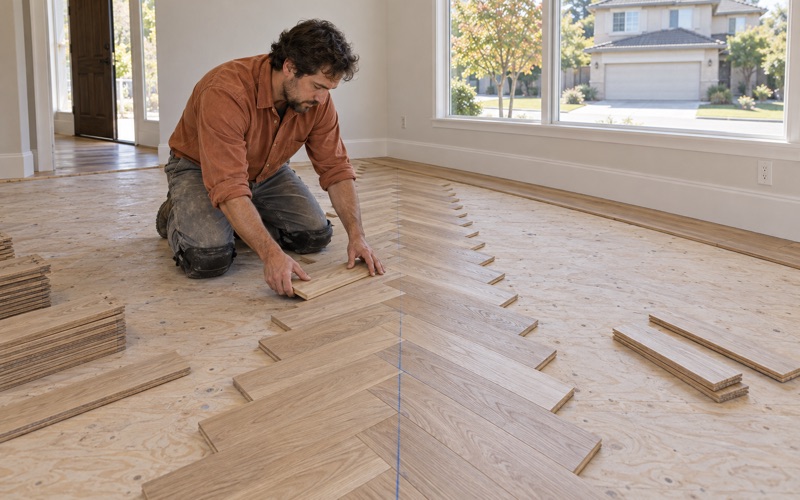
Baldwin Park Wood Flooring has handled wood-flooring in Valinda for more than 20 years, and most of that work happens in houses where the person signing the estimate also lives above the boards. We refinish worn oak, replace damaged runs, install new solid and engineered hardwood, and pull tired carpet to learn what sits underneath. Every job starts with the actual floor rather than a price read off a chart.
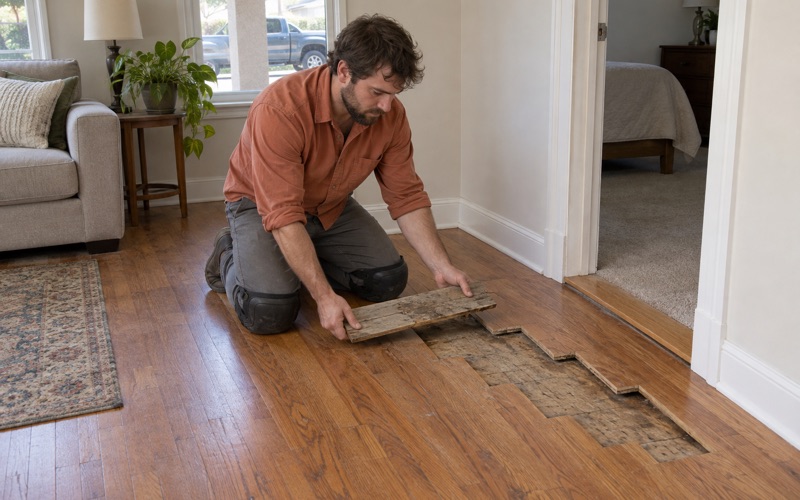
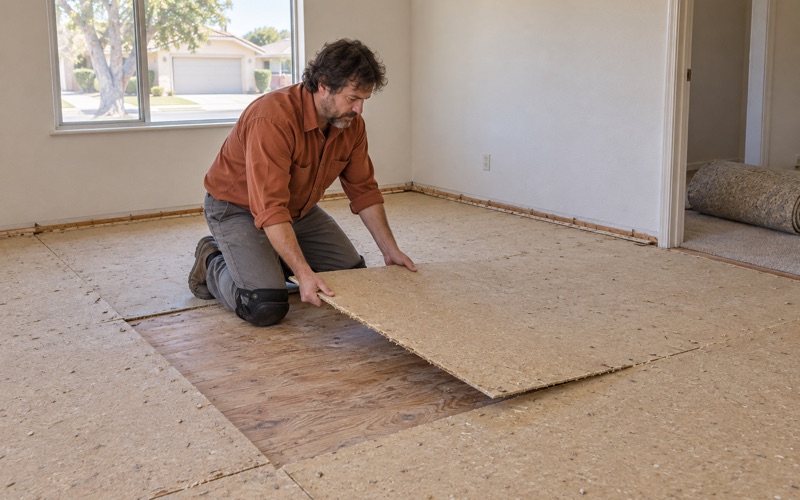
That starting point is literal. Before a number goes on paper, we fold back a corner of the carpet so the quote describes the red oak, plywood subfloor or particle board we found instead of a guess. When oak strip flooring turns up under the pad, the tack strip holes, staple rows and old pad stains are repaired inside the same scope rather than hidden under a new area rug.
Engineered floors get their wear layer measured before anyone promises a full sand, because a thin veneer will accept a screen and recoat but not a drum sander. Finishes come only from products legal to apply in the South Coast air district, where the wood coatings limit is 275 grams per liter, so the coat curing in your living room is one the regional rules allow.
A County Community of Detached Houses
No city hall, mostly single-family homes
Valinda is not an incorporated city. It is an unincorporated community in Los Angeles County, counted as a census-designated place since the 1980 census and covering about two square miles. In the ACS 2024 five-year estimates, 4,446 of its 4,954 housing units are one-unit detached houses, or 89.7 percent, and only 162 units sit in buildings of five or more.
Ownership follows the same shape. Of 4,713 occupied units, 79.3 percent are owner-occupied, and 3,530 of the 3,739 owner households live in detached houses. For a flooring contractor, that means the typical Valinda job is a whole-house decision made by someone planning to stay, not a quick unit turnover scheduled around a property manager’s calendar.
How the county’s area plan describes it
The East San Gabriel Valley Area Plan, adopted by the Board of Supervisors in 2024, places Valinda in a chapter with its southwestern neighbors. The public review draft describes the community as single-family residential subdivisions with limited multi-family residential, with commercial uses kept mostly to Amar Road and Azusa Avenue, and notes the Puente Creek Channel running through the south.
That description matches the kind of floor problems these houses bring us. Subdivision homes from the middle of the 20th century often carry several decades of layers: original oak strip, later wall-to-wall carpet, and kitchens or entries where a previous owner added linoleum, 9x9 floor tile, laminate flooring or luxury vinyl plank. Knowing the pattern helps us plan, but we still check the corner before quoting.
Build year before any sanding
Most of the housing went up mid-century, and ACS counts 88.9 percent of Valinda units as built before 1980. That census bucket ends at 1980 rather than 1978, so the pre-1978 share is somewhat lower, but a large part of the community is likely pre-1978 housing where the EPA Renovation, Repair and Painting Rule comes into play once old painted trim or finish layers are disturbed.
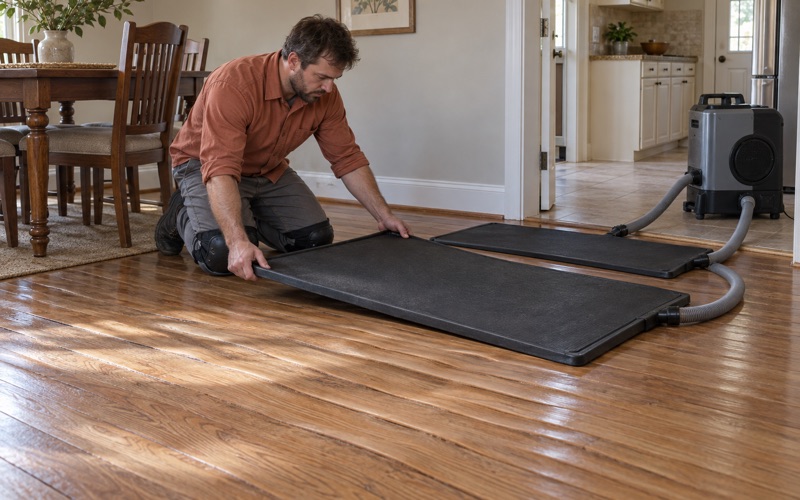
So the build year is confirmed before a sanding date goes on the calendar. The answer shapes containment, dustless sanding setup, cleanup and how baseboards and shoe molding come off. Old 9x9 tile or black mastic found under carpet raises a separate question, and we treat it as an asbestos survey matter under SCAQMD Rule 1403 before anyone scrapes or grinds.
Looking for wood-flooring closer to West Covina? See Wood-Flooring in West Covina.
Permits and Rentals Under County Rules
Who issues permits in unincorporated Valinda
Because Valinda has no city government, building permits come from Los Angeles County Public Works, Building and Safety, which serves unincorporated communities through its headquarters and district offices. The county building code is Title 26 of the Los Angeles County Code. We do not hand homeowners a permit answer from memory, because the scope of work drives that question.
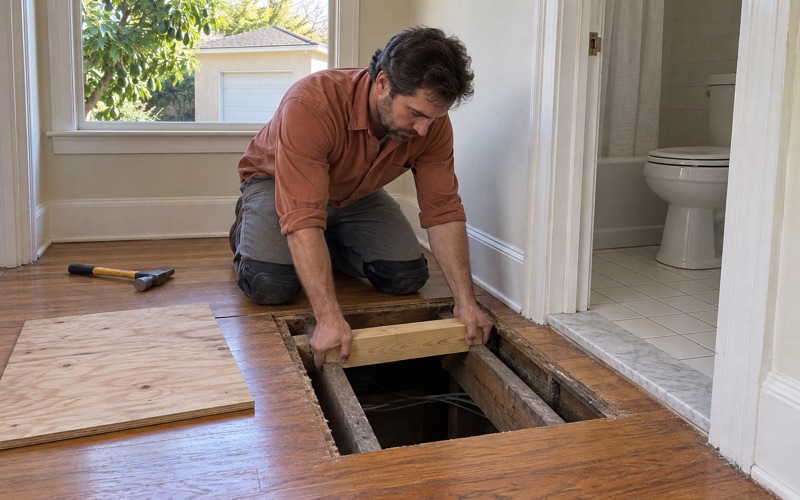
Refinishing an existing floor is a different job from cutting out a rotted subfloor, adding a sister joist beside a cracked floor joist or correcting a sagging floor. When a soft spot or a run of hollow spots turns out to be structural, we stop, describe what we found in writing, and ask the owner to confirm the permit question with Building and Safety before that part is scheduled.
Renting out a Valinda house
About a fifth of Valinda households rent, and 675 of the 974 renter households rent a detached house. Rental housing here falls under the Los Angeles County Rent Stabilization and Tenant Protections Ordinance, run by the Department of Consumer and Business Affairs, which covers rental units in unincorporated areas with a certificate of occupancy issued on or before February 1, 1995.
How the ordinance’s provisions apply to one particular house is a question for DCBA, not for a flooring estimate, and we point landlords there. What we can supply is paperwork. The DCBA page notes that landlords may pass on costs related to certain property improvements and renovations, and a dated written scope listing rooms, materials and work performed is the kind of record that conversation needs.
Floors between tenants
When a tenant moves out, we quote from the move-out photos and write a room-by-room scope the owner can keep with the deposit records. The scope separates normal wear and tear, such as sun fading along a window wall or seasonal gapping, from pet urine stain, black water stain and deep gouges, which may belong on a security deposit itemized statement under California Civil Code 1950.5.
The scope also says what each floor can take. A solid oak floor with enough thickness left can be sanded and refinished during the vacancy, while an engineered plank with a thin wear layer may get a buff and coat plus board replacement only where damage runs deep. The owner chooses between those options with prices and dates already on paper.
Two ZIP Codes, One Retrofit List
Where Valinda’s addresses fall
Valinda has no ZIP code carrying its own name. The county’s 1st District listing places the community in two, 91744 and 91791, and both are shared with neighboring cities and communities. The same listing warns that ZIP boundaries do not follow community boundaries, so a Valinda address can read like a neighboring place on a mailing label or a program form.
That matters for one program in particular. The 2025 Earthquake Brace + Bolt list for Southern California includes both 91744 and 91791, and the program states that eligibility is based on ZIP code only, with the city printed as a reference. An owner scanning the list for the word Valinda will not find it, but will find both of the community’s ZIPs.
Retrofits and floors in the same year
Owners who plan a seismic retrofit and a floor project in the same year usually ask which should come first. We suggest settling the retrofit schedule before a new finish goes down, so outside crews, tools and foot traffic are through the house before the final coat cures. A fresh waterborne polyurethane needs its full cure time without work boots crossing it.
The paperwork overlaps too. If another trade or a Wood Destroying Pests and Organisms Inspection Report notes drywood termite activity or damaged wood, we want to read it before quoting boards. Small holes and powdery piles are identified as termite pellets, powderpost beetle frass or old nail holes first, so any tent fumigation question is answered before a single board is replaced.
Floor Work in a House the Owner Plans to Keep
Refinish, repair or replace
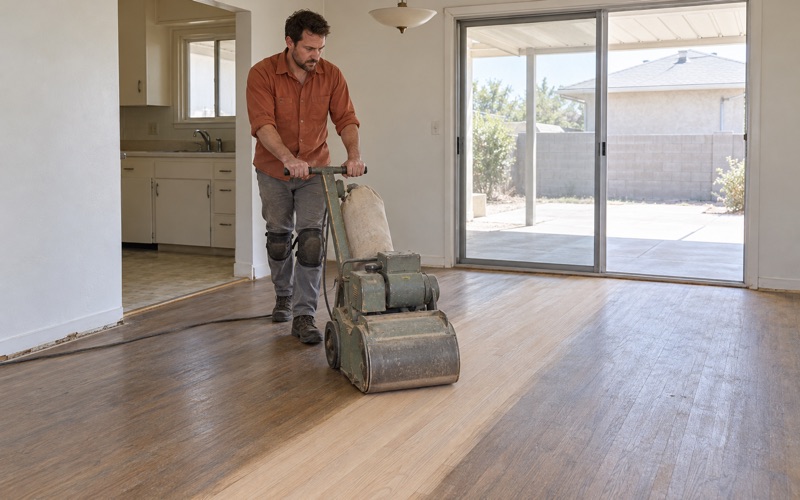
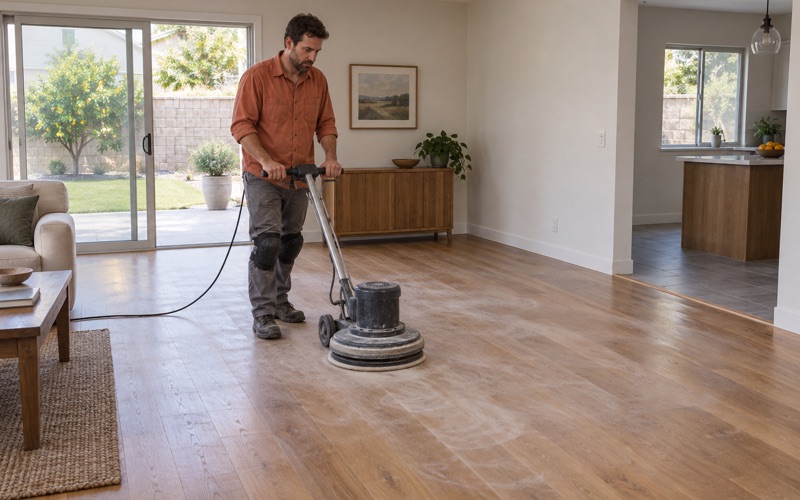
Owners who expect to stay tend to ask for the floor that lasts rather than the quickest cover. Where oak strip flooring is sound, a full sand through a proper abrasive grit sequence with a drum sander, edger and orbital sander brings the original boards back, and a weave-in repair ties matching red oak or white oak into areas where old damage was cut out.
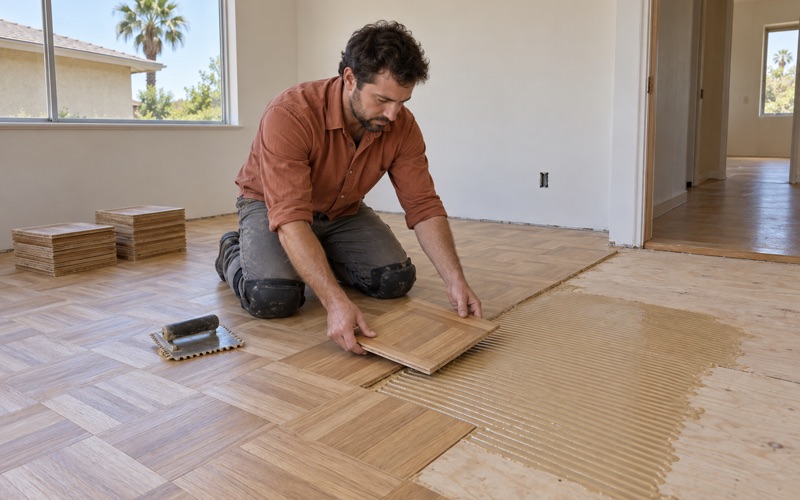
Where the subfloor is particle board, particleboard edge swell near a kitchen, laundry or bathroom is a real risk, and a nail-down installation over it is a poor bet. We say so in the estimate and price the plywood subfloor repair alongside the flooring, rather than discovering the problem halfway through a glue-down installation or a floating floor that starts to feel spongy.
Moisture, weather and acclimation
Valinda sits in National Weather Service forecast zone CAZ548, the Los Angeles County San Gabriel Valley zone. Indoor relative humidity still shifts between dry and damp stretches of the year, and wood answers with seasonal gapping, cupping or crowning. We take moisture meter readings on boards and subfloor before delivery and give new material time to acclimate in the rooms where it will live.
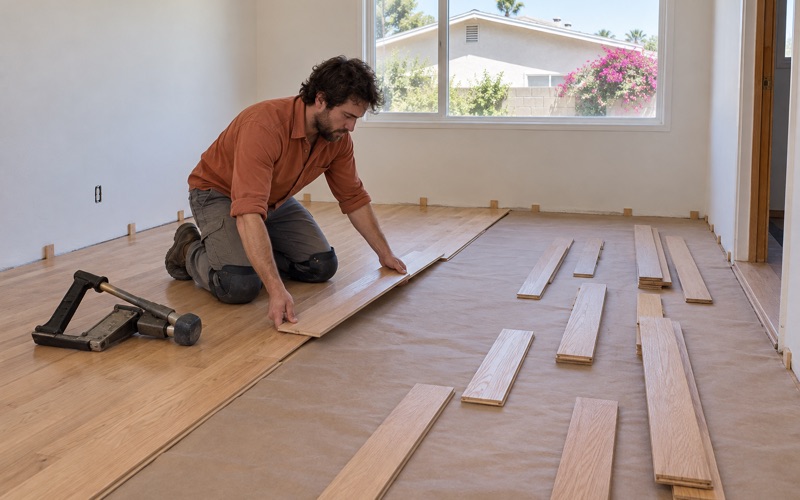
Where a room sits on concrete, the reading comes from an ASTM F2170 in-situ relative humidity test rather than a hand on the floor, and a vapor retarder goes down wherever the product calls for one. Expansion gaps stay open at the walls under baseboard and quarter round, because a floor pinned tight against the drywall will eventually find its own way to buckle.
Stairs, schedules and water losses
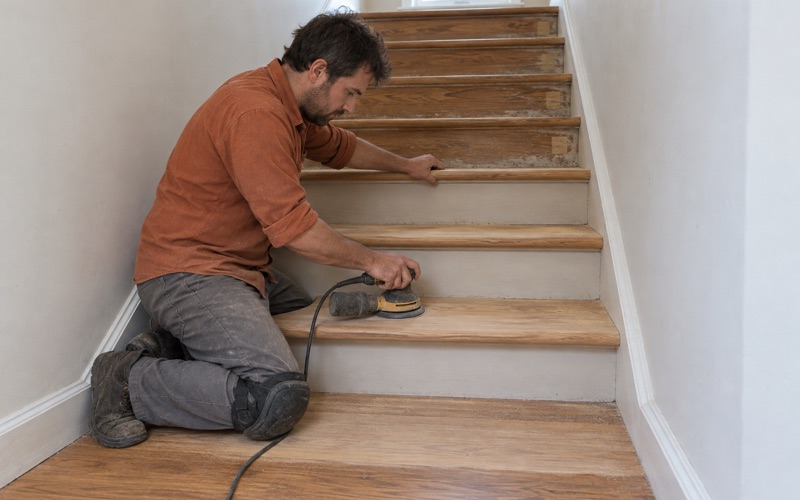
Stairs are priced by the tread, riser and stair nosing rather than averaged into the square-foot number for the hallway. A retrofit tread over an old carpeted staircase is a different job from sanding original treads, and the estimate lists both. Larger and multigenerational households also get a written room-by-room schedule showing when furniture, rugs and people can return.
When a floor has been through a leak or a kitchen fire, we document it with photos and moisture readings an adjuster can use, and we note cupping, gray boards, soot or smoke damage room by room. That record lets the owner and the insurer agree on whether the floor gets a sand and refinish or a board replacement before anyone starts pulling wood out.
- 20+ Years in Wood Floors
- Free Written Estimates
- Rental and Claim Documentation