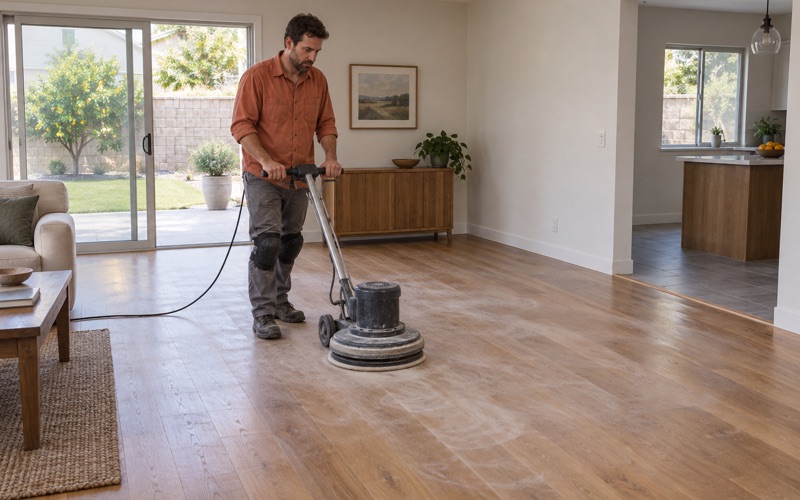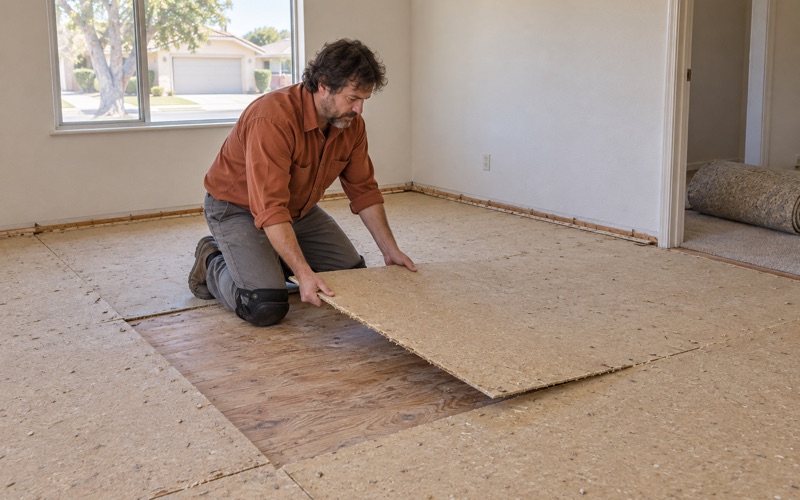
Baldwin Park Wood Flooring has spent more than 20 years on wood flooring in Vincent and across the San Gabriel Valley, sanding, repairing and installing floors in houses where the owner is usually the person living on them. Before we price anything, we fold back a corner of the carpet, because an estimate should describe the oak, plywood or particle board that is really there.
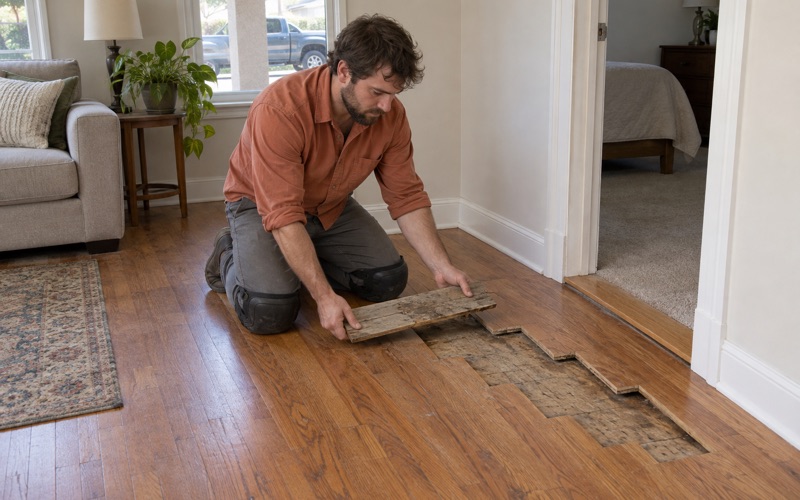
That habit matters most on carpet-to-wood jobs. Pulling carpet leaves tack strip holes along every wall, rows of carpet staples and sometimes a carpet pad stain that has soaked into the boards. We fill, patch or replace those areas as part of the job, so the finished floor never depends on a rug placed over the worst spot.
The rest of this page covers what actually changes about floor work here: a housing stock that is almost entirely detached and owner-held, a small group of duplex rentals, and a community with two mailing cities and a second name that still sits under county rules. Each of those shapes how we quote, schedule and finish a job.
Detached Houses, Nearly All Owner-Held
A Single-Family Floor Market
Vincent is close to a pure single-family neighborhood. Census estimates put 93.6 percent of its housing units in one-unit detached houses, and among owner households the share is higher still: 98.8 percent live in a detached house. Owner-occupied condos and townhomes barely register, so the floors we see belong to people who chose the house and plan to stay.
That changes the conversation. An owner who will live on a floor for years weighs a full sand and refinish differently than someone preparing a quick sale, and asks sharper questions about durability, stain color and cure time. We spend real time on sheen level and on how waterborne polyurethane or oil-modified polyurethane will wear in a busy kitchen doorway.
Houses From One Building Decade
Most of the stock went up at once. About 71.6 percent of units were built between 1950 and 1959, so many floors here have been through several owners, several coverings and more than one round of patching. We never assume what a house holds; a lifted carpet corner or a pulled floor register tells us far more than the street does.
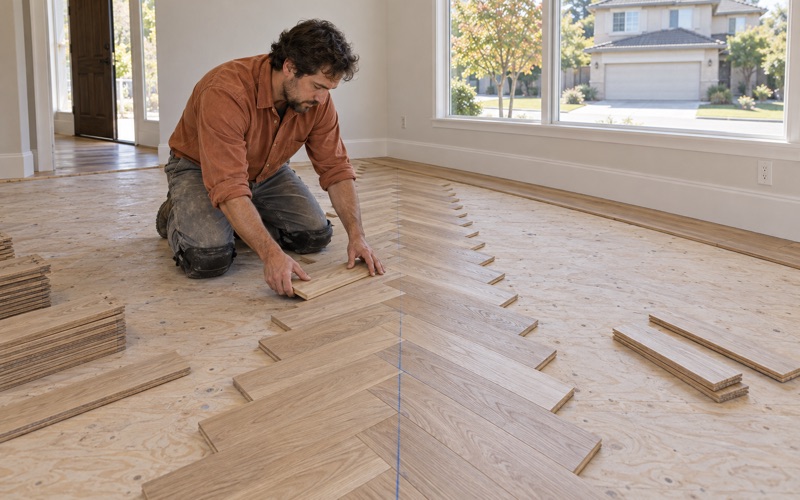
What turns up varies from house to house. We may find oak strip flooring worth sanding, a plywood subfloor under old sheet goods, or linoleum adhesive that has to come off before anything new goes down. Black mastic and 9x9 floor tile call for an asbestos survey under SCAQMD Rule 1403 before anyone disturbs them, and hollow spots or nail pops get traced to their cause first.
Flat Tracts, Cul-de-Sacs and Frontage Streets
County planners describe East Irwindale as flat terrain with a curvilinear street layout, numerous cul-de-sacs, and many major streets paralleled by frontage streets. For a floor crew, that layout is practical. The drum sander, edger and dust extraction equipment stay close to the front door, and a quiet cul-de-sac makes a multi-day refinish easier on the neighbors than a busy arterial would.
The layout also shapes how we plan a household’s week. We write a room-by-room schedule showing when furniture, rugs and people can come back, which matters in larger and multigenerational homes where nobody can simply leave for four days. Bedrooms can be finished in stages so the family always has somewhere to sleep while the living areas cure.
Looking for wood-flooring closer to South Monrovia Island? See South Monrovia Island Wood-Flooring.
Duplex and Small Rental Floors
The Two-Unit Slice
Owners dominate, but renters live here too. Of the 858 renter households, 91, or 10.6 percent, live in two-unit buildings. Those duplexes are a small, distinct part of our work in Vincent, and the floor decisions there balance durability, turnover time and what the next tenant will actually notice when they walk through the door.
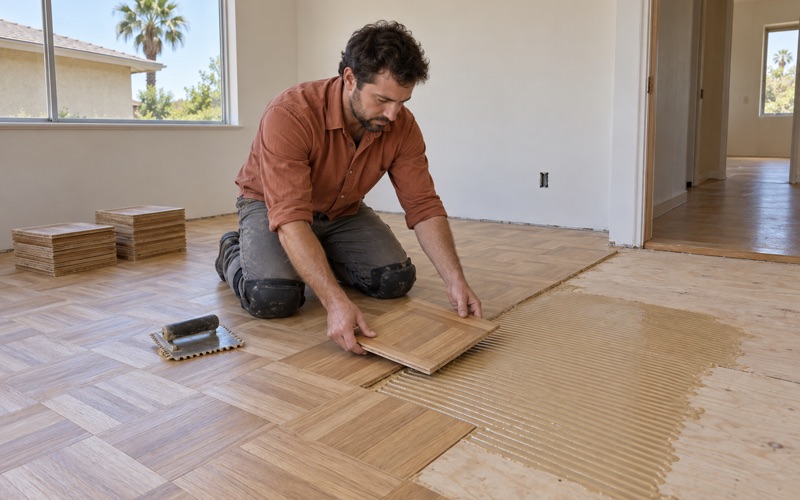
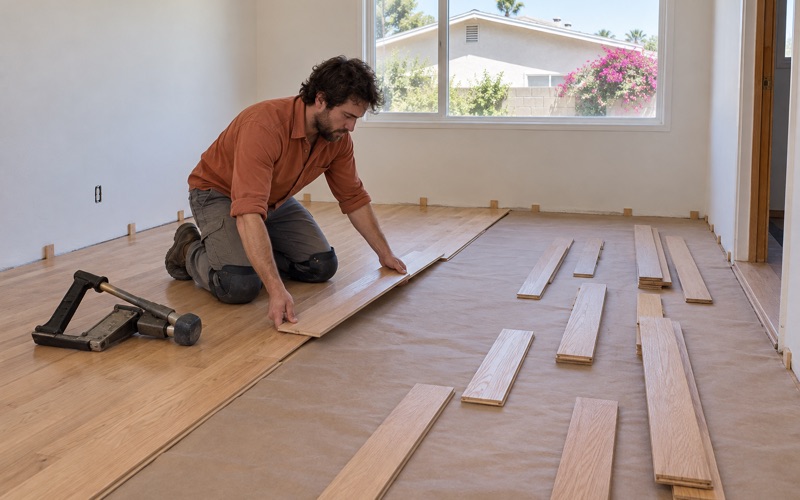
In a duplex, two households share one structure, so noise and access come up early. We talk through whether a floating floor, a glue-down installation or a nail-down installation suits each unit, and we plan a reducer or T-molding wherever hard flooring meets another surface. Work hours and dust containment are set with the tenant on the other side in mind.
Between Tenants
Rental floors are usually quoted in the gap between one lease and the next. We work from the move-out photos and write a scope a landlord can keep with the deposit records, separating ordinary wear from damage. That line matters under California Civil Code 1950.5, which does not allow normal wear and tear to be charged against a security deposit.
Turnover damage follows familiar patterns: a pet urine stain that has turned boards gray or black, sun fading along a window wall, and gouges near the entry. We decide whether a board replacement or weave-in repair handles it or whether the room needs a full sand. Where the finish is only worn, a screen and recoat can return a unit to rentable condition quickly.
County Tenant Rules and Records
Los Angeles County’s Rent Stabilization and Tenant Protections Ordinance, administered by the Department of Consumer and Business Affairs, applies in unincorporated communities like this one. How it treats any particular property is a question for the county, not for a flooring crew. What we can supply is dated documentation of floor condition and the work performed, which landlords find useful whenever their records are reviewed.
East Irwindale, Two Mailing Cities, One County
Another Name for the Same Place
Vincent is also known as East Irwindale, the name the Los Angeles County Department of Regional Planning uses for the community within its East San Gabriel Valley Area Plan. County documents describe it as roughly 1.5 square miles, overwhelmingly residential and bisected by a Southern Pacific railroad right-of-way, with Irwindale Avenue, Azusa Avenue, Arrow Highway and Badillo Street as its major roads.
Both names turn up in paperwork. A homeowner may see Vincent on a census page and East Irwindale on a planning map, while the envelope on the kitchen counter says Covina or Azusa. When we write an estimate, we record the actual street address and treat the property as part of the community it belongs to, whichever label a document happens to use.
The Arrow Highway Split
The mailing line runs along Arrow Highway. Addresses south of it use Covina and ZIP 91722, while addresses north of it use Azusa and ZIP 91702. The school line differs again, with the community divided between Azusa Unified and Covina-Valley Unified. None of those labels places a house inside either city, and none changes which government oversees building work on it.
County Public Works and Title 26
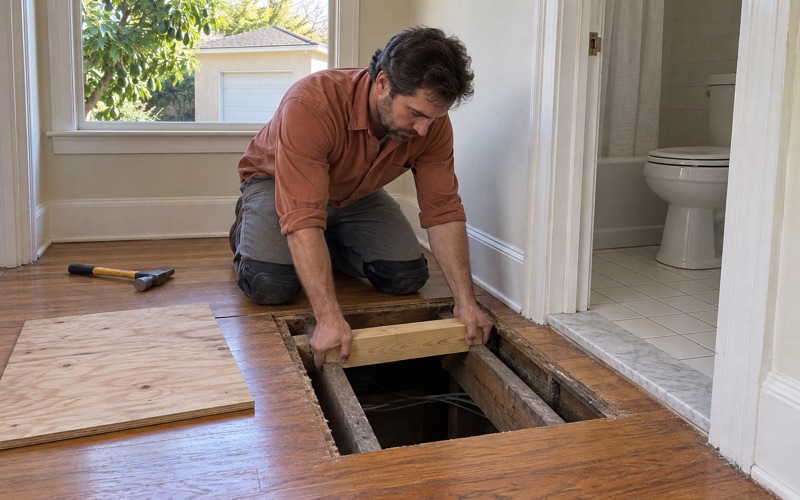
Vincent is unincorporated Los Angeles County. Building work here runs through Los Angeles County Public Works, Building and Safety, under the Title 26 Building Code, rather than through the City of Covina or the City of Azusa. When a floor project reaches past the surface, such as a rotted subfloor section or a sagging floor that needs a sister joist, we confirm requirements with the county first.
Both ZIP codes, 91702 and 91722, also appear on the 2025 Earthquake Brace + Bolt Southern California list. An owner considering that program may want any retrofit work sequenced before new flooring goes down, and we are glad to build the floor schedule around it rather than install first and risk having a finished floor disturbed a few months later.
Sanding and Finishing an Older House
Build Year Before Any Sanding
We check the build year before a sanding date is set. With 94.2 percent of Vincent’s units built before 1980, a large share of houses here likely predate 1978, where older paint and finish layers can bring the EPA Renovation, Repair and Painting Rule into play. We plan containment and cleanup for that possibility instead of discovering it with a drum sander running.
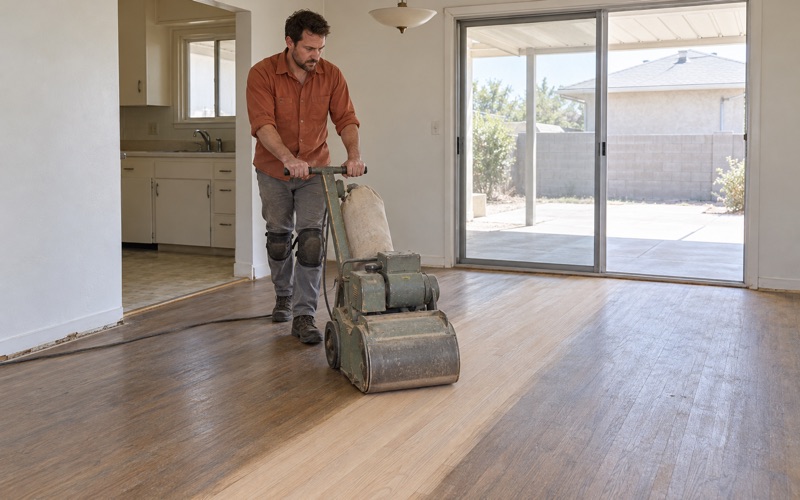
Dustless sanding helps, but it does not replace planning. We work through an abrasive grit sequence matched to the floor’s condition, keep edger marks and chatter marks out of the field, and check older oak for thin spots where earlier sanding went deep. A floor that has been sanded many times may not survive another full cut, and we say so before starting.
Finishes Legal in the South Coast Air District
Vincent sits within the South Coast Air Quality Management District, where the wood coatings VOC limit under SCAQMD Rule 1113 is 275 grams per liter. We choose sealers, stains and topcoats from products legal to apply here, which rules out some solvent-heavy finishes sold in other states. Compliant waterborne polyurethane and hardwax oil options cover most looks, from matte to semi-gloss.
Engineered Floors, Pellets and Frass
Engineered hardwood needs its own check. We measure the wear layer thickness before promising a full sand, because a thin veneer can take a screen and recoat but not a sanding, and cutting through it leaves a sand-through that cannot be hidden. Veneer delamination or a cloudy finish on a newer engineered floor points us toward repair or replacement instead.
Small holes and powdery piles also get identified before we replace anything. Drywood termite pellets, powderpost beetle frass, kick-out holes and old nail holes look alike at a glance, and each calls for a different response. If pests are active, a Wood Destroying Pests and Organisms Inspection Report and any tent fumigation come before new boards go in.
Stairs, Water and Smoke
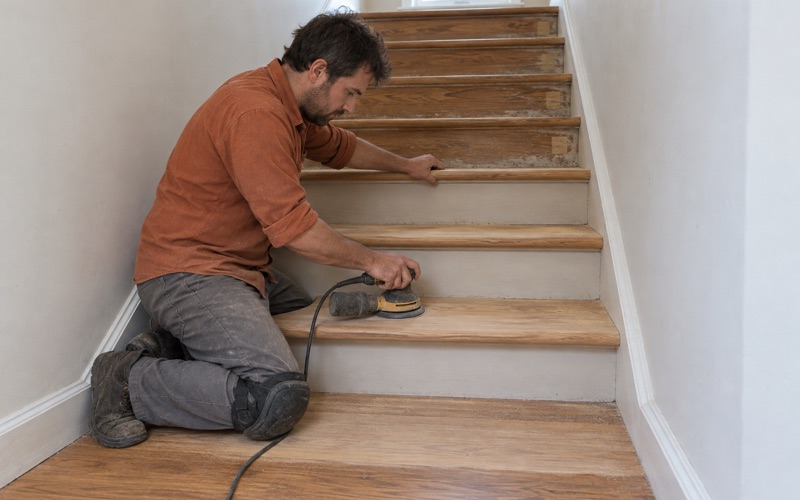
Where a house or duplex has stairs, we quote them by the tread, riser and stair nosing rather than folding them into a square-foot price. A worn stair tread may take a retrofit tread, while a nosing that no longer matches the landing needs its own piece. Pricing each part separately shows an owner exactly where the money goes.
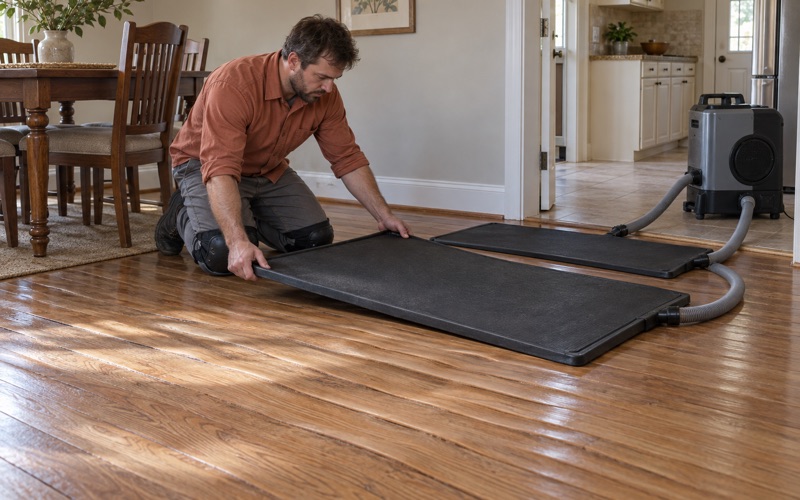
Water and smoke losses get documented before cleanup erases the evidence. We take photos and moisture meter readings an adjuster can use, note cupping, crowning or buckling across the affected boards, and record soot or ash residue on the finish. That record supports the claim and tells us whether the floor can be dried and refinished or needs replacing.
- 20+ Years in Wood Floors
- Free Written Estimates
- Rental and Claim Documentation