
Baldwin Park Wood Flooring repairs water damaged hardwood floors in Baldwin Park, CA, drawing on more than 20 years of work with floors that have been soaked by leaks, overflows and plumbing failures. We assess the damage, confirm the floor has dried and repair or replace only what cannot be saved.
Water damage is rarely limited to what you can see. A stain near the dishwasher can be the visible edge of wet subfloor stretching under the cabinets, and a cupped hallway can be fed by a slow leak in a wall. Repairing the surface before the moisture is gone is the most common and most expensive mistake.
We work from measurements rather than appearances. Moisture readings, photos and a written scope give you a clear plan, and they give your insurance adjuster the documentation a claim depends on.
How Water Damages a Wood Floor
Cupping and Crowning
Cupping happens when the underside of a board takes on more moisture than the top, so the edges rise above the center. It is often the first visible sign of a leak below the floor or a damp crawl space. Crowning, where the center of the board is higher than the edges, often appears when a cupped floor is sanded before it dries.
Mild cupping can relax on its own once the moisture source is fixed and the floor dries. That is why we measure over time before deciding whether sanding, board replacement or both are needed.
Buckling and Lifting Boards
Buckling is the most severe response to water. The boards swell so much that they push against each other and lift off the subfloor, sometimes several inches. Buckled boards and the fasteners beneath them are usually damaged beyond reuse, and the subfloor underneath needs a close inspection.
Stains, Gray Boards and Finish Damage
Standing water leaves white haze in the finish when it is caught early, and gray or black stains when it reaches the wood. A cloudy finish may be corrected with a recoat, but black water stains run deep into the boards. Veneer delamination is another sign on engineered hardwood, where the top layer begins to separate from its core.
Common Sources of Water Damage
Kitchen and Laundry Leaks
Dishwasher supply lines, refrigerator ice-maker lines, sink drains and washing machine hoses are among the most common sources of water under wood floors. Slow leaks are especially damaging because they continue for weeks before anyone notices a cupped board or a soft spot. We trace the damage pattern back toward the source and recommend that the plumbing repair is completed before any flooring work begins.
Bathrooms, Water Heaters and Exterior Doors
Toilet wax ring failures, shower pan leaks and water heater drips soak the subfloor beside wet rooms. Exterior doors and sliding doors can let rainwater in along the threshold. These areas often have rotted subfloor under the finished floor, so we check the structure as well as the boards.
Floods, Roof Leaks and Crawl Space Moisture
A flooded room, a roof leak running down a wall or a wet crawl space beneath a raised foundation can affect a large area at once. Crawl space moisture tends to cause widespread cupping rather than one stain. We check ventilation, drainage and vapor retarder conditions below the floor before repairing above it.
Our Water Damage Assessment
Moisture Mapping
We use a moisture meter to take readings across the damaged area and beyond it, until we reach dry wood. Mapping those readings shows how far the water traveled and where drying is still needed. Comparing them with an unaffected room in the same house gives a baseline for your floor.
On slabs, relative humidity testing helps show whether moisture remains in the concrete. Installing new flooring over a slab that is still wet repeats the damage.
Drying Before Repair
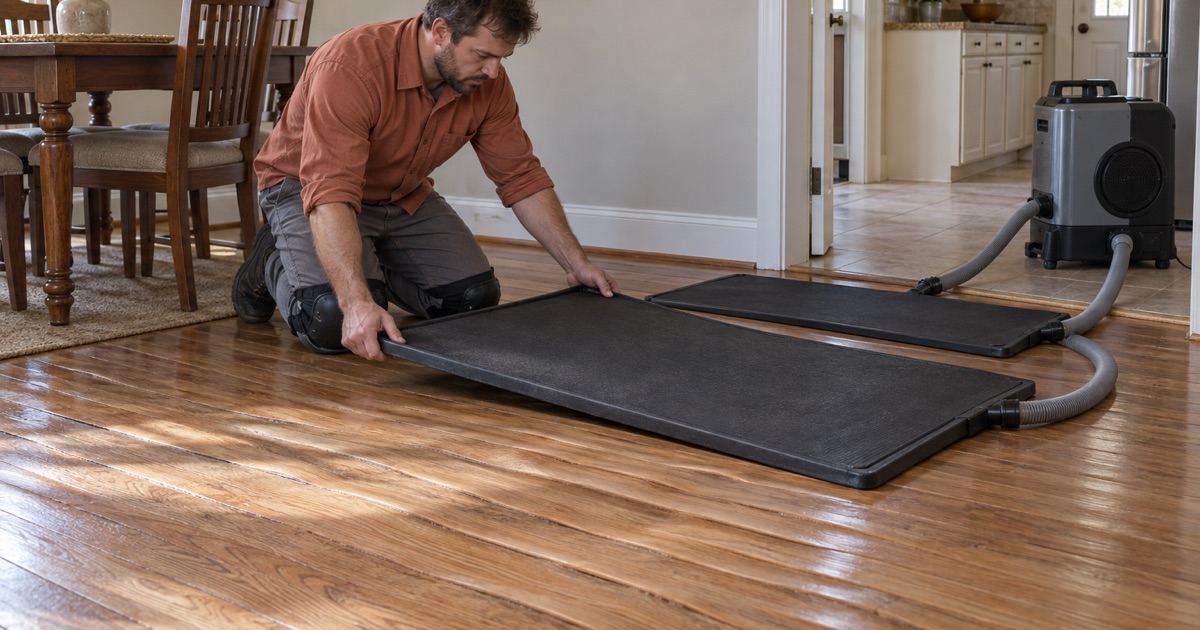
Drying equipment, open cabinets and ventilated crawl spaces help wood and subfloor return to normal levels. We re-check readings on a schedule and do not begin sanding or permanent repairs until the floor has stabilized. Rushing this stage is the most common reason a repaired floor cups or crowns again.
Checking the Subfloor and Joists
Where boards have buckled or readings stay high, we lift sections to inspect the subfloor. Rotted plywood, swollen particle board and damaged joists are replaced before new hardwood goes down. On a raised foundation, we also look at the framing from the crawl space.
Repairing the Floor
Board Replacement and Weave-In Repairs
Damaged boards are cut out at staggered lengths and replaced with matching species, width and grade, woven into the existing rows. Salvaged boards from a closet can help match older floors. The repair area is then sanded and refinished so color and sheen blend with the rest of the room.
Sanding and Refinishing After Drying
Once the floor is dry and flat enough, a full sand removes remaining cupping, stains and damaged finish. We finish with products that meet SCAQMD Rule 1113 and its 275 grams per liter wood coatings limit. On engineered hardwood, we measure the wear layer first to make sure sanding is possible.
Replacing Laminate, Vinyl Plank and Engineered Floors
Laminate flooring that has swollen at the seams cannot be repaired and must be replaced. Luxury vinyl plank and floating floors may be reusable after the subfloor dries, depending on their condition. Engineered planks with delaminating veneer are replaced, since the layers will not rebond.
Water Damage and Insurance Claims
Documentation for Your Adjuster
Claims move faster with good records. We photograph the damage before removal, record moisture readings with locations and dates, and write a repair scope that separates board replacement, subfloor work and refinishing. You can share that package directly with your insurance adjuster.
Matching and Continuous Floors
When hardwood runs uninterrupted from a damaged kitchen into a dining room and hallway, repairing only the wet area can leave an obvious mismatch. California regulation 10 CCR 2695.9(a)(2) addresses replacing items in the damaged area to achieve a reasonably uniform appearance. We document how the floor is laid out so that question can be evaluated on facts.
Timelines Worth Knowing
California regulation 10 CCR 2695.7(b) generally requires an insurer to accept or deny a claim within 40 calendar days after receiving proof of claim, unless it notifies you that more time is needed. For replacement cost policies, Insurance Code 2051.5 gives at least 12 months from the first payment to complete repairs and collect the balance. Your own policy terms still govern the details.
- 20+ Years in Wood Floors
- Free Written Estimates
- Rental and Claim Documentation