
Baldwin Park Wood Flooring has handled wood floor refinishing for more than 20 years, sanding worn oak and engineered floors in Baldwin Park, CA back to clean wood and sealing them with durable, compliant finishes. We also serve surrounding cities including West Puente Valley, Vincent, South Monrovia Island, Mayflower Village and North El Monte.
Refinishing is the most economical way to renew a hardwood floor, but only when the floor can still take it. Before we schedule a drum sander, we check whether the damage sits in the finish or in the wood, how much sanding life the boards have left, and whether the house’s age calls for lead-safe work practices.
The result is an estimate that says exactly what will be sanded, repaired, stained and coated, and a written schedule showing when each room is closed and when you can use it again.
Deciding How Much Refinishing Your Floor Needs
Screen and Recoat for Finish-Only Wear
A screen and recoat, sometimes called a buff and coat, lightly abrades the existing finish and adds a fresh topcoat. It restores sheen and protection without removing any wood, and it takes a fraction of the time of a full sand. It works only when the old finish is intact and well bonded.
We test adhesion first, because a new coat will not stick over wax, some cleaning products or an old finish that is already peeling. When the test fails, recoating would only put a new layer on a surface that is coming loose.
Full Sanding for Worn, Gray or Damaged Wood
Once traffic lanes have worn through to bare wood, water has grayed the boards, or the finish is flaking, the floor needs a full sand. That removes the old finish and a thin layer of wood to reach a fresh, even surface. It is also the only way to change the stain color.
A full sand also exposes problems a recoat would hide: loose boards, old nail holes, dark water marks and gaps where a strip has shrunk. We repair those while the floor is bare, because fixing them after the finish goes down means sanding the same area twice.
Sanding Life on Solid and Engineered Floors
Solid hardwood has thickness above the tongue that allows several sandings over its life. Engineered hardwood only has its top veneer, and wear layer thickness decides whether a sand is possible at all. We check both before promising a result, since a sand-through on engineered flooring means replacing planks.
On a solid floor that has already been sanded several times, we look at the exposed tongue edges and the depth of face-nail heads. When too little wood remains above them, another aggressive sand risks splintering the edges, and we will say so rather than taking the job anyway.
Our Step-by-Step Wood Floor Refinishing Process
Step 1: Inspect, Measure and Test
We check the build year, measure an engineered wear layer at a vent or threshold, read moisture in suspect boards and test the existing finish. Pet stains, termite holes and loose boards are marked for repair before sanding begins, so they are priced up front rather than discovered midway.
Small round holes with pellets nearby get a closer look at this stage. Drywood termite pellets, powderpost beetle frass and old nail holes each call for a different next step, and replacing boards before active insects are treated only feeds them new wood.
Step 2: Prepare and Contain
Furniture comes out of the work area, and we seal doorways, vents and returns. On older houses, containment follows lead-safe work practices. Protruding nails are set, squeaks are fastened, and damaged boards are replaced with a weave-in repair so they sand level with the rest.
Step 3: Sand Through the Grit Sequence
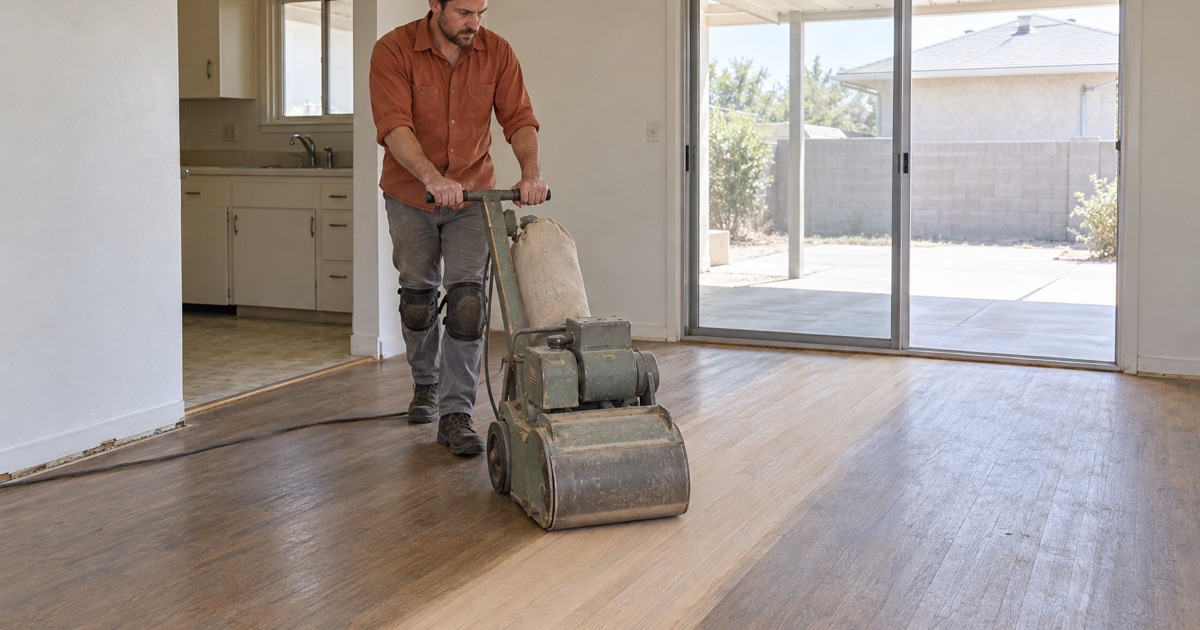
The drum sander works the main floor through an abrasive grit sequence, commonly starting at 36, then 50 and 80, while the edger reaches walls and the corners are scraped by hand. Each pass removes the scratches from the last. Skipping a grit is what leaves chatter marks and swirls.
Step 4: Stain and Seal
After final vacuuming and tacking, we apply stain if you chose one, or go straight to a sanding sealer or first coat. Stain is wiped evenly by section so lap marks do not form. We check the floor under a low-angle light for missed scratches before the first coat locks them in.
Stain needs time to dry fully before any topcoat goes on, and that wait depends on the product and the room’s air. A finish applied over damp stain can stay soft or turn cloudy, which is one of the most common reasons a refinished floor has to be sanded again.
Step 5: Topcoats, Cure and Handback
Topcoats go on with light abrasion between them to remove dust nibs and improve bonding. We leave written instructions showing when you can walk in socks, when furniture can return with felt pads, and when rugs can go back down after the finish has cured.
Stains, Sheens and Finishes for Refinished Floors
Stain Choices on Red Oak and White Oak
Red oak turns up in many older houses, and its open grain can blotch with very dark stains. Honey oak and mid-brown tones take evenly. White oak accepts natural, gray and modern tones more predictably, which is why it dominates newer floor designs. Samples on your own boards remove guesswork.
Waterborne, Oil-Modified and Hardwax Oil Finish Systems
Waterborne polyurethane stays clear, has little odor and dries quickly, so households get rooms back sooner. Oil-modified polyurethane gives an amber glow and a thicker film but takes longer to cure. Hardwax oil penetrates the wood for a matte, natural feel and allows spot repairs, with more regular maintenance.
Sheen level matters as much as the product. Satin and matte hide everyday scratches and dust far better than gloss, which is why most families with pets choose one of the two.
Finishes That Meet SCAQMD Rule 1113
Floor finishes fall under the wood coatings category of South Coast AQMD Rule 1113, limited to 275 grams per liter of volatile organic compounds. That rule applies to whoever applies the product here, including coatings bought online. We use only compliant products, so your floor never ends up with a finish that should not have been used.
Refinishing Floors in Older Baldwin Park Houses
Oak Strip Found Under Carpet
A large share of Baldwin Park’s housing went up in the 1950s, and many of those homes hide oak strip flooring beneath later carpet. After tack strip and staples come out, these floors often refinish beautifully. We repair the perimeter holes and any split edge boards so the border matches the room.
Pad stains and old carpet adhesive sometimes sit on top of these floors as well. Most of that residue comes off in the first sanding pass. Where glue or a stain has soaked into the wood, we show you the affected boards before deciding whether to replace them.
Pre-1978 Homes and Lead-Safe Practices
Most houses in the city were built before 1980, and the EPA Renovation, Repair and Painting Rule applies when work disturbs paint in pre-1978 housing. Baseboards, shoe molding and old coatings near walls are where that most often happens during refinishing. We plan containment and cleanup into the job rather than treating it as an afterthought.
Refinishing While the Family Stays Home
Many households cannot empty a whole house for a week. We phase the work so bedrooms, a bathroom and a path to the kitchen stay usable, and we time coats so fumes and wet finish do not trap anyone. The written room-by-room schedule is part of every estimate.
For rentals, the job is simpler to schedule because the unit is empty. We refinish between tenants to meet a leasing date and give the owner dated before-and-after photos and a written scope, which fit neatly alongside the move-out records a landlord already keeps.
- 20+ Years in Wood Floors
- Free Written Estimates
- Rental and Claim Documentation